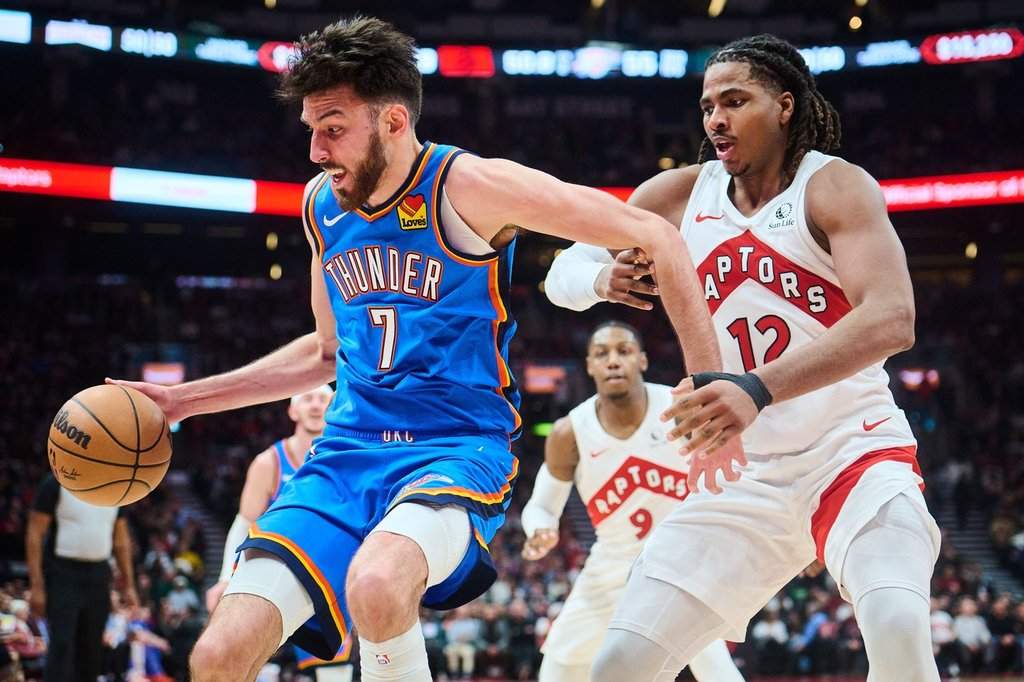
When an NBA front office places both its primary downhill wing creator and a developmental interior anchor on the injured list simultaneously, the resulting damage extends far beyond two empty seats on the bench. The placement of RJ Barrett and Collin Murray-Boyles on the Toronto Raptors injured list triggers a compounding operational crisis across offensive spacing, defensive switching geometry, and cap-constrained rotation management. Standard sports reporting treats injured-list transactions as isolated medical updates, overlooking how synchronized absences distort the mathematical equilibrium of a 15-man roster.
To understand the true operational impact of losing Barrett and Murray-Boyles at the same time, analysts must evaluate the Raptors through three structural lenses: the loss of primary paint-touch generation, the collapse of defensive switchability in the frontcourt, and the contractual mechanics governing injury exemptions under the NBA Collective Bargaining Agreement.
The Anatomy of Simultaneous Roster Depletion
NBA lineups function as closed ecosystems where every rotation player absorbs a specific distribution of usage, defensive matchups, and rebound share. Removing two distinct archetypes—a high-usage slashing wing in Barrett and a physically dense, switchable forward-center in Murray-Boyles—forces the remaining active roster to operate outside its optimal efficiency zones.
The Primary Usage Vacuum
RJ Barrett occupies a specific, difficult-to-replicate functional tier within Toronto's half-court offense. His primary value lies in high-volume rim pressure, straight-line drives, and secondary pick-and-roll initiation. In modern NBA offenses, possessions that fail to generate a paint touch result in drastically lower expected points per possession because weak-side defenders never have to collapse toward the basket.
Without Barrett absorbing high-leverage possessions against set defenses, Toronto's offensive burden shifts disproportionately onto perimeter shooters and primary ball-handlers who thrive best when attacking tilted defenses. When defenders no longer fear a 215-pound wing bulldozing into the restricted area, they stay attached to shooters along the three-point arc. The immediate downstream effect is a measurable drop in catch-and-shoot quality across the entire starting unit, even though Barrett himself is not primarily classified as an off-ball perimeter specialist.
Frontcourt Physicality and Defensive Geometry
Collin Murray-Boyles represents a completely different, yet equally vital, structural asset: interior connective tissue. Built as an undersized, high-motor frontcourt defender with strong lateral agility and low-center-of-gravity post defense, his presence allows coaching staffs to deploy aggressive switching schemes without surrendering offensive rebounds or interior positioning.
Removing Murray-Boyles from the rotation creates a binary tactical dilemma for the coaching staff:
- Downsize the frontcourt: Replace his minutes with perimeter wings, which preserves switching speed on the perimeter but severely degrades defensive rebounding percentage and interior rim deterrence.
- Upsize with traditional centers: Deploy slower, drop-coverage bigs, which protects the paint against post-ups and drives but exposes the defense to high-volume pull-up three-point shooting in pick-and-roll actions.
Neither adjustment resolves the deficit. Both represent controlled compromises that opponents can systematically target over a 48-minute game.
The Three Pillars of Operational Impact
Evaluating an injured-list designation requires separating short-term tactical friction from long-term organizational consequences. The absence of Barrett and Murray-Boyles destabilizes three distinct pillars of franchise operations.
1. Shot-Diet Distortion and Usage Redistribution
Every NBA team budgets its shot attempts across a hierarchy of efficiency. When a high-usage scorer exits the lineup, those 15 to 18 field goal attempts do not vanish; they redistribute to players lower on the offensive hierarchy. Economists and basketball analysts refer to this phenomenon as the Usage-Efficiency Trade-Off. As role players are forced to scale up their shot volume and self-creation duties, their true shooting percentage typically declines because they are taking shots outside their core competency.
In Toronto's system, Barrett's absence forces secondary finishers to become primary creators. Spot-up shooters are suddenly asked to run pick-and-rolls late in the shot clock, and screening bigs are forced to make short-roll playmaking reads under heavy defensive pressure. This creates a turnover bottleneck, as players accustomed to finishing plays are suddenly responsible for initiating them.
2. Defensive Rotation Stress and Foul Trouble Cascades
Defensive efficiency relies heavily on communication and synchronized help rotations. When a team loses both a stout perimeter body (Barrett) and a versatile frontcourt helper (Murray-Boyles), individual defenders are beaten off the dribble more frequently.
This triggers a predictable chain reaction:
- Initial perimeter containment breaks down at the point of attack.
- The weak-side low man must rotate early to contest the layup, abandoning his assignment in the corner.
- Recovering defenders close out recklessly, leading to higher foul rates and bonus free-throw situations for the opponent.
- Core starters accumulate early foul trouble, forcing the coaching staff to dig even deeper into the end of the bench during high-leverage quarters.
3. Developmental Opportunity Cost
For a franchise balancing competitive viability with player development, the injured list carries a hidden tax: lost evaluation time. For an established veteran, missed games represent a temporary dip in team win probability. For a young frontcourt prospect like Murray-Boyles, every game on the inactive list delays critical live-game reps against NBA physicality, scheme recognition, and pace adjustment.
Development in professional basketball is non-linear and heavily dependent on contiguous game blocks. Interrupting a young player's rhythm with an injured-list stint resets their conditioning curve and forces coaching staffs to re-integrate them gradually upon return, stretching the true impact of the injury well beyond the official medical clearance date.
CBA Mechanics and Roster Flexibility Constraints
Public discourse around NBA injuries frequently assumes front offices can simply sign a replacement player to plug a hole. In reality, the NBA Collective Bargaining Agreement imposes strict thresholds that govern when and how a team can add emergency reinforcements.
Inactive List Rules vs. Hardship Exceptions
Placing players on the injured list (technically designated as the Inactive List on game-day active rosters) frees up active game-day slots for healthy players already under contract, including Two-Way players, but it does not create a new 15-man standard roster spot. Under standard NBA rules, a team can carry up to 15 standard contracts and three Two-Way contracts, but only 13 players (or up to 15 depending on active roster minimums) can dress for a given game.
To sign an additional player outside the 15-man limit via the NBA Hardship Exception, a franchise must meet strict criteria:
- At least four players on the standard roster must be sick or injured and have missed a minimum of three consecutive games.
- A league-appointed physician must verify that those four players will remain unable to play for at least two more weeks.
Unless Toronto's injury list expands to meet that four-player threshold, the front office cannot bring in external free-agent help without waiving an existing guaranteed contract. Management is locked into solving the Barrett and Murray-Boyles absences purely through internal reallocation.
Two-Way Contract Burn Rate
With external signings restricted, the immediate pressure valve is utilizing Two-Way contract players. Under the current CBA, Two-Way players are capped at 50 active NBA games per regular season. Every game a Two-Way wing or forward is activated to cover for Barrett or Murray-Boyles depletes that finite 50-game bank.
If the coaching staff burns through a Two-Way player's active game limit in November and December to survive early-season injury attrition, that player becomes ineligible to dress in March and April unless the front office converts their deal to a standard NBA contract—a move that requires opening a 15-man roster spot and absorbing additional luxury tax or apron implications.
Tactical Reallocation Blueprint for the Coaching Staff
Surviving a dual-archetype injury event requires deliberate structural adjustments rather than simply inserting the next man up into the exact same playbook. Coaching staffs must alter the geometry of the floor to mask missing skill sets.
Inverting the Offensive Spacing
Without Barrett's downhill force, running standard high-ball-screen actions results in stagnant perimeter passing. The coaching staff must shift toward movement-heavy offensive principles—specifically Delay actions, Zoom triggers, and 5-out spacing—that generate paint touches through cutting and off-ball screening rather than isolated one-on-one drives. By forcing defenders to chase cutters across the lane, the offense manufactures the defensive collapses that Barrett normally creates through physicality.
Zone Defenses and Matchup Preserving Schemes
To mitigate the loss of Murray-Boyles' interior versatility and prevent foul trouble cascades among remaining bigs, deploying selective 2-3 or 3-2 zone alignments becomes a high-value tactical lever. Zone structures protect slower frontcourt players from being isolated in space on the perimeter, dictate where opponents must shoot from, and conserve physical energy across a compressed regular-season schedule. The limitation of this approach is defensive rebounding vulnerability, requiring all five defenders to gang-rebound rather than leaking out in transition.
Staggering Remaining Core Creators
With overall roster depth compressed, lineups featuring zero primary creators become untenable. The rotation must be rigidly staggered so that at least one established primary playmaker remains on the floor for all 48 minutes. Bench units cannot be left to survive on pure energy; they must be anchored by a starter who can organize half-court sets and prevent multi-minute scoring droughts.
Strategic Forecast and Roster Management Protocol
Front offices and coaching staffs facing simultaneous injuries to a primary wing scorer and a versatile frontcourt defender must resist the urge to overextend healthy core players in pursuit of short-term regular-season wins. Increasing starter workloads above 38 minutes per game to compensate for injured-list absences dramatically elevates soft-tissue injury risk across the remaining healthy roster, turning a two-player disruption into a systemic season collapse.
The optimal operational play is a disciplined, three-step containment protocol: cap healthy starters at strict 34-to-36-minute workloads regardless of fourth-quarter score differentials, aggressively deploy Two-Way contract forwards in controlled 15-minute bursts to absorb physical defensive matchups while monitoring their 50-game eligibility cap, and shift half-court offensive sets toward off-ball movement and pace-and-space principles until both Barrett and Murray-Boyles clear full-contact re-evaluation protocols.