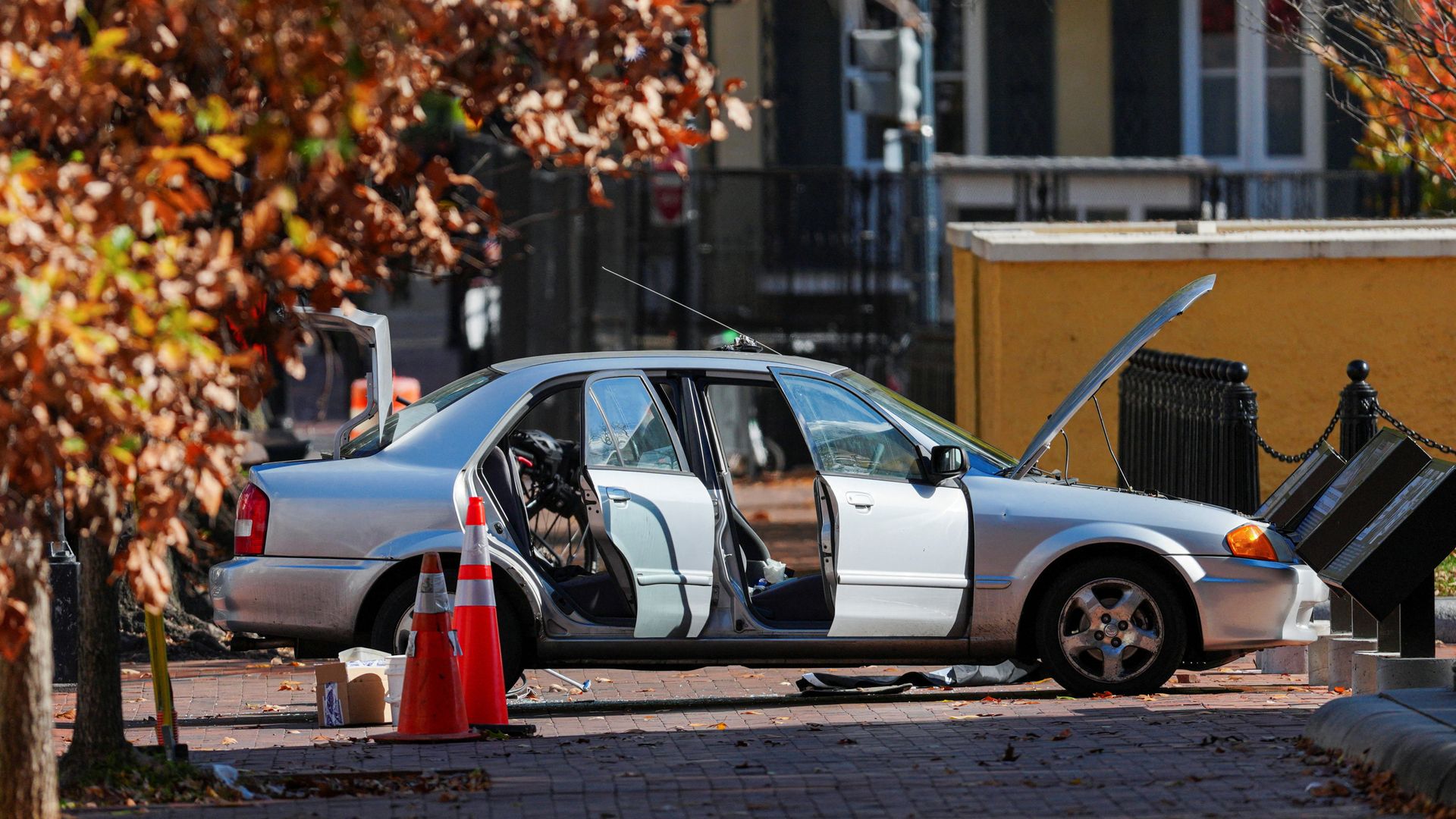
The sound does not register as an accident at first. It registers as an earthquake in miniature.
If you have ever stood near Lafayette Square on a humid Washington evening, you know the specific, low-frequency hum of the city—the distant whine of Metro brakes beneath the pavement, the shuffle of tourists clutching melted ice cream cones, the low murmur of Secret Service officers speaking into their wrists. Then, without warning, two tons of steel meet six tons of reinforced concrete at forty miles an hour. For a more detailed analysis into similar topics, we recommend: this related article.
Crunch.
Silence follows for a heartbeat before the sirens tear the air open. Within forty seconds, the perimeter around the White House transforms from a sleepy postcard into a fortress of flashing crimson and blue. Roads vanish behind yellow tape. Pedestrians are herded backward down 15th Street. Somewhere inside the West Wing, staffers pause over lukewarm coffee, their phones buzzing with the same terse alert from the United States Secret Service: *Vehicle collision
The Quiet Violent Shock of Steel Against Stone at 1600 Pennsylvania Avenue For broader information on the matter, comprehensive reporting is available on Associated Press.
news
Sound travels strangely through downtown Washington, D.C. at night. During the afternoon, the city is an acoustic soup of idling tour buses, street vendors shouting over the hum of central air conditioners, and the rhythmic clatter of dress shoes against Pennsylvania Avenue granite.
After midnight, everything changes. The noise drains away, leaving a heavy, expectant silence that turns every distant siren into a warning and every sharp metallic crack into an interrogation.
Crunch.
It is the unmistakable, sickening sound of crumpling aluminum meeting reinforced steel at forty miles per hour. If you have ever stood near a perimeter checkpoint when a vehicle breaches the outer buffer—or if you have ever been one of the commuters pinned behind yellow police tape three blocks away while bomb-sniffing dogs circle a smoking sedan—you know that the crash itself is only the first tremor. The real earthquake happens in the ninety seconds that follow, inside the chests of dozens of men and women whose entire professional existence is built around preventing a single bad second from rewriting American history.
Standard news bulletins reduce these moments to sterile, three-sentence wires. A car crashed into a security barrier near the White House complex late last night. Secret Service officers took the driver into custody. No injuries were reported.
We read those twelve words over morning coffee, nod once, and swipe to the sports scores. We treat a White House perimeter crash like a minor traffic fender-bender that just happened to occur near a famous house.
That detachment is a luxury bought and paid for by an invisible architecture of concrete, hydraulics, and human vigilance. To understand what actually happens when a car strikes a barrier near the White House, you have to strip away the wire-service shorthand and stand on the asphalt in the glare of flashing blue strobes.
The Anatomy of a Three-Second Crisis
To grasp the reality of a perimeter breach, consider a hypothetical scenario grounded in standard Secret Service protective protocols. Meet Marcus, a composite character representing the uniformed officers who work the midnight shift along 17th Street and Pennsylvania Avenue.
At 1:14 a.m., Marcus is scanning the pedestrian plaza. His eyes are trained not on the illuminated neoclassical facade behind him, but outward—toward headlights, wheel angles, and the subtle deceleration patterns of approaching traffic. Most drivers in D.C. know the geography of restriction. They know where the roads pinch off into pedestrian zones, where the black steel bollards rise like iron teeth from the pavement, and where the massive hydraulic wedges wait beneath the street surface.
Then comes the anomaly. A silver sedan, moving twenty miles per hour faster than the flow of late-night traffic, fails to brake at the outer intersection.
Time compresses. In the span of three heartbeats, Marcus has to solve an impossible equation without knowing any of the variables. Is this a drunk tourist confused by Washington's notoriously labyrinthine one-way streets? Is it a medical emergency—a driver slumped over the wheel after a sudden cardiac event? Or is it a deliberate, high-speed assault carrying five hundred pounds of homemade explosives in the trunk?
There is no time to ask. Training takes over where conscious thought stalls.
The vehicle clips the outer pedestrian bollard—a hollow-looking cylinder that is actually a steel pipe anchored four feet deep in reinforced concrete—and careens into the primary security gate. Airbags detonate with the sound of a shotgun blast. Coolant hisses onto the warm asphalt, sending a plume of sweet, acrid steam into the sodium-vapor streetlights.
Within four seconds, the entire complex shifts posture. Radios crackle with clipped, coded urgency. Counter-assault teams in heavy tactical gear materialize from recessed doorways that looked like decorative stonework moments earlier. Across the street, late-night joggers freeze mid-stride, their earbuds still pulsing with music while uniformed officers scream at them to get behind concrete planters.
For the next forty minutes, nobody breathes easily. Even after the driver is dragged from the wreckage, handcuffed, and placed on the curb, the car remains a question mark. Until the Explosive Ordnance Disposal technicians send their tracked robot rolling toward the shattered windshield, that crumpled sedan is Schrödinger’s bomb—simultaneously harmless scrap metal and an existential threat to the seat of the executive branch.
Why It Happens More Often Than You Think
If you feel a sudden jolt of anxiety reading about a vehicle slamming into the White House perimeter, you are not alone. We like to believe that the fortress around the presidency is inviolable, a zone of absolute control where chaos simply cannot reach.
The truth is far messier. And frankly, it is a little unsettling.
According to historical incident logs compiled by the U.S. Secret Service and congressional oversight committees, unauthorized vehicles strike or breach the outer perimeters of the White House complex several times every single year. Most never make the national evening news because they occur at the outer rings—the checkpoints at 15th Street, 17th Street, or E Street—where traffic still brushes dangerously close to the pedestrian buffer zones.
The reasons behind these crashes tell a remarkably human story about modern America, one that rarely fits into a neat political narrative.
Some are deliberate acts of desperation or grievance. In May 2023, a 19-year-old driver rented a U-Haul box truck, drove it directly into the security barriers at Lafayette Square on the north side of the complex, and later told investigators he wanted to seize power and harm the president. No explosives were found inside the truck, only a Nazi flag, yet the incident forced the evacuation of a nearby luxury hotel and shut down the heart of the capital for hours.
Others are tragic intersections of mental health crises and national symbolism. Because the White House is the ultimate physical manifestation of American power, it acts as a psychological magnet for people whose lives are unraveling. When someone in acute psychiatric distress wants to be heard, or wants their pain to register on the largest possible stage, they do not drive to a local municipal building. They drive toward the white columns on Pennsylvania Avenue.
And then there are the mundane mistakes. Washington, D.C. is a confusing city even for locals, a web of diagonal avenues slicing across a numbered grid at sharp angles. Add rain, fatigue, unfamiliarity with rental cars, or a driver glancing down at a GPS screen for two seconds too long, and a two-ton SUV suddenly becomes an unguided missile aimed straight at a federal checkpoint.
The Invisible Fortress Beneath Your Feet
Think of the White House security perimeter not as a single wall, but as an onion made of steel, physics, and surveillance.
When tourists walk along the north fence today, they see the upgraded thirteen-foot-tall wrought-iron barrier installed between 2019 and 2022—a structure twice as tall as the old fence, fitted with anti-climb pickets and reinforced foundations designed to withstand massive kinetic impact. They see the uniformed officers pacing the walkway and the dark silhouettes of snipers perched near the roof edge.
What they do not see is the engineering hidden beneath their sneakers.
To understand how a barrier stops a speeding car without letting it reach the mansion lawn, imagine trying to catch a bowling ball thrown at fifty miles per hour. If you hold your hands rigid like a brick wall, the impact breaks your wrists and the ball might still roll past you. If you engineer a system that absorbs, redirects, and dissipates that kinetic energy downward into the earth, the ball stops dead in its tracks.
Modern anti-ram bollards and hydraulic wedge barriers work on that exact principle of kinetic dissipation. Beneath the granite pavers around the White House lies an underground network of interconnected steel reinforcement cages poured into tons of high-density concrete. When a 4,000-pound vehicle hits a certified K12-rated bollard at fifty miles per hour, the steel post does not simply snap off at ground level. Instead, the impact forces are transferred deep into the subterranean foundation, shredding the vehicle’s front axle and engine block while keeping the passenger cabin—and whatever might be inside the trunk—stopped cold outside the fence line.
It is brutal, unforgiving physics. The barrier wins every time.
Yet engineering only solves half the problem. Every time the Secret Service hardens the perimeter—raising the fence, widening the pedestrian buffer zones, adding retractable wedges—the friction between security and democracy grows sharper.
The Tension Between Fortress and People's House
Here is the paradox that keeps security planners awake at night: the White House is not supposed to be a bunker.
Thomas Jefferson opened the grounds to the public in 1805, and for more than a century, citizens could literally walk up to the front door, knock, and ask to speak with the president. Abraham Lincoln was routinely woken up by office-seekers camping in the hallways outside his bedroom. Even in the mid-twentieth century, visitors strolled freely across the South Lawn during the annual Easter Egg Roll with minimal screening.
Every major barrier around the White House today is a scar left behind by a specific moment of violence.
The concrete Jersey barriers that ring the complex appeared in 1983, rushed into place after a suicide truck bomber killed 241 U.S. service members at a Marine barracks in Beirut, proving that a commercial vehicle packed with explosives could level a fortified building in seconds. Pennsylvania Avenue itself—once one of the busiest commuter arteries in the nation’s capital—was permanently closed to vehicular traffic in May 1995, just weeks after Timothy McVeigh used a rented Ryder truck to destroy the Alfred P. Murrah Federal Building in Oklahoma City.
Each new layer of steel pushes the American public a few yards further back from the symbol of their own government.
When a car crashes into a barrier near the White House today, the ripple effects extend far beyond the police tape. Commuters sitting in gridlock on Constitution Avenue feel a flicker of low-grade dread. Tourists standing with their cameras at the edge of Lafayette Park suddenly realize that the picturesque backdrop behind their family photo is an active tactical zone. And the officers working the line carry the quiet, cumulative weight of knowing that they are allowed to be right a million times in a row, while an attacker only needs to get lucky once.
I have stood along that perimeter in the rain at two in the morning, watching a tow truck winch a mangled sedan away from a scuffed steel bollard while street sweepers brushed shards of safety glass into the storm drains. The efficiency was breathtaking. Within ninety minutes of the crash, the yellow tape came down, the tactical vehicles melted back into the shadows, and the early-morning joggers returned to their routes, stepping right over the dark oil stain on the granite without breaking stride.
By sunrise, the city had erased the evidence. The morning news anchors read their twelve-word summaries, the nation moved on to the next headline, and the steel bollards stood silent in the morning light, bearing nothing more than a faint silver scratch where metal had met stone.

