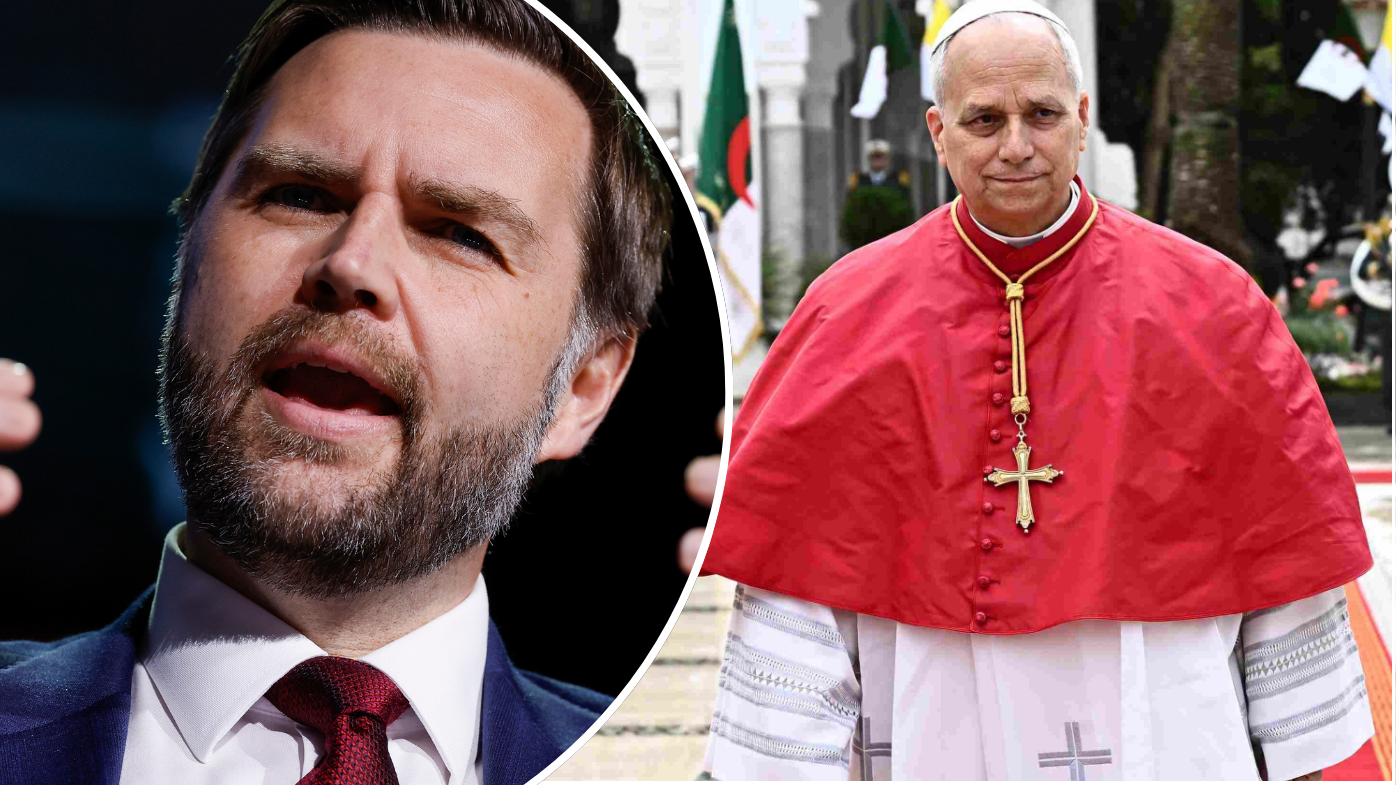
The tension between JD Vance’s public critique of Pope Leo and the traditional hierarchy of the Catholic Church is not merely a political spat; it is a fundamental clash between nationalist populist rhetoric and supranational institutional theology. When a high-ranking political figure suggests a Pontiff should be "more careful" when speaking on theological matters, they are attempting to reallocate intellectual authority from the center of the institution to its periphery. This friction reveals a broader strategy where political actors treat religious doctrine as a variable in a cost-benefit analysis rather than a fixed moral constant.
To analyze this conflict, one must categorize the grievance into three distinct operational pillars: the Territorial Sovereignty Conflict, the Theological Precision Gap, and the Institutional Trust Deficit. If you liked this piece, you should look at: this related article.
The Territorial Sovereignty Conflict
The core of the disagreement often centers on the intersection of migration policy and Christian ethics. From a political perspective, a nation-state operates on a closed-system logic. Resources, security, and social cohesion are viewed as finite assets that must be protected via border integrity. Vance’s critique suggests that the Pope’s statements—often emphasizing universal human dignity and the welcoming of the stranger—disregard the logistical and economic constraints faced by specific nation-states.
In this framework, the Pope is operating on a universalist ethical plane, while the politician operates on a particularist nationalist plane. The friction arises because the Church’s teaching on migration is not a policy white paper; it is a deduction from the Imago Dei (the belief that all humans are made in the image of God). Vance’s pushback attempts to subordinate this universal theological claim to the practicalities of national interest, effectively arguing that the Church should limit its moral reach to the interior lives of believers rather than the exterior policies of the state. For another perspective on this event, check out the recent coverage from Associated Press.
The Theological Precision Gap
Vance’s specific phrasing—that the Pope must be "careful"—implies a perceived lack of rigor in the Pontiff’s public utterances. This critique targets the mechanism of Ordinary Magisterium. Within the Catholic Church, not every statement made by a Pope carries the weight of infallibility. There is a hierarchy of truths and a hierarchy of authority:
- Ex Cathedra Statements: Dogmatic definitions that are considered infallible (extremely rare).
- Encyclicals: Formal letters to the bishops and the faithful on specific doctrines.
- Apostolic Exhortations: Documents that encourage the faithful to live out certain virtues.
- Informal Commentary: Press conferences, interviews, and off-the-cuff remarks.
Vance is exploiting the ambiguity of the fourth category. By framing the Pope’s comments as "careless," he creates a rhetorical space for Catholic voters to ignore the Pope’s social teachings without feeling they have abandoned their faith. This is a deliberate decoupling strategy. If the Pope’s speech can be categorized as a personal opinion rather than a doctrinal mandate, the political cost of opposing the Pope drops to zero.
The mechanism at work here is the Subjective Interpretation Loop. When a political leader critiques a religious leader’s "theological care," they are signaling to their base that the layman’s interpretation of tradition is more "authentic" than the current leader’s application of that tradition. This shifts the power from the office to the individual’s perception of the office.
The Cost Function of Religious Alignment
For a politician like Vance, the utility of Catholicism is found in its cultural signaling power. Catholicism provides a framework of tradition, family values, and a sense of historical continuity that appeals to a specific demographic of the American electorate. However, the social justice and pro-migrant elements of the faith often create a negative utility in a populist framework.
The strategy, therefore, becomes one of Selective Extraction.
- Positive Alignment: Emphasizing stances on abortion, gender, and traditional family structures.
- Neutralization: Critiquing statements on climate change or immigration as "theologically imprecise" or "politically motivated."
- Redefinition: Claiming to be more "Catholic than the Pope" by appealing to older, more conservative traditions (e.g., Traditional Latin Mass or pre-Vatican II rhetoric) to undermine the current administration of the Church.
This creates a bottleneck in the Church’s ability to communicate its message. If every moral directive is filtered through a political lens, the "cost" for a politician to follow the Church’s lead becomes prohibitively high whenever that lead contradicts the party platform.
The Logical Fallacy of Theological Gatekeeping
When a layman tells a Pope to be "careful with theology," it ignores the structural reality of the Papacy. The Pope is the final arbiter of Catholic theology within the system. To suggest he is being "imprecise" is a logical paradox for a believer: if the head of the institution defines the current theological direction, the definition of "precise" theology evolves to match that direction.
The critique, therefore, is not actually about theology; it is about Institutional Drift. Vance is identifying a divergence between the "Legacy Doctrine" (as understood by his voting base) and the "Iterative Doctrine" (as presented by the current Pope). By framing this drift as a failure of "care," he avoids the charge of heresy while simultaneously delegitimizing the current leadership.
This creates a Bifurcated Authority Model:
- The Institutional Authority: The Pope and the Vatican.
- The Ideological Authority: A decentralized network of conservative media, political leaders, and traditionalist clerics who claim to represent the "true" Church.
The second group uses the first as a foil to consolidate its own power. Every time the Pope speaks on a controversial topic, this network analyzes the statement for any lack of "rigor," providing their audience with the tools to dismiss the message.
The Strategic Misalignment of Temporal and Eternal Goals
The Church operates on a Long-Horizon Timeline (centuries), whereas political actors operate on a Short-Horizon Timeline (two to four-year election cycles).
Vance’s critique is a tactical maneuver designed for immediate consumption. It serves to shore up his credentials as a defender of national sovereignty against "globalist" influences, even if that influence is the spiritual head of his own church. The long-term risk of this strategy is the erosion of the very institutional authority he claims to value. If the Papacy is reduced to just another voice in the political shouting match, its ability to act as a stabilizing social force is permanently diminished.
The "logic of care" Vance invokes is a rhetorical shield. It suggests that he is not attacking the Pope, but rather "protecting" the faith from a leader who is supposedly misrepresenting it. This is a classic Internal Reform Frame. It allows the politician to maintain the identity of a "devout believer" while acting as a disruptor.
Systematic Erosion of Supranational Power
The broader implication of this exchange is the continued retreat of supranational moral authority in the face of rising Sovereign Absolutism. Historically, the Church acted as a "check" on the power of kings and states. By publicly rebuking the Pope’s theological care, modern populists are signaling that the state (or the people as represented by the state) is the final authority on all matters that touch upon the material world.
This results in a Value Fragmentation. Instead of a unified moral code, we see the emergence of "Political Catholicism" vs. "Ecclesial Catholicism." In the political version, theology is a tool for mobilization. In the ecclesial version, it is a tool for salvation. These two goals are increasingly at odds, and the friction between JD Vance and the Vatican is the primary data point for this divorce.
The move for political actors moving forward is to continue the Intellectual Decentralization of the Church. By encouraging the faithful to look toward "independent" theological influencers rather than the central hierarchy, they can bypass any moral directives that conflict with their policy goals. The Church, in response, faces the challenge of re-establishing its authority in an era where "accuracy" is defined by the consumer, not the producer, of the doctrine.
Religious institutions that fail to recognize this shift toward Consumer-Led Orthodoxy will find their influence marginalized. The strategic play is no longer to win the argument with the politician, but to address the underlying anxiety of the population that makes the politician’s critique resonate. Until the Church can reconcile its universalist mission with the specific, material fears of national populations, the gap between the Vatican and the populist right will continue to widen, rendering "theological care" an irrelevant metric in a war of identity and survival.


