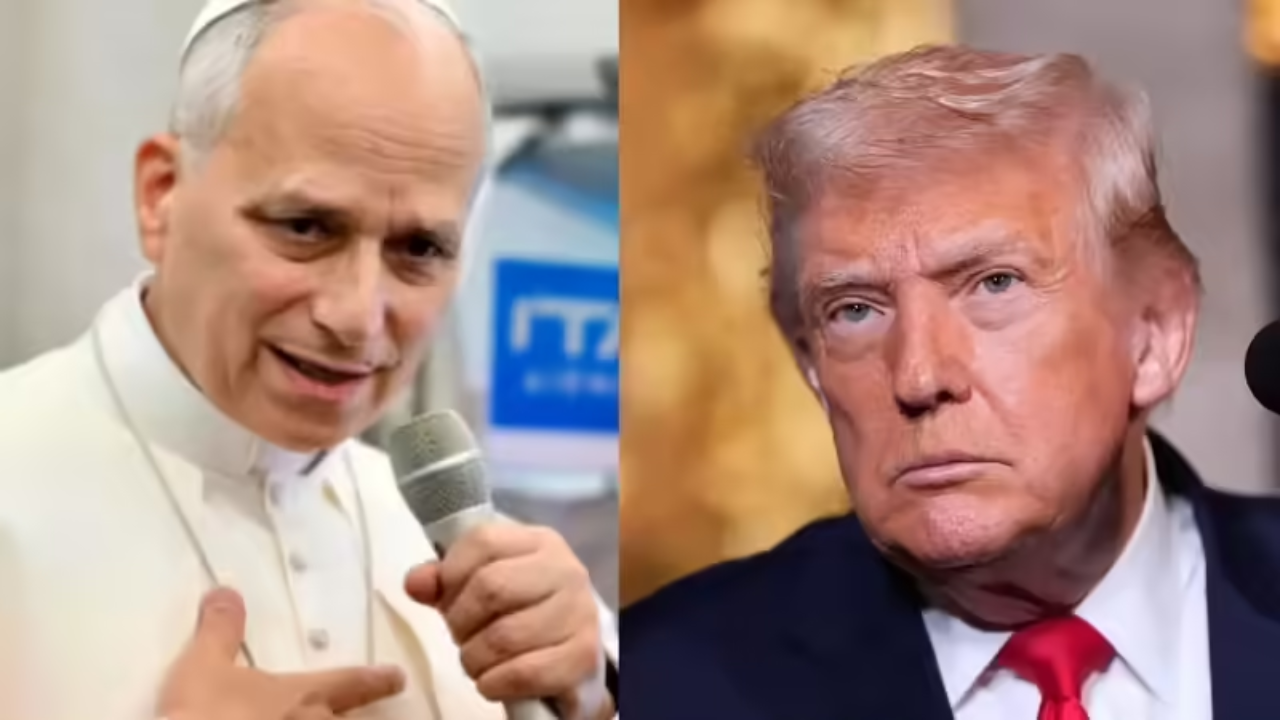
The friction between executive political power and ecclesiastical authority functions as a zero-sum competition for moral legitimacy. When a head of state and a global religious leader diverge on the ethical imperatives of governance, the result is not merely a "clash of personalities" but a structural destabilization of the voter blocs that reside at the intersection of both hierarchies. In the specific context of the United States, the tension between the presidency and the papacy acts as a stress test for the Catholic vote—a demographic that lacks monolithic alignment and instead operates as a high-variance swing constituency.
The Dual Sovereignty Framework
To understand the current divergence, one must map the competing jurisdictions of the President and the Pope. The President operates within a Temporal-Nationalist Framework, where the primary metrics of success are border integrity, economic protectionism, and national interest. The Pope operates within a Transcendent-Universalist Framework, prioritizing global human rights, environmental stewardship, and the preferential option for the poor.
This creates a structural "Double Bind" for the religious voter. The conflict is quantified through three primary vectors of tension:
- The Border as a Moral vs. Legal Construct: The executive branch treats the border as a hard line of sovereign exclusion (a security variable). The Vatican views the border as a soft line of humanitarian inclusion (an ethical variable).
- Environmental Stewardship vs. Industrial Deregulation: The papacy, particularly through encyclicals like Laudato si’, frames climate action as a non-negotiable moral obligation. The current political strategy frames it as a cost-prohibitive regulatory burden that inhibits GDP growth.
- Sanctity of Life vs. Secular Policy: While both entities may find alignment on anti-abortion stances, the definition of "pro-life" diverges at the point of the death penalty, social safety nets, and refugee treatment.
The Mechanics of Demographic Fragmentation
The "Catholic Vote" is a misnomer that obscures more than it reveals. Data indicates that this demographic is split not by theology, but by ethnic and socioeconomic markers. The divergence between the President and the Pope triggers different responses across two distinct sub-sectors:
The Traditionalist-Nationalist Cohort
This group prioritizes domestic cultural preservation over global ecclesiastical directives. For these voters, the President serves as a "secular protector" against perceived liberal encroachment. They resolve the cognitive dissonance of disagreeing with the Pope by applying the principle of Subsidiarity—arguing that political and social issues should be handled at the most local/national level possible, effectively neutralizing the Pope’s globalist critiques.
The Social Justice-Universalist Cohort
This group aligns more closely with the Vatican’s stance on migration and poverty. For them, the President’s rhetoric creates a "Moral Deficit." This cohort uses the Pope’s statements as a baseline for measuring the President’s ethical fitness. When the Pope labels certain political stances as "un-Christian," it provides this group with the rhetorical ammunition to decouple their religious identity from their national identity.
The Cost Function of Religious Antagonism
Political strategists often underestimate the risk of a "Divine Detour." While a President may gain short-term momentum by signaling to a nationalist base, the long-term cost function includes a degradation of institutional trust.
- Erosion of Moral Capital: When the President openly contests the Pope, they trade long-term moral authority for short-term populist energy.
- The Polarizing Feedback Loop: Each critique from the Vatican forces the President to lean further into an "Us vs. Them" narrative. This creates a feedback loop that alienates moderate voters who view the papacy as a stabilizing, non-partisan force.
- Institutional Friction: The Catholic Church remains one of the largest non-governmental providers of social services, healthcare, and education in the U.S. Persistent friction at the executive level can lead to logistical bottlenecks in public-private partnerships, particularly regarding refugee resettlement and low-income housing.
Logical Failures in Modern Political Analysis
Standard commentary often suggests that the Pope is "interfering" in domestic politics. This is a category error. By definition, the Catholic Church claims a universal mandate that precedes the existence of the modern nation-state. From a strategic perspective, the Pope is not acting as a foreign head of state, but as the CEO of a global moral franchise.
Conversely, critics of the President often argue that his "divine detour" is purely performative. This ignores the Functional Utility of Civil Religion. The President is not necessarily seeking theological validation; he is seeking the "Sacred Canopy"—a sociological phenomenon where political actions are shrouded in religious significance to make them unassailable to a specific base.
The Volatility of the 2026-2028 Electoral Cycle
The interaction between the Vatican and the White House is currently entering a phase of High-Intensity Moral Competition. The upcoming cycle will likely see three key developments:
- The Weaponization of Communion: The debate over which politicians are eligible for the Eucharist will move from a theological debate to a primary campaign tool.
- The Rise of Independent Lay Movements: As the gap between the Pope and the President widens, expect a surge in "Parallel Institutions"—Catholic organizations that bypass the official USCCB (United States Conference of Catholic Bishops) to align directly with either the President’s nationalism or the Pope’s universalism.
- The Latino Pivot: This is the most critical variable. As the largest growing segment of the U.S. Catholic population, Latino voters are caught directly in the crossfire of the border debate. If the President’s rhetoric is perceived as an attack on their dignity, the "divine detour" could lead to a permanent realignment of this demographic toward a more Vatican-aligned, populist-left position.
Strategic Recommendation for Executive Stakeholders
Political actors must shift from a strategy of Direct Confrontation to one of Compartmentalized Engagement. Attempting to "out-preach" the Pope is a losing game; the office of the papacy holds a duration of influence that outlasts any four-year term.
Instead, the administration should:
- Isolate the Issues: Pivot the conversation from "theology" to "operational feasibility." Address the Pope’s humanitarian goals as idealized benchmarks while framing the President’s actions as the necessary, messy implementation of order.
- Cultivate Domestic Clerical Allies: Strengthen ties with the subset of American bishops who prioritize domestic cultural issues over the Vatican’s global environmental and migration agenda. This creates a "Theological Buffer."
- Reframing the Secular Mandate: Publicly acknowledge the Pope’s moral authority while emphasizing the President’s "Duty of Care" to the American citizen first. This utilizes the "Two Kingdoms" doctrine—the idea that the spiritual and temporal realms operate under different rules of engagement.
The failure to manage this friction results in a "Legitimacy Leak." Every time the President is seen as being at odds with a global moral authority, a segment of the moderate religious base calculates the cost of their allegiance. In an era of razor-thin margins, this "Theological Tax" may be the most expensive variable on the political balance sheet. The executive must move beyond reactive rhetoric and adopt a structured approach to religious diplomacy that treats the Vatican not as a political opponent, but as a permanent, sovereign competitor in the marketplace of values.