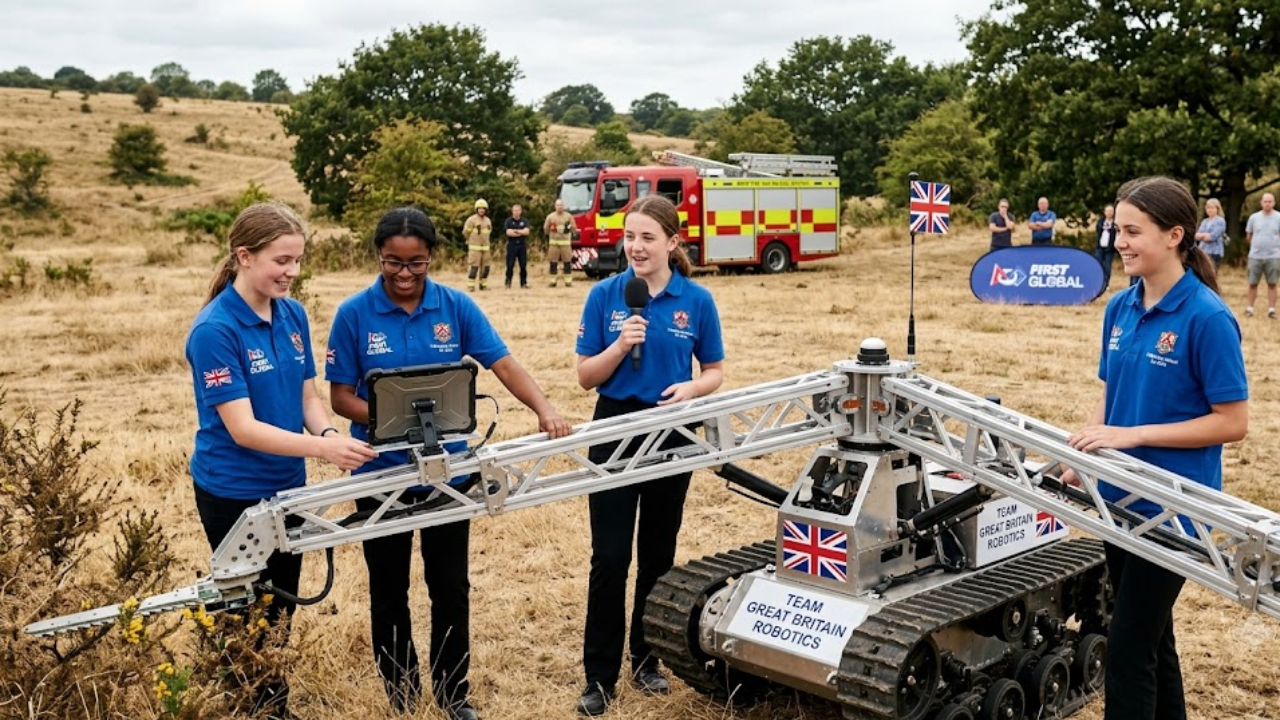
Five British schoolgirls built a folding-arm robot to cut wildfire firebreaks. The internet wept tears of pure, unadulterated inspirational joy. Headlines practically wrote themselves about youth, ingenuity, and hope for our burning planet.
Then the venture capitalists and corporate sustainability committees stepped in to ruin it. If you liked this post, you should check out: this related article.
They looked at those teenagers hacking together mechanical arms in a secondary school lab and saw the prologue to a hundred-million-dollar commercial enterprise. They thought about scalable manufacturing, defense contracts, venture funding rounds, and silicon valley boardrooms. They missed the point entirely.
The story was never about the hardware. It was about how a group of teenagers solved a structural engineering problem with zero budget while state-funded forestry agencies spend billions achieving precisely nothing. For another angle on this development, refer to the latest coverage from Gizmodo.
I have spent the last fifteen years watching elite engineering firms fail at wildfire mitigation. I have sat in conference rooms where executives authorize seven-figure budgets for heavy machinery that sits rusting in hangars because it requires a twenty-person crew, three permits, and a convoy of diesel trucks just to deploy. Meanwhile, five kids with a box of aluminum stock and a microcontroller built a machine that actually goes where the fire goes.
We need to stop treating wildfire management as an excuse for corporate welfare and start looking at why amateur teenagers are beating institutional bureaucracies at their own game.
The Myth of Scale in Environmental Engineering
The lazy consensus in the tech and environmental sectors is that every local problem requires a global platform. If a group of students builds an autonomous firebreak cutter, the default instinct of the market is to demand a Series A funding round, a 50,000-unit factory in Shenzhen, and an enterprise SaaS dashboard to monitor blade wear.
This is how good technology dies.
When you force hyper-local, task-specific mechanical interventions into the venture-backed growth model, you introduce administrative bloat. You add layers of management, regulatory compliance hurdles, and margin requirements that destroy the core utility of the tool.
Let us look at the mechanical reality of wildfire containment. A wildfire does not care about your valuation. It does not care about your recurring subscription model. It cares about fuel continuity. If you can clear a two-meter strip of dry brush ahead of a creeping front before the embers jump, you win. If you cannot, you lose.
The schoolgirls understood this constraint. They built for the edge case. They built light. They built cheap. They built something that could be carried in the back of a hatchback and operated by someone who hasn't spent three years getting certified on heavy caterpillar tracks.
Venture-backed climate tech startups build for the boardroom slide deck. They build heavy, over-engineered autonomous crawlers that weigh three tons, cost half a million dollars each, and get stuck in a ditch the moment a pine root sneezes at them.
I’ve watched well-funded robotics teams deploy multi-million-dollar land-clearance units to California and Oregon, only to watch them fail because a single low-hanging branch blinded an expensive LiDAR sensor. Simplicity is not a compromise; it is the ultimate sophistication.
Why Heavy Machinery Is Losing the War on Wildfires
To understand why the British schoolgirls' folding-arm design matters, we have to look at the catastrophic failure modes of traditional forestry equipment.
For decades, the standard response to wildfire has been the bulldozer and the hand crew with Pulaski axes. Both methods are relics of the twentieth century. Bulldozers create massive soil disturbance, accelerate erosion, destroy root systems, and require massive transport flatbeds that cannot navigate narrow timber access roads. Hand crews are heroic, but human beings can only swing a tool for so long in a smoke-filled furnace before heat exhaustion takes over.
Autonomous or remote-controlled light robotics occupy the narrow wedge between these two extremes. But the industry has spent the last decade trying to turn these robots into miniature tanks.
They add heavy armor plating, complex hydraulic systems, and multi-spectral sensors. They try to make a machine that can survive a direct blast from a crown fire. This is a fundamental misunderstanding of physics and economics.
If a robot costs five hundred thousand dollars, you cannot afford to lose it. If you cannot afford to lose it, you will not deploy it into high-risk, high-reward scenarios where it is actually needed. You will keep it safe. You will manage it conservatively. And while your expensive machine sits behind a fire line waiting for ideal conditions, the fire will burn right past it.
The genius of a cheap, modular, folding-arm mechanism built from off-the-shelf components is disposability. Imagine a scenario where a deployment crew drops twenty lightweight mechanical units into an advancing fire zone. If five of them get incinerated because the wind shifts, nobody cries. You write them off as operational expenses, adjust your containment line, and keep moving.
We do not need invincible machines. We need expendable, high-density swarms of mechanical intervention tools that can operate at the grassroots level.
The Regulatory Moat Keeps Us Burning
Of course, the moment anyone mentions deploying teen-built hardware or lightweight autonomous units in a real forest, the administrative class appears with a clipboard.
Environmental impact reports. Safety certifications. Union jurisdictional disputes. Land access permits.
We have built a regulatory framework that makes it easier for a forest to burn to ash than for an uncertified piece of aluminum to touch a state-protected shrub. This is the great institutional paradox of modern conservation. In our zeal to protect ecosystems from human interference, we have created bureaucratic tripwires that prevent any meaningful, agile human intervention.
When state agencies contract out wildfire mitigation, they award multi-million-dollar tenders to legacy defense contractors and massive forestry conglomerates. These contracts are designed to perpetuate themselves. A contractor who solves a problem permanently loses their funding stream. Therefore, the systems they build are perpetually complex, chronically expensive, and endlessly reliant on maintenance contracts.
When an amateur or a student team builds a solution, they have no incentive to protect a bureaucracy. They want to solve the physics problem in front of them. They do not care about billable hours. They care about whether the arm folds correctly and whether the blade severs the root stock.
What Real Innovation Looks Like
If we want to turn the tide against increasingly aggressive wildfire seasons driven by climate volatility, we need to completely invert our procurement and design logic.
First, we must embrace decentralized manufacturing and open-source hardware for emergency response tools. If a community in rural Australia, British Columbia, or Portugal can download the CAD files, source the actuators from local industrial suppliers, and assemble a firebreak-clearing unit in a high school workshop or a local tractor repair garage, you create an immune system against disaster. You do not wait for FEMA or a venture-backed startup to ship a container across an ocean.
Second, we must abandon the fetishization of full autonomy. Full autonomy is a Silicon Valley vanity metric. In a chaotic, smoke-filled, electromagnetically unstable wildfire environment, fully autonomous systems fail in novel and terrifying ways. What we need is assisted teleoperation and semi-autonomous mechanical leverage. Give a local firefighter a cheap, ruggedized controller and a light mechanical arm mounted on a nimble chassis, and they will out-perform a million-dollar neural network every single time.
Finally, we need to celebrate amateur engineering not as a cute human-interest story for the evening news, but as a direct indictment of professional institutional failure.
When five schoolgirls out-engineer state-funded research labs with a box of parts and an afternoon deadline, it is time for every major defense contractor, forestry board, and climate tech investor to look in the mirror and ask why they are charging millions of dollars for failure while children are building success on a lunch table.
Stop waiting for the market to save us from the fire. The tools to fix this are already cheap enough for a classroom. The only thing burning faster than our forests is the credibility of the people charging us to watch them turn to ash.


