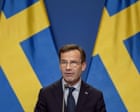
Elections rarely turn on a handful of ballots, but Swedish politics just experienced a seismic shock measured in hair-splitting margins. Prime Minister Ulf Kristersson handed in his resignation after a final vote count confirmed that the center-left opposition secured a razor-thin three-seat majority in the Riksdag. Just over 50,000 votes separated the two political blocs across the entire nation. That tiny gap ended four years of right-of-center governance under the Tidö Agreement.
If you look past the initial shock of the concession, the real story isn't just about who won. It is about how fragile parliamentary math has become in Scandinavia.
The Math Behind the Collapse
When the final districts reported their numbers, the center-left bloc comprising Magdalena Andersson's Social Democrats, the Left Party, the Greens, and the Centre Party claimed 176 seats. Kristersson's outgoing coalition of Moderates, Christian Democrats, Liberals, and the nationalist Sweden Democrats limped behind with 173.
That three-seat cushion is a nightmare scenario for anyone trying to govern.
Kristersson took power in 2022 by knitting together a right-wing bloc that relied on external support from the populist Sweden Democrats. It was an uneasy partnership from day one. This time around, Kristersson promised to bring the Sweden Democrats directly into cabinet roles if he won. Instead, voters pulled back. The Sweden Democrats dropped about three percentage points, breaking the momentum that the right wing had spent years building.
For Magdalena Andersson, who previously served as prime minister before losing her job in 2022, the path back to the top office is wide open yet fraught with internal contradiction.
Why Forming a Coalition Will Be Brutal
Winning the election is the easy part. Managing the ideological friction inside the winning bloc is where things get messy.
Andersson leads the Social Democrats, who finished as the largest single party with 99 seats. But her potential partners hold deeply conflicting views. The socialist Left Party wants aggressive tax hikes and state intervention. Meanwhile, the liberal Centre Party fiercely opposes tax increases and sits squarely on the opposite side of economic policy. Add the Greens into the mix, and you have four parties that agree on very little outside of their shared desire to keep the right wing out of power.
This dynamic creates a political deadlock before a single piece of legislation is even drafted. The Centre Party refuses to sit in a government with the Left Party, meaning Andersson faces weeks of exhausting, high-stakes bargaining just to put together a functional cabinet.
What Stays the Same
Despite the dramatic shift at the top, foreign policy and national security in Sweden run on a different track.
During Kristersson’s tenure, Sweden completed its historic transition into a NATO member and became a vocal, steadfast supplier of military aid to Ukraine. Those positions enjoy broad, cross-party consensus. A new center-left government under Andersson won't alter Stockholm's stance on eastern Europe or collective defense. The geopolitical baseline remains locked in place.
Domestically, however, the tone of governance will shift. The right-wing push to integrate nationalist parties directly into statecraft has hit a wall. Yet, because the previous government successfully pushed public discourse to the right on issues like immigration and public safety, much of the legislative framework built over the last four years will survive.
Sweden remains a nation deeply divided down the middle, governed by a coalition that can barely agree on breakfast, let how to run a country. Expect turbulent parliamentary sessions ahead.