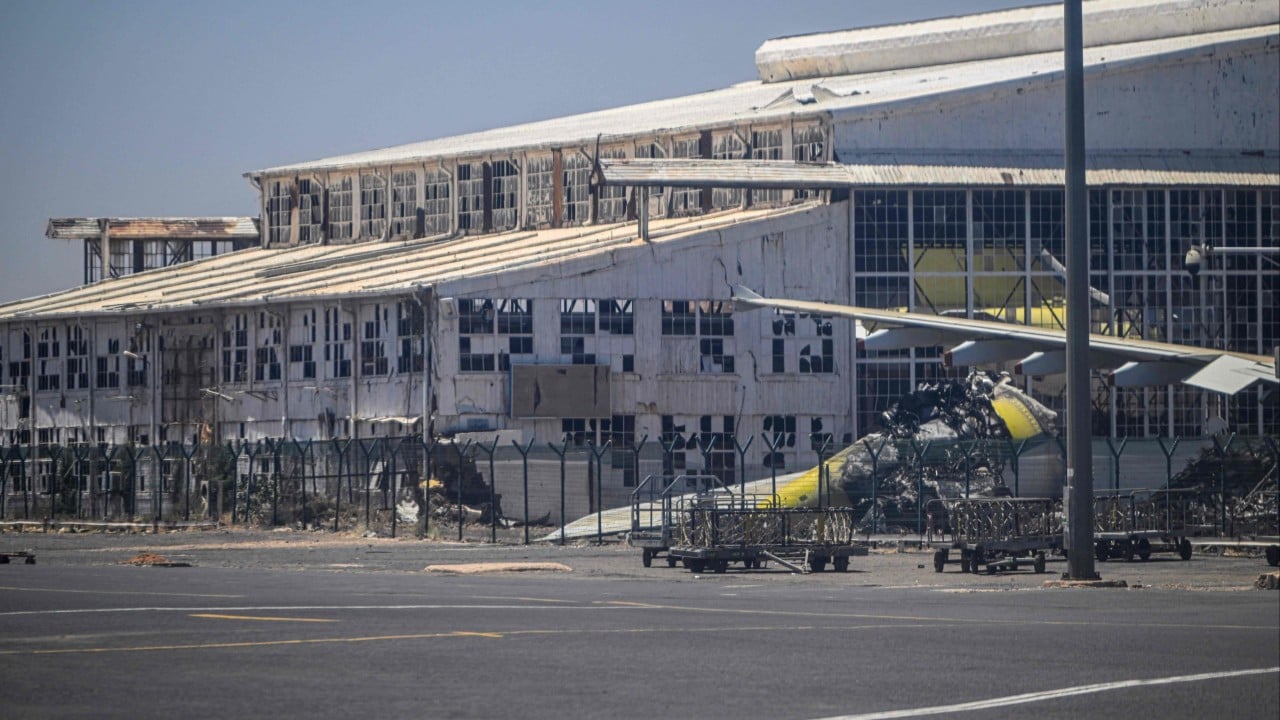
The recent swarm of suicide drones targeting Khartoum International Airport marks more than just a break in a temporary lull. It represents a fundamental shift in the Sudanese civil war from a struggle of territorial occupation to one of precision-guided exhaustion. While much of the international community remained focused on stalled peace talks in Geneva or the humanitarian catastrophe in Darfur, the Rapid Support Forces (RSF) and the Sudanese Armed Forces (SAF) have spent the last few months quietly evolving their arsenals. The strike on the nation's primary aviation hub proves that the era of "relative calm" was never a de-escalation; it was a retooling phase.
This isn't just about broken windows or charred runways. The targeting of Khartoum’s airport is a strategic move to sever the SAF’s logistical spine. For the military government, the airport is the gateway for supplies, foreign diplomatic movement, and the few remaining avenues of legitimate trade. By demonstrating that even the most protected government assets are vulnerable to cheap, mass-produced loitering munitions, the opposition is forcing a psychological and financial collapse that traditional infantry charges failed to achieve.
The Democratization of Air Power
The hardware used in these attacks didn't come from a multi-billion dollar aerospace program. We are seeing the "FPV-ification" of the Sudanese conflict. Small, maneuverable drones—often modified commercial models or low-cost fixed-wing kits—have replaced the need for a traditional air force. This creates a massive power imbalance. A single military transport plane costs tens of millions of dollars; the drone that destroys it on the tarmac costs less than a used sedan.
The SAF has historically relied on its superiority in the skies, using aging MiGs and Sukhoi jets to pound RSF positions. However, these jets require sophisticated maintenance, fuel, and secure runways. Drones require none of those things. They can be launched from the back of a pickup truck in a suburban alleyway. This shift has effectively neutralized the SAF’s biggest conventional advantage. When you can’t protect your own hangar, your air superiority becomes a liability.
Supply Chains and the Grey Market
Where do these drones come from? That is the question that should be keeping regional analysts awake at night. Tracking the wreckage reveals a tangled web of origin points. Some parts are clearly sourced from the same global supply chains fueling the war in Ukraine. This includes consumer-grade flight controllers, GPS modules, and lithium-polymer batteries available on any major e-commerce site.
Evidence suggests that both sides are receiving "consultation" from external actors. It is no secret that the RSF has maintained ties with Russian private military contractors, while the SAF has looked toward regional neighbors like Egypt and Turkey for hardware. But the current trend toward DIY assembly within Sudan suggests a transfer of knowledge rather than just a transfer of goods. Local workshops are now capable of mounting improvised explosive devices (IEDs) onto frames, turning hobbyist toys into surgical killers.
The Failure of Traditional Ceasefires
International mediators often treat the "calm" between major battles as a sign of progress. This is a recurring mistake. In a modern war of attrition, a period of quiet is simply the time required to print more circuit boards and train more operators. The recent strikes shattered the illusion that the conflict was freezing into a stalemate.
The RSF has utilized the recent months to infiltrate urban pockets around the capital, moving in small cells that are difficult for traditional intelligence to track. They aren't trying to hold every street corner anymore. They are trying to hold the threat over every street corner. By hitting the airport, they signal to every resident and foreign observer that no zone is "green" and no infrastructure is safe.
The Human Cost of Technical Precision
While the headlines focus on the airport, the surrounding neighborhoods of Omdurman and Bahri bear the brunt of the technical failures. Cheap drones are notoriously prone to signal interference or mechanical failure. When a "precision" strike misses its mark at a high-value military target, it usually ends up in a civilian apartment complex.
We are seeing a new type of urban displacement. It isn't just people fleeing a moving front line; it is people fleeing the invisible threat from above. You can hide from a tank. You can’t hide from a 4-pound plastic bird that can fly through your kitchen window at 80 miles per hour. The psychological toll of this constant, buzzing anxiety is dismantling the social fabric of Khartoum faster than any artillery barrage ever could.
The Logistics of a Siege
Controlling an airport is about more than just planes. It is about the control of information and elite mobility. When the airport is under fire, the "government" essentially becomes a prisoner in its own capital. It cannot host foreign dignitaries safely. It cannot send delegations to peace talks without immense risk.
Defensive Limitations
The SAF is currently struggling with how to counter this threat. Traditional anti-aircraft systems, like the S-60 or even portable MANPADS, are designed to hit fast-moving jets or large helicopters. They are almost useless against a drone the size of a pizza box flying low and slow between buildings.
Electronic warfare (EW) is the only real defense, but EW suites are expensive and temperamental. Jamming a drone’s signal often means jamming the entire neighborhood's cellular and radio networks, further isolating the civilian population. This creates a "defense paradox" where protecting a target like the airport requires the military to shut down the very communications the city needs to function.
The Pivot to Total Infrastructure War
The airport strike is a bellwether. If the RSF can successfully shut down aviation at will, their next targets will likely be power plants, water treatment facilities, and grain silos. This is "infrastructure war"—a strategy designed to make the cost of governing so high that the opponent simply collapses from within.
Foreign powers are watching this closely. The lessons learned in the streets of Khartoum are being archived by militaries worldwide. We are seeing a real-time demonstration of how a paramilitary force with limited resources can paralyze a traditional state military through the clever application of off-the-shelf tech.
The international community's insistence on 20th-century diplomacy is failing because the war has entered a 21st-century technical reality. You cannot negotiate a ceasefire with a decentralised network of drone operators who don't answer to a central command. The command structure of the RSF has become as fragmented as the technology they use, making a top-down peace treaty almost impossible to enforce on the ground.
Economic Implications of the Strike
Sudan’s economy was already in a death spiral. The pound has lost nearly all its value, and the central bank is a shell of an institution. The airport was the last straw for any remaining foreign investment or commercial enterprise. By targeting this specific site, the attackers are ensuring that even if the shooting stops tomorrow, the recovery will take decades. No airline is going to fly into a city where the "security" cannot guarantee a clear runway against hobbyist electronics.
The ripple effect touches everything from the price of imported medicine to the ability of NGOs to rotate staff. This isn't just a military maneuver; it's a deliberate act of economic sabotage. The message to the SAF is clear: if we cannot have the capital, nobody can.
A New Definition of Victory
In the old manuals, victory meant capturing the palace. In the new reality, victory is the total denial of the opponent's ability to exist in public space. The strike on Khartoum International Airport confirms that the "relative calm" was a ghost. Both sides have accepted that this is a long-term war of technical and social erosion.
The focus shouldn't be on when the next "ceasefire" will be signed, but on who is providing the components for the next swarm. The front line is no longer a trench in the sand. It is a drone controller in a basement and a flight path over a terminal. The conflict has moved beyond the reach of traditional borders and traditional politics. It is now a battle of batteries, signals, and the sheer will to keep the sky dangerous.