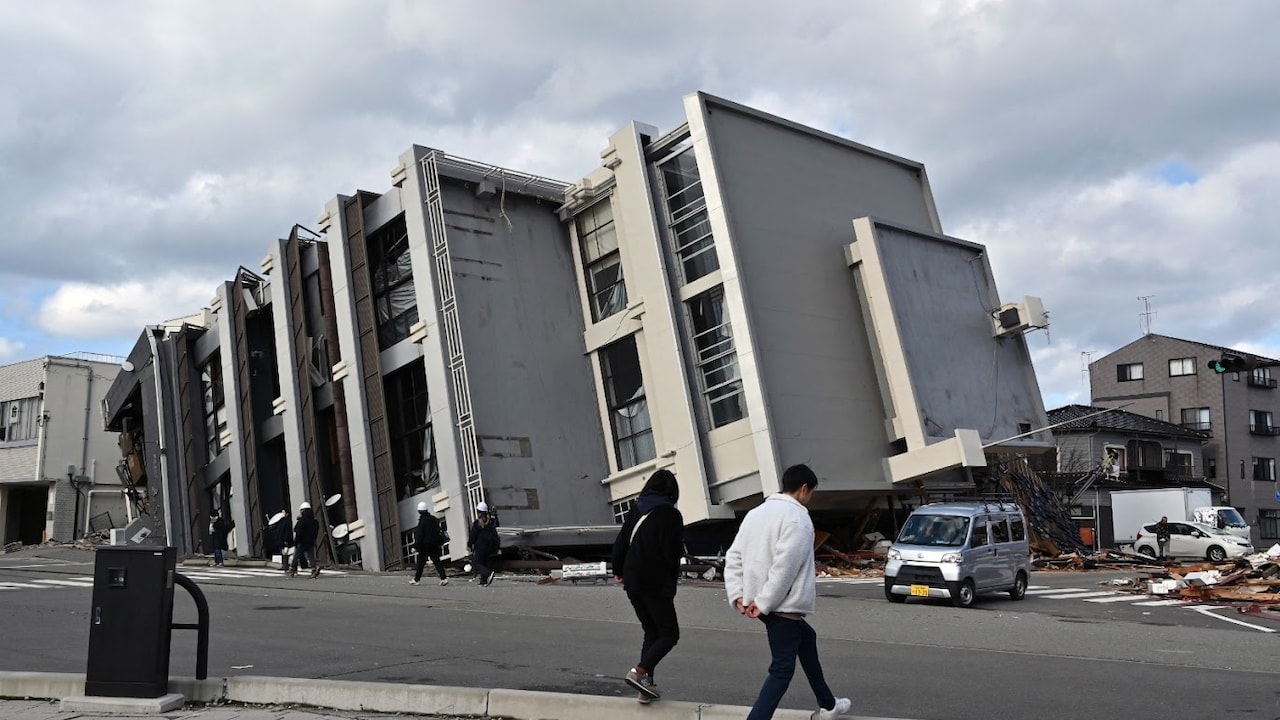
When an earthquake strikes a densely populated urban environment, the intersection between geological energy release and commercial infrastructure determines the threshold between survival and catastrophic failure. Seismic events do not treat buildings uniformly. Instead, they exploit micro-vulnerabilities in material composition, engineering redundancy, and spatial load distribution. Analyzing a structural failure during a high-magnitude seismic event requires shifting away from superficial disaster reporting toward a rigorous examination of physical forces, energy dissipation pathways, and municipal resilience metrics.
The Physical Mechanics of Seismic Vulnerability in Large-Scale Retail Facilities
Commercial properties, particularly multi-story retail complexes and shopping malls, present unique structural challenges during seismic activity. These structures require wide, open interior spans, minimal interior load-bearing walls to maximize retail floor space, and extensive use of glass facades. This architectural design language directly conflicts with seismic resistance principles, which rely on continuous shear walls, rigid diaphragms, and evenly distributed mass.
The fundamental force equation governing earthquake impact involves kinetic energy transference from tectonic plate slippage through soil strata and into the building foundation. The magnitude of this transfer depends on soil-structure interaction. Soft sedimentary basins amplify seismic wave amplitudes, converting high-frequency, low-amplitude waves into low-frequency, high-amplitude ground motions that resonate with large commercial footprints.
When ground acceleration exceeds the lateral load capacity of a building frame, secondary structural components experience extreme stress concentrations. Steel moment-resisting frames and reinforced concrete columns must absorb, dissipate, or reflect this kinetic energy. If energy dissipation mechanisms fail—such as through yielding steel dampers, base isolators, or ductile concrete detailing—the structural skeleton undergoes plastic deformation, leading to progressive collapse.
The Three Failures of Progressive Load Redistribution
Progressive collapse occurs when the failure of a primary load-bearing element triggers a chain reaction, transferring its load to adjacent members that lack the capacity to absorb the surplus. In commercial structures subjected to seismic loads, this failure mechanism breaks down into three distinct operational phases.
The first phase is diaphragm disconnection. Roof and floor diaphragms act as horizontal beams that distribute lateral seismic forces to vertical resisting elements like shear walls and frames. When excessive torsional or shear stress causes these diaphragms to fracture at connection nodes, the upper levels lose structural synchronization with the foundation. The floor plates begin to move independently, shearing vertical columns and removing lateral support.
The second phase involves column buckling under eccentric loading. As seismic waves induce violent lateral sway, vertical columns experience simultaneous axial compression and bending moments. Modern retail complexes often feature open central atriums, creating asymmetrical mass distributions. This asymmetry generates severe torsional forces, causing corner columns to twist and buckle under loads far below their static compressive limits.
The third phase is foundation liquefaction and settlement. In coastal or alluvial urban centers, intense ground shaking transforms saturated granular soils into a fluid-like state. When the underlying soil loses its bearing capacity, building foundations tilt, sink, or shear entirely. Even if the superstructure remains structurally sound, differential settlement alters the internal load path, precipitating localized structural failures that cascade throughout the facility.
Emergency Response and Rescue Logistics under Zero-Information Constraints
Immediately following a structural collapse, emergency management operations operate under severe information deficits. First responders face a chaotic operational environment characterized by compromised utility lines, blocked access routes, and an unknown number of trapped occupants. Effective rescue operations rely on rapid situational triage, systematic void space identification, and heavy rescue logistics.
Search and rescue teams deploy acoustic listening devices, thermal imaging cameras, and trained canine units to detect trapped survivors within the rubble matrix. However, the physical geometry of collapsed retail spaces complicates these efforts. Large-span steel roofs often pancake downward, creating hazardous, unstable progressive layers of concrete and corrugated metal decking. Cutting through these materials without triggering secondary collapses requires precise shoring techniques and hydraulic lifting equipment.
Simultaneously, municipal infrastructure management must isolate natural gas mains, electrical sub-stations, and municipal water lines connected to the disaster zone. Secondary hazards such as structural fires caused by ruptured gas lines or electrical short circuits frequently compound the lethality of the initial seismic event. Emergency dispatch protocols must prioritize containment zones to prevent rescue personnel from becoming casualties.
Municipal Resilience and Retrofitting Economics
Mitigating future structural failures in high-risk seismic zones demands a shift from reactive emergency response to proactive structural retrofitting. Building codes establish minimum safety baselines, but existing commercial stock often predates modern seismic design standards. Retrofitting these structures involves significant capital expenditure, creating an economic friction point between property owners and municipal regulators.
Engineering interventions include installing viscoelastic dampers to absorb kinetic energy, wrapping vulnerable concrete columns with carbon fiber-reinforced polymers to increase ductility, and reinforcing floor-to-column connections. These modifications alter the dynamic response of the building, reducing peak inter-story drift during future ground motions.
Deploy automated seismic shutoff valves on all commercial gas and liquid fuel lines to eliminate post-quake fire vectors instantly upon initial P-wave detection. Mandate real-time structural health monitoring sensors on all commercial properties exceeding fifty thousand square feet within active seismic zones to provide continuous data feeds on stress distribution and micro-fracturing.


