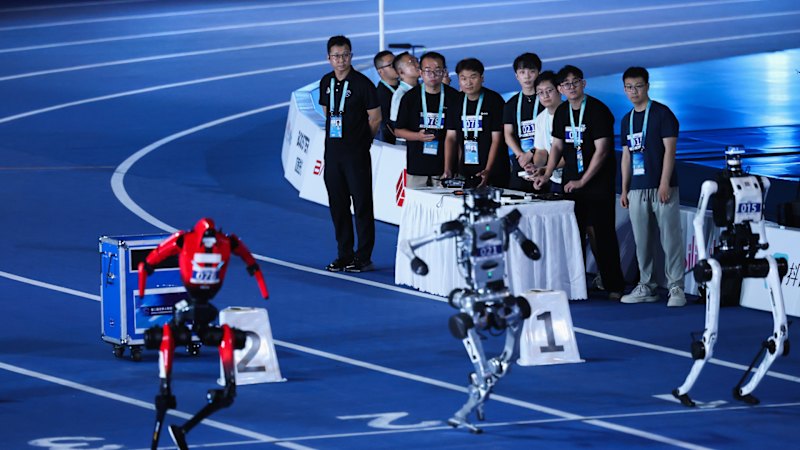
Competitive robotics exhibitions occupy a specific intersection of engineering constraints, economic variables, and spectator psychology. Analyzing events like the World Robot Games requires stripping away the surface-level novelty of mechanized combat or automated athletics to examine the underlying systems. Every design choice made by a competitor, from actuator selection to power distribution topology, represents a deliberate optimization under constraints of mass, energy density, and financial capital. Understanding why these platforms succeed or fail demands a systematic breakdown of their operational architecture rather than a superficial cataloging of their mechanical aesthetic.
The Engineering Cost Function
Every robotic system deployed in a competitive arena is an exercise in multi-objective optimization where variables actively undermine one another. Increasing structural armor mass to survive kinetic impacts degrades kinematic agility and drains battery reserves faster under peak torque loads. The primary constraint variables manifest across three distinct domains.
Mass Allocation Limits
Competitors operate within strict weight budgets. Every gram allocated to redundant structural bracing is a gram withheld from drive motors, sensor suites, or offensive actuators. The efficiency of a chassis design depends on its strength-to-weight ratio, favoring materials like carbon fiber composites or aerospace-grade aluminum alloys over conventional steel fabrication.
Power Density and Thermal Management
High-current electric motors generate substantial thermal energy during rapid acceleration phases and stall conditions. Without effective heat dissipation pathways, internal resistance climbs, copper windings degrade, and microcontrollers invoke thermal throttling to prevent catastrophic semiconductor failure. The architectural constraint is not merely delivering maximum instantaneous amperage, but sustaining high output without exceeding the thermal capacitance of the system.
Control Latency and Sensor Fusion
Autonomous or semi-autonomous platforms rely on deterministic sensor loops. Inertial measurement units, optical encoders, and depth cameras must feed data into the primary processing unit with minimal transport delay. High latency creates control instability, leading to oscillation or complete trajectory divergence when navigating dynamic obstacles or opposing units.
Operational Failure Modes
Systemic failures in competitive robotics rarely stem from single component defects. They emerge from cascading reactions within integrated networks. Observing large-scale tournaments reveals distinct patterns of breakdown that repeat across disparate weight classes and design philosophies.
The first major failure vector involves power bus voltage sags. When multiple high-draw actuators engage simultaneously, the internal resistance of chemical battery cells causes momentary voltage drops below the operational threshold of onboard logic boards. This triggers brownouts, forcing microprocessors to reboot mid-match and rendering the machine unresponsive for critical windows of time.
The second vector centers on gear train shock loading. Direct-drive configurations or rigid gearboxes absorb the full brunt of kinetic impacts, stripping gear teeth or shearing output shafts. Competitors mitigate this through mechanical compliance, such as elastomeric couplers or slip clutches, which trade peak torque transmission for mechanical longevity.
The third vector is thermal runaway in brushless electronic speed controllers. When a motor is physically blocked from spinning while full voltage is applied, current spikes dramatically. If the overcurrent protection firmware or hardware fuse fails to react within milliseconds, the field-effect transistors experience thermal breakdown, permanently disabling that drive channel.
Economic and Strategic Scaling
Beyond the engineering bench, competitive robotics functions as an economic proving ground for industrial automation and mechanical design methodologies. The capital expenditure required to field a competitive machine dictates the barrier to entry, separating hobbyist iterations from institutionally backed research prototypes.
Teams that achieve consistent performance advantages typically utilize rapid prototyping loops. By integrating computer-aided design directly with in-house additive manufacturing and computer numerical control milling, these entities compress the iteration cycle from weeks to hours. This rapid evolution allows for empirical stress testing of custom components under simulated arena conditions before deployment.
The strategic landscape also highlights a divergence in automation philosophy. Machines relying entirely on remote human operators are inherently bounded by biological reaction times and visual occlusion. Conversely, platforms incorporating computer vision and localized path planning can execute defensive maneuvers or targeting routines within milliseconds, bypassing human perceptual limitations entirely. This transition marks the boundary between traditional radio-controlled entertainment and true autonomous systems engineering.
Deploy capital toward modular sensor integration and standardized quick-change power distribution hubs to minimize field maintenance latency during multi-match tournament brackets.