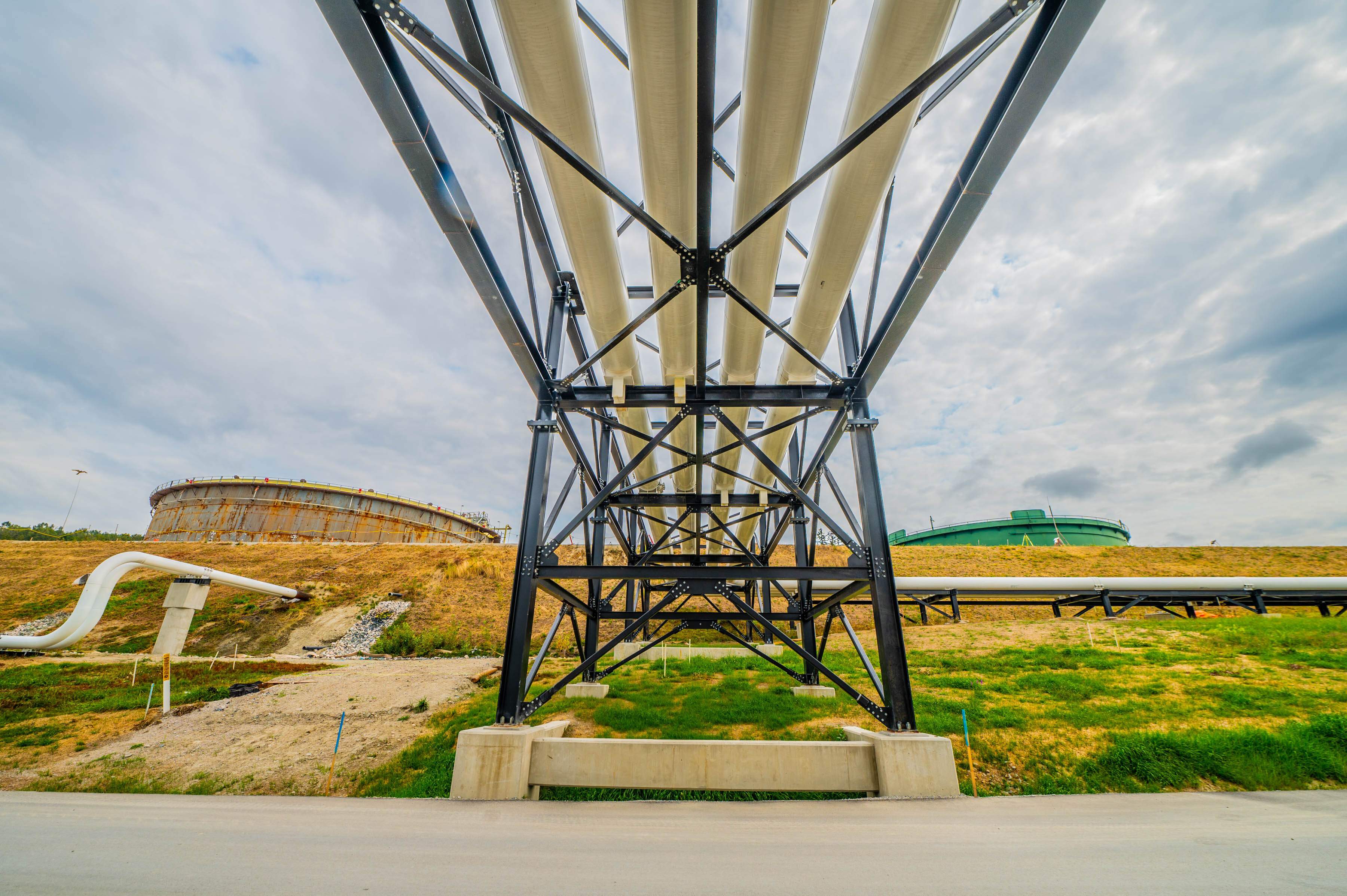
Canadian oilsands production is entering a phase defined by a fundamental decoupling of reservoir potential and logistics capacity. While the commissioning of the Trans Mountain Expansion (TMX) provided a temporary reprieve for Western Canadian Select (WCS) differentials, the Enverus analysis of the Western Canadian Sedimentary Basin reveals a hard ceiling approaching faster than current capital expenditure cycles suggest. The logic governing this sector is no longer driven by the availability of bitumen, but by the mathematical reality of the "Takeaway Limit"—the point where incremental production volume exceeds the physical diameter of existing steel in the ground.
The Triad of Production Drivers
The growth trajectory of the oilsands is governed by three distinct variables that dictate whether a barrel of bitumen reaches the Hardisty hub.
- Brownfield Optimization Efficiency: Most current growth is not coming from multi-billion dollar greenfield projects. It is the result of "debottlenecking"—the technical process of identifying and removing specific constraints within an existing plant's flow. If a facility has a nameplate capacity of 100,000 barrels per day (bpd) but the steam generators can only support 90,000, upgrading the generators unlocks 10,000 bpd at a fraction of the cost of new construction.
- Solvent-Aided Process (SAP) Adoption: The industry is shifting toward injecting solvents like propane or butane alongside steam. This reduces the Steam-to-Oil Ratio (SOR). Lowering the SOR means less energy is required per barrel, which effectively increases the production capacity of existing steam assets.
- The Decline Rate Offset: Unlike shale, which suffers from steep initial decline rates, oilsands assets have decline rates as low as 2% to 5%. This creates a massive "base" production level. Almost every dollar of reinvested capital goes toward growth rather than merely treading water to maintain flat production.
The Physics of Pipeline Inelasticity
The central conflict in the Enverus data is the rigid nature of pipeline infrastructure versus the fluid nature of production growth. Pipelines are binary assets; they are either underutilized or at "nameplate capacity." Once a pipe is full, the marginal cost of transporting the next barrel does not just increase—it hits a vertical wall.
The Trans Mountain Expansion added roughly 590,000 bpd of capacity. In the immediate aftermath, the WCS-WTI differential—the price gap between Canadian heavy oil and the US benchmark—narrowed significantly. This narrowing occurred because the market was no longer pricing in the "apportionment risk," where producers are forced to compete for limited space by lowering their prices.
This equilibrium is fragile. Current projections indicate that Western Canadian production will grow by over 500,000 bpd by the end of the decade. This growth will effectively consume the entirety of the TMX "buffer" within a three-to-five-year window. When that threshold is crossed, the sector returns to a state of logistical saturation.
The Cost Function of Alternative Export Modes
When pipelines reach capacity, the industry reverts to Rail-as-a-Safety-Valve. This shift fundamentally alters the netback equations for producers.
- Pipeline Tolls: Generally range from $7 to $12 per barrel depending on the destination and commitment length.
- Crude-by-Rail: Costs typically escalate to $15–$22 per barrel.
The reliance on rail creates a "Price Floor for Differentials." Because rail is the marginal transport option, the WCS differential must widen enough to cover the higher cost of rail transport. If the differential is only $10, no one ships by rail because they lose money. If the differential widens to $20, rail becomes viable. Therefore, the moment pipelines are full, the market automatically punishes the producer with a $20 differential to force the excess barrels onto tracks.
The Capital Discipline Constraint
A secondary bottleneck exists within the boardrooms of the "Big Five" producers (Suncor, CNRL, Cenovus, Imperial, and MEG Energy). Following the 2014 and 2020 price collapses, these firms shifted from a "Growth at All Costs" model to a "Total Shareholder Return" model.
This creates a self-imposed production cap. Even if the geology allows for a 10% annual growth rate, debt repayment mandates and dividend commitments limit capital allocation to levels that support only 2% to 3% growth. This discipline prevents the immediate "crashing" of the pipeline system, but it also means Canada is failing to capture the full global market share made available by the decline of heavy oil production in Venezuela and Mexico.
The Regulatory and Environmental Friction Point
The Enverus report highlights "pipeline constraints," but the underlying cause is regulatory calcification. The TMX took over a decade to complete and cost over $34 billion. The probability of another major greenfield pipeline being approved and built in the current Canadian regulatory environment is statistically near zero.
Producers are now forced to operate within a "Fixed System." Any growth must be managed through:
- Optimization of existing lines: Using Drag Reducing Agents (DRAs) to squeeze a few extra percentage points of throughput out of existing pipes.
- Storage Play: Utilizing massive tank farms in Hardisty and Edmonton to time sales, though this does not solve the long-term volume problem.
- Refining Integration: Increasing the amount of bitumen processed locally into diesel or gasoline, bypassing the need for crude export pipes entirely.
Strategic Trajectory
The Canadian energy sector is approaching a "Congestion Equilibrium." Within 48 months, the industry will have exhausted the breathing room provided by TMX. At that juncture, the WCS differential will begin to decouple from global benchmarks once more, reflecting the local logistical reality rather than global demand.
Investors and operators must calibrate for a market where the "Pipeline Ceiling" acts as a hard regulator of valuation. Firms with secured, long-term firm service on existing pipes will command a massive premium, while "basin-exposed" producers—those relying on the spot market for transport—will face significant margin compression. The era of building our way out of this problem is over; the era of managing the scarcity of space has begun.
The strategic play is no longer about finding the most oil; it is about owning the most certain path to the coast. Producers who fail to secure long-term downstream egress or refinery integration will find themselves producing a commodity they cannot move, effectively stranded by their own success in the field. The countdown to the next "differential blowout" has started, and the TMX was merely a reset of the clock, not a removal of the alarm.
Operational Mandates for the 2026-2030 Period
Operators must prioritize three technical levers to survive the impending saturation:
- Bitumen Partial Upgrading: Investing in technology that removes the heaviest "bottoms" of the barrel before shipping. This reduces the amount of diluent required. Currently, a "barrel" of export bitumen is often 30% diluent (naphtha or condensate). Reducing diluent requirements by 10% effectively increases pipeline capacity for actual bitumen by 10% without laying an inch of new pipe.
- Secondary Hub Diversification: Shifting focus toward US Gulf Coast (USGC) connectivity. The completion of TMX opened the Pacific, but the USGC remains the world’s most sophisticated market for heavy sour crude.
- Direct-to-Rail Infrastructure: Maintaining "warm" rail loading facilities. In a constrained environment, the ability to pivot to rail within a 30-day window is the difference between maintaining cash flow and shutting in production.
The logistical ceiling is a mathematical certainty. The only variable is the efficiency with which the industry adapts to its new, permanent boundaries.