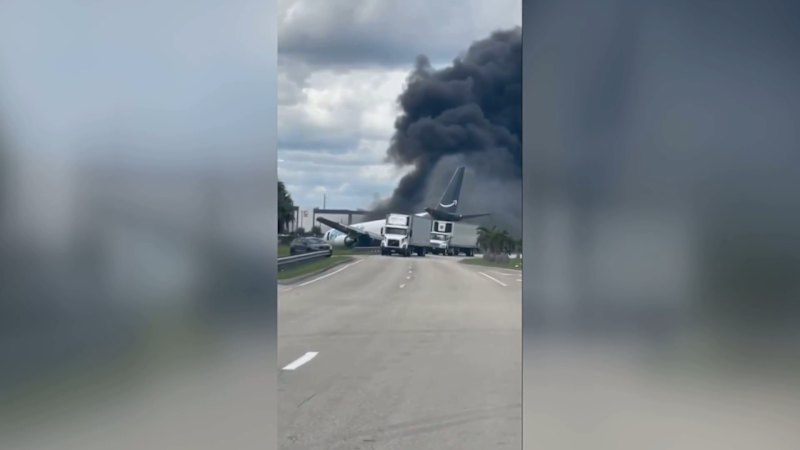
Air cargo safety relies on an intricate balance of contractual risk allocation, aerodrome safety margins, and high-tempo fleet utilization. When a Boeing 767-300 freighter operating under the Amazon Prime Air network overran the active runway at Miami International Airport, crashing through perimeter infrastructure and igniting a multi-agency response, the event exposed the operational vulnerabilities inherent in outsourced logistical scaling.
Analyzing this occurrence requires stripping away sensationalized media framing to examine the core mechanics: the structural limits of aerodrome safety areas, the regulatory mechanics of wet-lease and contracted air operations, and the compounding variables of high-frequency regional cargo turns.
The Aerodrome Safety Deficit
Runway overruns are fundamentally failures of energy dissipation within defined spatial boundaries. Commercial aviation infrastructure utilizes specific containment zones known as Runway Safety Areas (RSAs) and Runway End Safety Areas (RESAs) to absorb aircraft that fail to decelerate within the paved touchdown zone.
When a widebody freighter like the Boeing 767 exceeds these designated safety margins, transitioning from pavement to adjacent terrain, several structural variables converge:
- Kinetic Energy Decay Rate: Heavy freighters arriving from short-haul regional routes, such as the San Juan to Miami segment, land with substantial landing weights relative to their fuel burn, requiring precise braking coefficients.
- Surface Adhesion Friction: Contaminated or wet pavement drastically reduces wheel-braking effectiveness, shifting deceleration dependency entirely to reverse thrust and aerodynamic spoilers.
- Perimeter Hardening Obstacles: Urban-adjacent airports frequently feature perimeter roadways, perimeter fences, and unyielding civil infrastructure immediately beyond the RESA boundary, turning a standard runway excursion into a catastrophic structural collision.
The Miami incident demonstrated the hazard of spatial compression. Because the aircraft crossed a public thoroughfare and impacted vehicular traffic outside the airport perimeter, the event bypassed containment protocols meant to keep excursions isolated to airfield property. This highlights a structural friction point between modern metropolitan expansion and legacy airport boundary designs.
The Contractual Architecture of Outsourced Logistics
A critical misinterpretation in standard reporting involves the operational entity operating the aircraft. Amazon does not hold an Air Operator Certificate (AOC) under Federal Aviation Regulations Part 121. Instead, the Prime Air network functions as an asset integrator that subcontracts flight operations to third-party certificated air carriers—in this instance, 21 Air.
This creates a decentralized operational risk profile governed by three distinct layers:
- The Certificate Holder: The contracted airline maintains absolute legal and operational control over flight crews, maintenance execution, safety management systems, and regulatory compliance.
- The Network Integrator: The corporate shipper dictates schedule density, network velocity, and asset allocation, driving utilization rates that compress maintenance windows.
- The Infrastructure Provider: The airport authority manages physical runway conditions, braking action reporting, and navigational aid reliability.
When an accident occurs, liability and institutional accountability are fragmented across these organizational boundaries. The economic model incentivizes high asset turnover, transforming aircraft into high-frequency nodes that must maintain tight schedule integrity to feed regional fulfillment hubs.
The Cost Function of High-Tempo Cargo Turns
To understand why a cargo overrun occurs, one must evaluate the operational cost function of a narrow-body or widebody freighter network. Unlike passenger carriers that operate on predictable daily peaks, cargo networks run continuous, overnight, and tightly timed sorts designed to guarantee next-day delivery promises.
The economic variables governing this system include:
- Utilization Pressure: Freighters generate revenue only when airborne. Ground time is a direct cost center, creating latent organizational pressure to minimize turnaround intervals at origin and destination stations.
- Maintenance Scheduling Latency: Contracted operators balancing multiple enterprise clients often operate under thin operational margins, where unexpected component deferrals under the Minimum Equipment List (MEL) can constrain tactical flexibility.
- Weather and Flow Constraints: High-density hubs like Miami International experience frequent convective weather patterns, forcing sudden arrival sequencing changes that alter approach profiles, touchdown points, and stabilized approach criteria.
If a flight crew encounters a compressed approach profile due to air traffic flow management, or if braking effectiveness is compromised by unpredicted surface moisture, the operational imperative to maintain schedule velocity interacts dangerously with the physical limits of deceleration physics.
Regulatory Oversight and Systemic Vulnerabilities
The Federal Aviation Administration and the National Transportation Safety Board evaluate these incidents through the lens of systemic safety barriers. The recurrence of serious incidents within contracted cargo networks underscores the difficulty of maintaining uniform safety cultures across disparate operating partners.
Independent air carriers flying under contract often experience recruiting and retention pressures distinct from legacy passenger airlines, influencing crew resource management and operational decision-making under adverse environmental conditions. When an aircraft fails to stop within the paved infrastructure, the ensuing ground stop—such as the full operational pause imposed at Miami—disrupts regional supply chain nodes instantly, proving that a single localized excursion propagates systemic economic friction across the entire logistics grid.
Reconfigure flight-dispatch risk matrices for contracted heavy cargo operations by mandating real-time runway surface condition telemetry integration before approach clearance is finalized at urban-constrained airports.