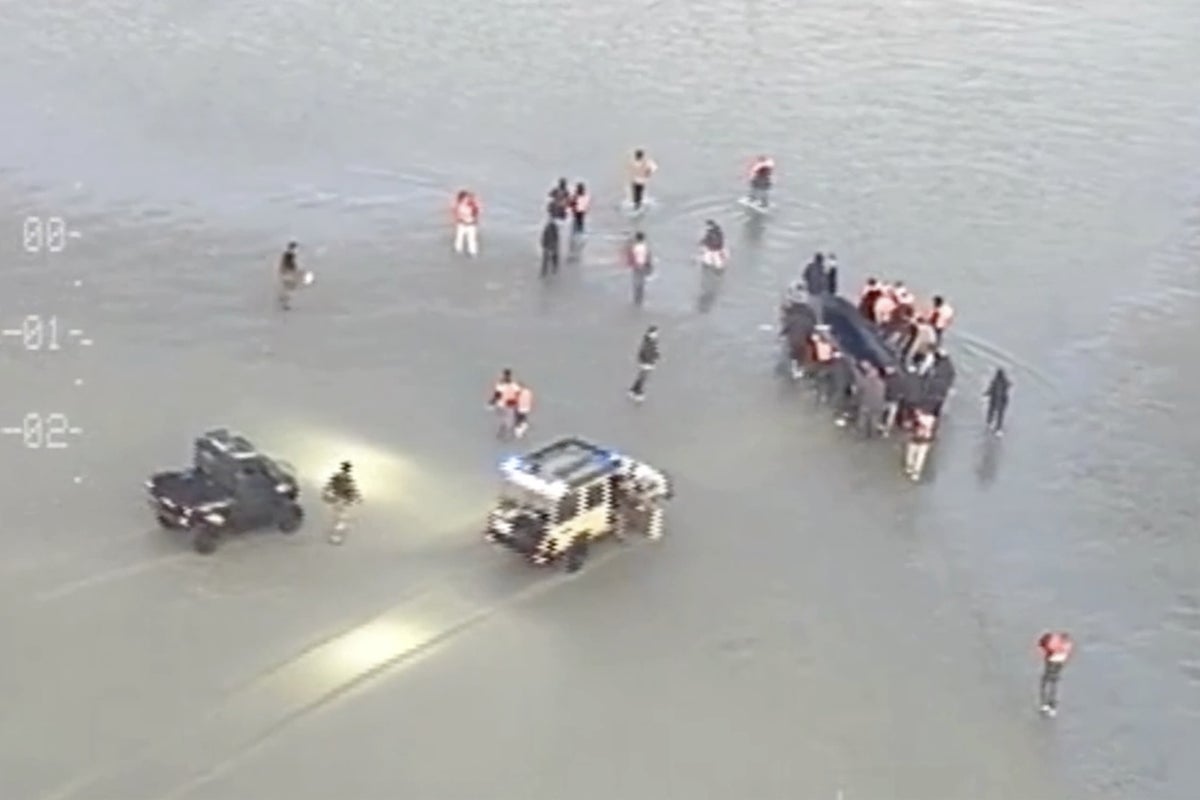
The operational friction at the maritime border between France and the United Kingdom exposes a systemic vulnerability in modern state enforcement: tactical suppression at the water's edge accelerates violent resistance without altering the underlying economic variables of unauthorized migration. When footage captures individuals attacking French law enforcement to secure passage on small boats, public discourse typically fixates on the spectacle of physical confrontation. That focus misdiagnoses a structural engineering problem. The escalation of violence is not an aberration; it is a predictable output of a constrained system where interdiction pressure meets inelastic human demand.
To understand why enforcement operations frequently degenerate into kinetic conflict, we must deconstruct the mechanics of cross-channel transit into three core variables: spatial containment, financial arbitrage, and tactical adaptation by smuggling networks.
The Cost Function of Channel Crossings
The economic model governing small boat operations relies on high-volume, low-margin transport facilitated by centralized logistics networks. Smuggling syndicates in Northern France operate under strict capital constraints. Equipment procurement, specifically the acquisition of low-grade inflatable dinghies, outboard motors, and substandard flotation devices, represents a sunk cost that must be recouped per voyage.
When state actors increase patrol density along specific coastal sectors, they do not eliminate the supply of migrants; instead, they increase the operating costs for the syndicates. These increased costs manifest as:
- Asset Attrition: Higher rates of equipment seizure by police force syndicates to procure replacement watercraft at inflated black-market prices.
- Time-Sensitive Vulnerability: Smugglers are forced to compress launch windows into narrower meteorological and temporal frames to avoid detection, increasing operational chaos on the beaches.
- Price Elasticity: Rather than deterring movement, increased interdiction risk is priced directly into passage fees, transferring the financial burden onto the end-users.
This creates a severe operational bottleneck. As launch sites become heavily contested by French security forces, the spatial distribution of departures shifts toward marshlands and isolated dunes. These terrain types reduce police response times but require desperate measures from migrants who realize that missing a departure window means losing capital they cannot recover.
Tactical Friction and the Physics of Confrontation
The immediate trigger for physical clashes between migrants and law enforcement stems from the asymmetry of objectives. French police operate under mandates focused on asset seizure, crowd dispersal, and localized deterrence. Conversely, migrants face an existential threshold: failure to board means remaining in an untenable encampment under constant harassment, facing deportation or prolonged destitution.
When police attempt to deflate watercraft or detain individuals on the shoreline, they alter the immediate risk-reward calculation of the crowd. For an individual who has liquidated their life savings to reach the northern coast, the intervention of a police officer represents a total loss of future agency. This desperation generates a collective action dynamic where the perceived cost of attacking law enforcement is eclipsed by the perceived cost of compliance.
- Deterrence Threshold: Initial police presence deters casual movement but fails against highly motivated groups.
- Escalation Phase: Interdiction efforts using physical barriers or deflation tools trigger defensive aggregation among migrants.
- Kinetic Failure: Small tactical units, often outnumbered on open beaches, find themselves vulnerable to swarming tactics designed solely to protect the integrity of the boat.
The security forces are structurally reactive. They respond to tactical indicators on the beach rather than disrupting the financial nodes or communication networks operating miles inland. Consequently, tactical engagements become zero-sum struggles over single watercraft rather than strategic disruptions of the trafficking enterprise.
The Geography of Enforcement Disconnect
A primary driver of persistent operational failure is the jurisdictional disconnect between littoral containment and destination-country labor markets. France functions as a transit state rather than a destination of choice for the majority of these populations. The enforcement posture of French authorities is funded and heavily influenced by bilateral agreements with the United Kingdom, creating a delegated security model.
Under this model, French police bear the physical and political cost of managing border friction, while the United Kingdom attempts to project sovereignty outward onto foreign soil. This arrangement distorts operational priorities. French tactical units are deployed to manage public order and prevent departures, but they lack the legal and systemic incentive to dismantle the broader underground economies that sustain the migration hubs in Calais and Dunkirk.
When enforcement focuses exclusively on the point of departure, it triggers the hydra effect: cutting off one launch vector immediately spawns two decentralized alternatives further along the coastline. The maritime boundary between France and England spans approximately twenty-one miles at its narrowest point, heavily trafficked by commercial shipping and monitored by radar systems. Yet, radar tracking and maritime surveillance do not equal interception capacity. Even when French or British maritime assets track a vessel, international maritime law regarding safety at life creates operational paralysis. Once a boat enters the water and takes on passengers, towing it back to shore safely without triggering a mass casualty event becomes logistically fraught. Smugglers understand this legal constraint and weaponize it, overloading vessels deliberately to ensure that rescue or safe passage remains the default outcome enforced by maritime conventions.
Strategic Realignment for Border Management
Attempting to solve maritime unauthorized crossings through tactical suppression on the shoreline ignores basic systems dynamics. As long as the structural demand for entry into the United Kingdom remains high—driven by informal labor markets, existing diaspora networks, and linguistic familiarity—surface-level policing will only mutate, not eliminate, the transit methods.
Effective systemic intervention requires shifting capital from beach-level interdiction to financial intelligence units that target the cryptocurrency wallets and informal hawala networks used by smuggling syndicates. Disrupting the cash flow upstream reduces the procurement of maritime assets before they ever reach the French coast.
Until enforcement strategies pivot from reactive beach containment to proactive financial and logistical disruption, clashes between desperate populations and overextended police forces will remain a recurring feature of the channel frontier.