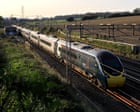
The operational utility of High Speed 2 (HS2) is governed by the rigid interplay between rolling stock dimensions, platform infrastructure, and the physics of high-speed aerodynamics. Recent shifts in the procurement strategy—specifically the move toward shorter, non-tilting train sets designed to fit the existing West Coast Main Line (WCML) gauge—threaten to fundamentally compromise the project’s original economic and logistical objectives. This technical erosion stems from a conflict between The Gauge Constraint and The Throughput Requirement, creating a system where the "high speed" label remains, but the "high capacity" utility evaporates.
The Kinematic Conflict of Shared Infrastructure
The core engineering failure in adapting HS2 trains for the existing northern network lies in the divergence of British and European loading gauges. HS2 was designed to GC gauge standards, allowing for "captive" trains that are wider and taller, maximizing internal volume. However, the decision to run these trains onto the existing network north of Birmingham necessitates "conventional compatible" units.
These compatible trains must adhere to the W6A gauge, which is significantly narrower. When a train designed for a constrained profile operates on a high-speed line, it fails to utilize the available spatial capacity of the new infrastructure. This creates a permanent efficiency gap:
- Internal Volume Deficit: Compatible trains lose approximately 15% to 20% of their cross-sectional area compared to captive sets.
- Seating Density Bottlenecks: To maintain passenger comfort, the narrower carriage forces a shift from 2+2 or 3+2 seating configurations to more restrictive layouts, directly reducing the total passenger per meter (PPM) metric.
- Aerodynamic Drag Factors: Running smaller-profile trains on lines optimized for larger sets creates sub-optimal pressure waves in tunnels, though the primary loss is not energy efficiency, but the opportunity cost of the unused physical space.
The Velocity Penalty of Non-Tilting Stock
Speed is not merely a function of engine power; it is a function of track geometry and the train's ability to negotiate curves. The existing WCML is characterized by significant curvature. Currently, Pendolino trains navigate these curves using Tilting Technology, which allows them to maintain higher speeds by compensating for lateral G-forces that would otherwise cause passenger discomfort or derailment risks.
The current HS2 rolling stock specifications do not include tilting mechanisms. The logic was that a brand-new, straight track would render tilting obsolete. However, by forcing these non-tilting trains onto the legacy northern infrastructure, a Velocity Ceiling is introduced.
- Curve Speed Restrictions: A non-tilting HS2 train must traverse the same curves on the WCML at slower speeds than the existing 20-year-old Pendolinos.
- The Braking Distance Variable: High-speed trains require longer blocks for deceleration. When integrated into a mixed-use legacy line, they must adhere to the signaling constraints of slower freight and commuter services, preventing them from ever reaching their designed $360\text{ km/h}$ peak.
- Scheduling Instability: Slower speeds in the north create a ripple effect. If a train takes 10 minutes longer to navigate the northern section, that platform at London Euston or Birmingham Curzon Street is occupied for longer, reducing the total number of paths available across the entire network.
The Throughput Paradox: Length vs. Frequency
The most significant threat to the HS2 business case is the reduction in unit length. Original plans envisioned 400-meter-long trains (formed of two 200-meter units coupled together). Recent technical adjustments suggest a move toward shorter single units or configurations that cannot be easily doubled due to platform length constraints at existing northern stations like Crewe, Manchester Piccadilly, or Glasgow Central.
Capacity is a product of Total Seats per Train $\times$ Trains per Hour (TPH).
If train length is halved to accommodate existing platform infrastructure, the system must double its frequency to maintain the same capacity. However, the WCML is already one of the most congested rail corridors in Europe. There is no "spare" frequency. Therefore, reducing train length creates a linear reduction in total system throughput.
This leads to The Crowding Feedback Loop:
- Lower capacity per train leads to higher load factors.
- High load factors increase "dwell times" at stations as passengers take longer to board and alight.
- Increased dwell times lead to schedule drift.
- Schedule drift reduces the reliable TPH the line can handle.
The Economic Elasticity of Time Savings
The Treasury’s appraisal of HS2 relies heavily on the Value of Time (VoT). If the time savings between London and the North are eroded by the inability to tilt or the need for more frequent stops, the Benefit-Cost Ratio (BCR) collapses.
The relationship is not linear; it is threshold-based. For business travelers, a journey time reduction from 120 minutes to 90 minutes might trigger a significant shift from road or air to rail. A reduction that only reaches 110 minutes because of "slow-running" in the north fails to trigger that modal shift, leaving the massive capital expenditure of the southern section under-leveraged.
Furthermore, we must account for the Sunk Cost Fallacy in Gauge Selection. By committing to conventional compatible trains now, the UK is locking itself into a sub-optimal rolling stock profile for the next 35 to 40 years. This prevents future upgrades to the northern infrastructure (such as four-tracking or straightening) from ever being fully utilized, as the trains themselves will remain the limiting factor.
Strategic Operational Failure Points
The integration of high-speed assets into legacy networks creates three specific failure points that the current "compatibility" strategy ignores:
- Power Supply Mismatch: High-speed trains draw immense current. Legacy overhead line equipment (OLE) on the northern sections often lacks the tension and power capacity to support multiple high-speed units accelerating simultaneously.
- Platform Height Incompatibility: Captive HS2 stations feature high platforms for level boarding. Legacy stations do not. Compatible trains require complex, heavy, and maintenance-intensive folding steps to bridge the gap, increasing the probability of mechanical failure and extending dwell times.
- Wind Sensitivity: Narrower, non-tilting trains have a different center of gravity and lateral surface area. When operating at high speeds in the exposed corridors of the north, they may be more susceptible to speed restrictions during high-wind events compared to the heavier, wider captive sets originally planned.
The Critical Path for Northern Connectivity
To salvage the utility of the northern segments, the procurement strategy must pivot from "compatibility" to "transformation." If the trains cannot tilt, the track must be straightened. If the platforms are too short, they must be extended. Attempting to solve a multi-billion-pound infrastructure bottleneck by shrinking the rolling stock is a form of Engineering Regressiveism.
The current trajectory indicates that HS2 will arrive in the north not as a transformative high-speed artery, but as a marginally faster, lower-capacity replacement for existing services. To prevent this, the technical specifications must prioritize the 400-meter standard and investigate Active Lateral Suspension as a middle ground between full tilting and static stock. Without these interventions, the north-south divide will be physically codified into the very gauge of the rails, ensuring that the "high-speed" benefits remain localized to the southern half of the country while the north inherits the inefficiencies of a compromised design.
Investment must be redirected toward selective gauge clearance and platform elongation at key northern hubs. This is the only mechanism to decouple the capacity of the train from the limitations of the Victorian-era footprint. The failure to do so converts HS2 from a national infrastructure project into a regional shuttle service with an over-engineered southern terminus.



