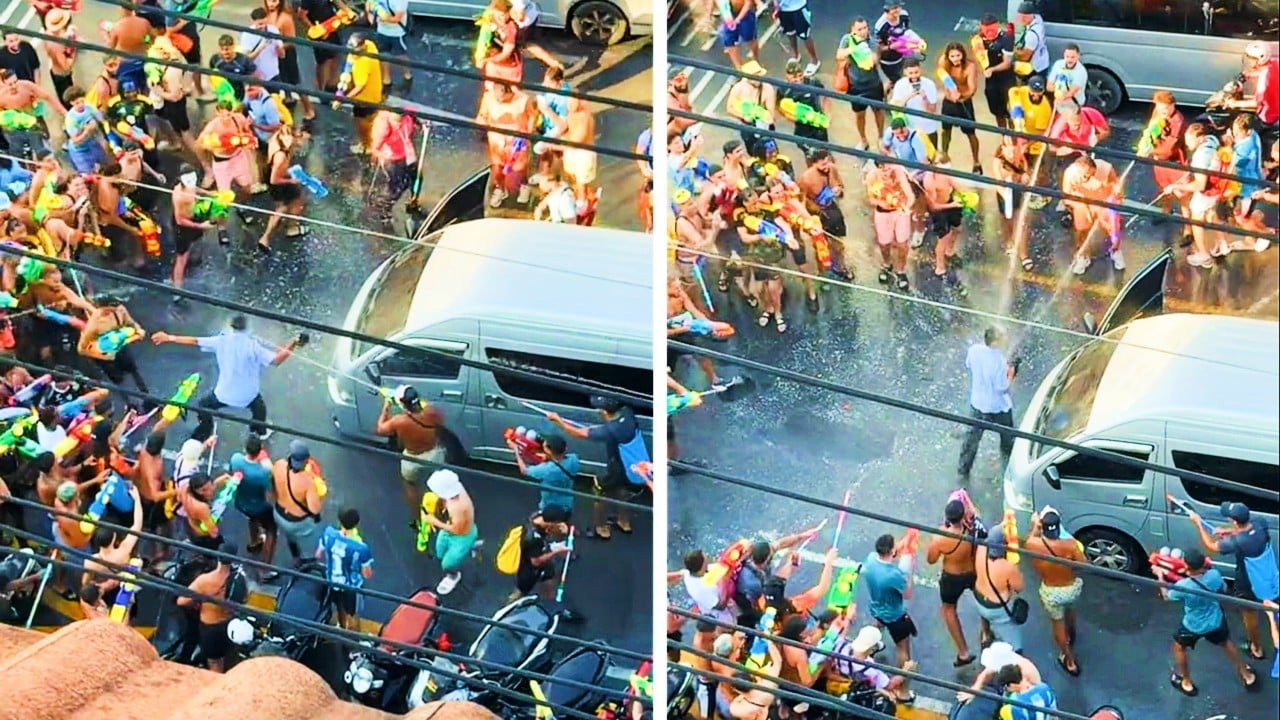
The arrest of seven French nationals in Phuket following a violent altercation with a local van driver during the Songkran festival represents a catastrophic failure of risk management at the intersection of cultural celebration and mass tourism. While mainstream reporting focuses on the sensationalism of the "viral clash," a rigorous analysis reveals a deeper friction between three distinct variables: the deregulation of behavior during water festivals, the physical constraints of urban transit corridors in Phuket, and the erosion of the "Social License to Operate" for foreign visitors in Thailand.
The Mechanism of Escalation: A Three Pillar Model
To understand why a celebratory water fight devolved into a criminal proceeding involving the Phuket Provincial Court, one must examine the specific conditions that transformed a high-spirit environment into a theater of conflict.
- The Contextual Permission Structure: Songkran functions as a period of "liminality," a sociological state where normal social rules are suspended. For tourists, this often translates to a perceived immunity from local laws. When water spraying—a ritualized act—is directed at non-participants (drivers, delivery workers, or law enforcement), the boundary between "play" and "harassment" dissolves.
- The Transit Constraint: The incident occurred within the confined geography of Phuket’s road networks. In high-density tourism zones like Patong or Rawai, the physical proximity of slow-moving vehicles and intoxicated pedestrians creates a high-frequency collision of interests. A van driver is operating within a professional productivity framework; the tourist is operating within a leisure framework.
- The Retaliatory Loop: The conflict began with a water spray hitting a vehicle and escalated through verbal provocation to physical assault. In this specific case, the use of a water gun served as the initial breach of the driver's professional space, triggering a defensive response that the seven tourists met with disproportionate collective force.
Quantifying the Legal and Economic Fallout
The arrest of seven individuals simultaneously is not a standard law enforcement response; it is a strategic signaling mechanism by the Royal Thai Police and the Immigration Bureau. The state’s objective is to maintain the "Tourist Safety Image" while satisfying the domestic demand for justice against perceived "bad guests."
The Cost Function of Behavioral Misconduct
For the arrested individuals, the cost is not merely the immediate fine or short-term detention. The legal architecture in Thailand for such incidents involves:
- Administrative Blacklisting: Under Section 12 of the Immigration Act B.E. 2522, the Ministry of Interior holds broad powers to declare individuals "persona non grata." An arrest for a violent public disturbance during a national festival almost certainly triggers a permanent entry ban.
- Legal Processing Overhead: Unlike minor infractions, a "clash" involving multiple assailants is categorized as a public order offense. This necessitates the posting of bail, often ranging from 50,000 to 100,000 THB per person, and the seizure of passports, effectively trapping the subjects in-country during a protracted trial.
- Reputational Contagion: The viral nature of the footage ensures that the professional lives of those involved are compromised globally. In an era of digital persistence, the "Phuket 7" label becomes a permanent search engine optimization (SEO) liability.
Jurisdictional Enforcement and the "Phuket Model"
Phuket has recently implemented the "Yellow Card/Red Card" system for foreigners. This incident serves as a stress test for that policy. The logic of the system is binary:
- The Yellow Card (Warning): Applied for minor traffic or public nuisance offenses.
- The Red Card (Deportation): Applied for acts of violence, repeat offenses, or significant disruptions of public order.
The collective nature of the assault on the van driver moves this incident directly into Red Card territory. Law enforcement prioritizes the protection of the Thai workforce (the driver) over the retention of high-spending tourists when the latter threatens the underlying stability of the tourism ecosystem.
The Bottleneck of Cultural Intelligence
The root cause of such clashes is a deficit in "Cultural Intelligence" (CQ). Foreign visitors often fail to distinguish between the sanctioned chaos of Songkran and the uninterrupted requirements of local infrastructure.
The conflict exists because of a fundamental misunderstanding of the "Wet Zone" boundaries. While the entire island celebrates, the main thoroughfares remain functional arteries for commerce. When tourists treat a public road as a private playground, they ignore the "Economic Imperative" of the locals. The van driver is not a participant in the festival; he is a node in the logistics network. Spraying a professional driver is not an act of celebration; it is an interference with a critical infrastructure component.
Systematic Risk Mitigation for Foreign Nationals
To avoid the jurisdictional traps that ensnared the French nationals, travelers and expatriate managers must apply a "High-Risk/High-Reward" framework to public festivals.
- Avoidance of Collective Aggression: The "mob mentality" that occurs in groups of seven or more leads to a diffusion of responsibility. Thai law enforcement, however, applies collective liability in public brawls. If one person in a group strikes a blow, the entire group is often detained for questioning and potential charging as co-conspirators.
- De-escalation Hierarchy: In any interaction with a local service provider (drivers, vendors, or police), the power dynamic is inherently skewed toward the citizen. Any escalation—verbal or physical—is a losing proposition for the non-citizen. The legal system is designed to protect the "social fabric," and a foreigner fighting a local is, by definition, a tear in that fabric.
- The 5-Minute Rule: In high-tension environments like Phuket during Songkran, the window to de-escalate is approximately five minutes. Once physical contact occurs, the state's involvement becomes mandatory. The objective must always be to disengage before the police are summoned, as the Thai "Process is the Punishment."
Long-term Structural Shifts in Thai Tourism Policy
This incident will likely accelerate the transition toward "Quality Tourism"—a euphemism for more stringent vetting and higher barriers to entry. The Thai government is increasingly viewing "budget" or "party" tourists as a net-negative when the costs of policing and the damage to the national brand are factored against their direct spending.
The second-order effect of the Phuket arrest will be increased surveillance in "Safety Zones." We can anticipate:
- Increased CCTV Integration: Use of facial recognition to identify repeat offenders in nightlife districts.
- Visa Linkage: Tying minor police reports directly to the digital visa system, making it impossible to renew a stay if any "Yellow Card" incidents are pending.
- Local Vigilantism: As viral videos empower local citizens to record and shame tourists, the "informal police force" of the Thai public becomes a potent deterrent.
The strategic play for any foreign entity or individual in this environment is the adoption of a "Zero-Visibility" profile. In a landscape where the state is looking for examples to make a point of "Law and Order," being the protagonist of a viral video is a terminal mistake for one’s residency or travel privileges. The seven French tourists did not just lose a fight; they lost their access to the Thai market and, potentially, their freedom of movement within the ASEAN region.
The immediate requirement for travelers is a recalibration of the "Songkran Permission" mindset. The festival does not provide a legal vacuum; it provides a heightened state of scrutiny where the margin for error is significantly narrower than during the rest of the year.
Those managing travel groups or operating in the Phuket region must enforce a strict policy of "Zero Interaction" with moving vehicles during water play. Any contact with a commercial vehicle (taxis, vans, logistics trucks) should be treated as a high-risk event with a 90% probability of a negative outcome. The state has demonstrated that it will prioritize the dignity of its labor force over the leisure of its visitors, a shift that signals a more assertive, less tolerant era of Thai tourism management.
Ensure all members of a traveling party are aware that in the Thai judicial system, "Provocation" is rarely a successful defense for physical assault by a foreigner. The law favors the maintenance of public peace over the determination of who "started" a verbal argument. The only winning move in a roadside confrontation is a rapid, silent exit from the scene.


