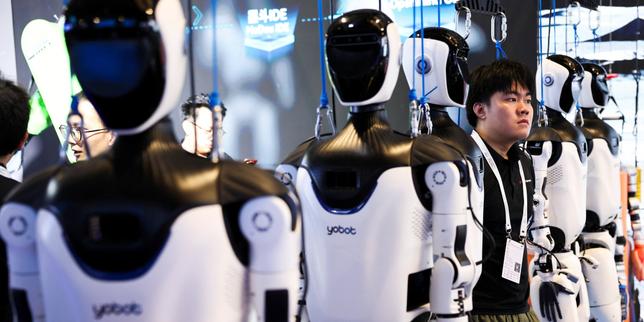
National technology policies increasingly utilize trade restrictions not merely as fiscal instruments, but as strategic containment mechanisms. The reported consideration or implementation of import barriers targeting foreign humanoid robots in the United States represents a structural shift from traditional tariff applications to absolute market segmentation. When sovereign states restrict the inflow of physical automation hardware originating from specific jurisdictions, the intervention alters the supply curve of embodied intelligence. Understanding this friction requires moving past geopolitical rhetoric to map the underlying mechanical, economic, and logistical variables governing international hardware deployment.
The Economic Vector: Capital Expenditure Versus Operational Expenditure in Embodied Automation
The economic viability of an industrial or commercial robot rests on a straightforward equation: the total cost of ownership measured against human labor displacement over a fixed asset lifecycle. Foreign manufacturers, particularly within specific Asian markets, have optimized their supply chains to drive down the bill of materials for robotic actuators, gearboxes, and tactile sensors.
When import restrictions are introduced, they artificially inflate the acquisition cost for domestic buyers. This price shock alters the financial calculations of adopting organizations in three distinct ways:
- Capital depreciation timelines stretch because initial acquisition costs spike due to tariffs, compliance overhead, or rerouted supply chains.
- Domestic integration firms face reduced margin pressures from foreign competition, which disincentivizes rapid cost-reduction engineering.
- End-users delay deployment thresholds, preferring to maintain legacy manual labor or partially automated fixed-base machinery rather than investing in unproven domestic alternatives.
This intervention creates a protected window for domestic robotics developers. However, protectionism without concurrent manufacturing efficiency gains results in capital misallocation. Rather than optimizing production lines, local firms may rely on regulatory moats to sustain higher pricing models, ultimately delaying the maturation of the domestic automation ecosystem.
Supply Chain Vulnerabilities and Component Dependency
Humanoid robotics is not a monolithic industry; it is an assembly of highly specialized sub-systems. No single nation possesses a completely self-contained domestic supply chain capable of producing every critical component at scale without external inputs.
A restriction on finished humanoid robots or major sub-assemblies forces a fragmented sourcing strategy. When an importing nation blocks foreign platforms, the supply chain breaks down across several functional layers:
- Rare earth elements and permanent magnets essential for high-torque brushless motors remain concentrated in specific international nodes.
- Precision harmonic drives and specialized force-feedback sensors often rely on manufacturing tolerances achieved by only a handful of global suppliers.
- Semiconductor fabrication for edge-computing neural processors depends on globally distributed lithography and packaging networks.
Attempting to bypass foreign finished goods by importing raw components for domestic assembly fails if the upstream components face identical geopolitical chokepoints. Consequently, import bans on foreign humanoid hardware often generate perverse outcomes, forcing domestic startups to spend valuable engineering bandwidth reverse-engineering or legally sourcing restricted components through secondary markets, thereby increasing latency in product delivery cycles.
The Software Hardware Disconnect
A critical oversight in broad trade restrictions is the false equivalence between hardware form factors and software capability. Humanoid robots are dual-nature assets: they are physical kinematics platforms and execution hosts for artificial intelligence foundation models.
Foreign actors may be restricted from shipping the physical chassis, but data models, simulation environments, and reinforcement learning pipelines flow across borders via digital networks. If physical imports are blocked, foreign entities can pivot to licensing software architectures to domestic integrators, partnering with local hardware manufacturers, or establishing domestic assembly subsidiaries that comply technically with local origin requirements while maintaining foreign ownership and IP control.
This regulatory loophole renders simple import bans structurally porous. A comprehensive containment strategy cannot target the physical shell while ignoring the velocity of algorithmic transfer. Conversely, if software and data flows are restricted alongside hardware, the domestic research ecosystem risks isolation, cutting itself off from global advancements in simulation-to-real transfer learning and multimodal perception datasets.
Regulatory Compliance as a Non-Tariff Barrier
Beyond outright prohibitions, regulatory frameworks serve as sophisticated filtering mechanisms. Safety certifications, liability frameworks, and cybersecurity mandates function as structural hurdles that disproportionately impact foreign market entrants.
In the context of humanoid robots operating in unstructured human environments, safety standards are non-existent or currently under active draft. When a government institutes rigorous certification processes for foreign-built robotics, the compliance burden manifests as a multi-year delay.
- Certification costs require extensive testing against domestic electrical, mechanical, and functional safety standards.
- Data privacy laws, particularly concerning onboard cameras, LiDAR, and audio sensors, require local data residency compliance that foreign cloud architectures may violate.
- Liability assignment in the event of hardware failure remains legally ambiguous, creating insurance market friction that discourages enterprise adoption of imported units.
These non-tariff barriers achieve the objective of market exclusion without requiring explicit trade bans. They weaponize bureaucratic friction to protect domestic incumbents while preserving plausible deniability regarding direct protectionism.
Strategic Allocation of Capital and Talent
The imposition of import barriers on foreign humanoid systems forces a reallocation of engineering talent and venture capital. When global supply chains are accessible, capital flows toward the most efficient integrator, regardless of geography. When those channels close, capital is diverted toward sub-scale domestic alternatives.
For venture capital funds and institutional investors, this shifts the risk profile of robotics investments. The addressable market is artificially cordoned off, reducing the competitive pressure that drives rapid iteration. Startups funded under an umbrella of regulatory protection often prioritize regulatory compliance and lobbying over functional reliability and cost efficiency.
Concurrently, engineering talent becomes a bottleneck. The intersection of mechanical engineering, real-time control systems, and spatial intelligence requires scarce expertise. Restricting foreign hardware limits the hands-on exposure domestic engineers have to competing architectural designs, narrowing the institutional knowledge base available within the domestic workforce.
Operational Deployment Realities
Enterprises evaluating humanoid robotics for warehouse logistics, manufacturing assembly, or hazardous maintenance operate under strict return-on-investment models. They do not purchase robots based on national origin; they purchase them to solve labor shortages, reduce injury rates, and stabilize unit economics.
When import restrictions remove the most cost-effective or functionally mature foreign options from the consideration set, enterprises face a tactical dilemma. They can either:
- Absorb higher costs by deploying less efficient domestic alternatives, depressing their own operating margins.
- Defer automation initiatives entirely, leaving operational bottlenecks unaddressed.
- Lobby for specific exemptions, creating a bureaucratic marketplace where regulatory favor outweighs engineering excellence.
None of these outcomes accelerate the fundamental readiness of the technology. Instead, they distort the feedback loop between the end-user market and the engineering teams building the platforms. True technological maturation requires exposure to harsh operational environments and relentless cost competition across open markets.
Strategic Vector Implementation
Organizations navigating the shifting landscape of automated hardware restrictions must execute a multi-layered adaptation framework:
- Decouple hardware procurement strategies from single-region dependencies by establishing modular interface standards that allow rapid swapping of sub-assemblies based on regulatory shifts.
- Invest heavily in simulation infrastructure and synthetic data generation to maintain algorithmic velocity independently of physical hardware availability.
- Shift enterprise procurement evaluations from finished-unit acquisition to service-level agreements with domestic integrators who assume the regulatory and compliance liabilities.
- Monitor non-tariff regulatory vectors, such as data residency and functional safety mandates, as the primary indicators of market access limitations rather than focusing solely on customs tariffs.