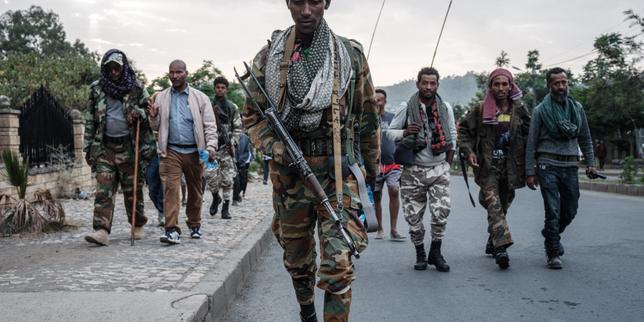
The modern Ethiopian state operates on a structural paradox. It is simultaneously an aspiring geopolitical anchor in the Horn of Africa and a fragile federation bound by competing visions of sovereignty. Understanding the recurrent descent into multi-front internal conflict requires abandoning simplistic regional narratives and analyzing the mechanics of elite competition, ethnic federalism, and the centralizing imperatives of the state.
The Architecture of Ethnic Federalism and Power Transition
To decode the current instability, one must examine the institutional framework established in 1991. The Ethiopian People's Revolutionary Democratic Front (EPRDF), spearheaded by the Tigray People's Liberation Front (TPLF), engineered an ethnic federalist model codified under Article 39 of the 1995 Constitution. This system partitioned the state into ethno-linguistic administrative zones, granting regions formal autonomy and the theoretical right to secession. For an alternative view, consider: this related article.
While designed to manage diversity, the architecture concentrated de facto military and economic hegemony within the TPLF-led coalition for nearly three decades, despite Tigrayans accounting for a minority of the national population. The structural friction that triggered the 2020–2022 civil war, and subsequent instability, originated from a core governance dilemma: how to dismantle a centralized ethnic monopoly without unravelling the constitutional glue holding the federation together.
When Prime Minister Abiy Ahmed assumed power in 2018 through the newly formed Prosperity Party, his administration initiated a counter-hegemonic project. This project sought to replace ethnic fragmentation with pan-Ethiopian civic nationalism. However, this transition threatened the institutional rents and security autonomy of regional elites, particularly in Tigray, setting off a systemic security dilemma. Further coverage regarding this has been provided by Al Jazeera.
The Multi-Polar Belligerent Matrix
The conflict landscape cannot be reduced to a binary struggle between Addis Ababa and regional separatists. It functions as a multi-actor matrix defined by shifting coalitions, overlapping insurgencies, and regional proxy dynamics.
The Federal Government and the ENDF
The primary objective of the federal government and the Ethiopian National Defense Force (ENDF) is the preservation of unitary state authority and the enforcement of constitutional primacy. Armed with technological modernization—including domestic and imported drone capabilities that alter battlefield calculus—the federal strategy relies on preventing regional fragmentation, neutralizing armed resistance, and projecting central authority.
The TPLF and Tigrayan Forces
The political and military apparatus in Tigray operates from an existential survival framework. Following the erosion of the 2022 Pretoria Agreement—which stalled over unfulfilled disarmament terms, disputed territorial boundaries, and the delayed return of displaced populations—the TPLF and its defense forces have cycled back into armed confrontation. Their strategic calculus centers on safeguarding regional autonomy, challenging federal administrative overreach, and re-establishing local hegemony against federally backed interim structures.
Regional Militias and Factional Insurgencies
The conflict vector is further complicated by autonomous actors such as the Fano militias in the Amhara region and the Oromo Liberation Army (OLA). The Fano movement, having fought alongside federal forces during the initial Tigray war, turned against Addis Ababa following federal directives to disband regional special forces in 2023. Their objective is the defense of Amhara regional security interests and the restructuring of federal power arrangements. Meanwhile, factions of the OLA continue an asymmetric insurgency in Oromia, driven by demands for self-determination that have resisted piecemeal peace accords.
Geopolitical Spillovers and External Interference
Internal state weakness in Ethiopia invariably invites regional intervention, transforming domestic friction into a transnational security crisis across the Horn of Africa.
- Eritrean Realignment: The relationship between Asmara and Addis Ababa has undergone radical shifts. Initially united by a shared hostility toward the TPLF during the 2020–2022 war, strategic convergence gave way to profound divergence. The fluctuating posture of Eritrean forces—oscillating between direct intervention, tactical withdrawals under drone pressure, and reported backing of alternative anti-federal factions—demonstrates a zero-sum foreign policy aimed at preventing a consolidated, stable Ethiopian state on its border.
- Nile Basin Hydro-Politics: Downstream pressures, particularly from Egypt, intersect with internal Ethiopian instability. The operationalization of the Grand Ethiopian Renaissance Dam (GERD) remains a core flashpoint. Cairo's strategic objective to counter unilateral Ethiopian control over the Blue Nile creates fertile ground for regional proxy alignments, compounding the domestic security burden on Addis Ababa.
The Structural Trajectory
The underlying mechanics of Ethiopia's crises point to a permanent institutional deficit. Peace agreements and military offensives address symptoms rather than the root cause: an unresolved debate over the distribution of sovereignty between the center and the periphery.
As long as regional administrative boundaries overlap with heavily armed ethnic constituencies possessing historical grievances, kinetic solutions will yield diminishing returns. The long-term stability of the state depends less on tactical military victories and more on constitutional engineering capable of credibly reconciling regional autonomy with central governance without triggering state collapse.


