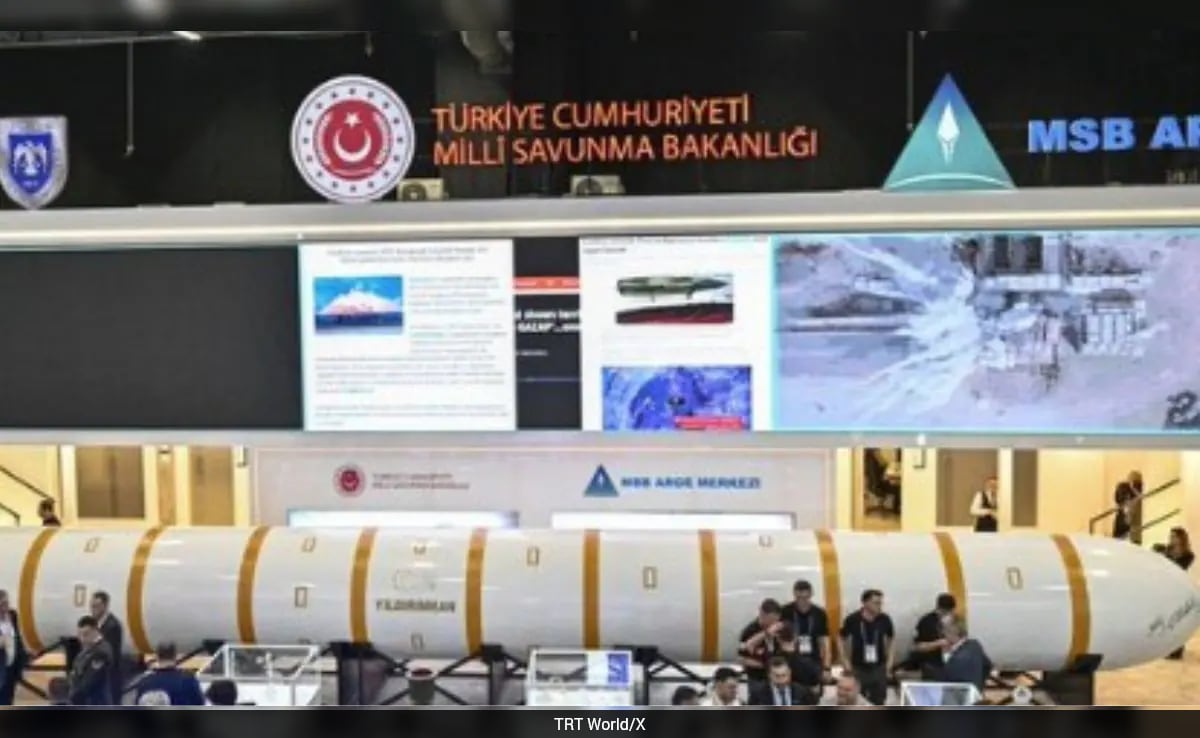
The persistent claims regarding Turkey’s developmental "Yıldırımhan" missile system and its purported ability to strike the United States mainland represent a fundamental misunderstanding of ballistic physics and the economic-industrial requirements of intercontinental reach. To project a payload across 10,000 kilometers, a nation must master the intersection of high-energy chemical propulsion, advanced inertial guidance systems, and extreme thermal shielding for atmospheric reentry. Turkey’s current aerospace trajectory, while expanding rapidly in the tactical and theater-range domains, lacks the specific infrastructure required for an Intercontinental Ballistic Missile (ICBM) capable of trans-Atlantic or trans-polar transit.
The Physics of Intercontinental Range
The technical threshold for an ICBM is defined by the delta-v requirement—the change in velocity necessary to escape the lower atmosphere and enter a suborbital trajectory that terminates on another continent. For a missile based in Anatolia to reach the North American eastern seaboard, it would need to achieve burnout velocities exceeding 7 kilometers per second.
The Propulsion Bottleneck
Intercontinental range is a function of mass-ratio and specific impulse. To date, Turkey’s solid-fuel rocket motor development—embodied in the Bora and Tayfun series—demonstrates proficiency in the 300 to 1,000-kilometer range. Scaling this to 10,000 kilometers is not a linear engineering task; it is an exponential one.
- Stage Separation Dynamics: Achieving ICBM range requires a multi-stage architecture (usually three stages). Each stage must discard dead weight with surgical precision to allow the next motor to accelerate a lighter load.
- Solid vs. Liquid Propellants: While solid fuels are preferred for rapid response, they require sophisticated grain geometry to ensure consistent thrust. High-performance liquid fuels provide higher specific impulse but necessitate a massive industrial footprint for cryogenic storage and handling—infrastructure currently absent from the Turkish defense landscape.
- Structural Mass Fractions: To reach the US, the missile’s airframe must be incredibly light yet capable of withstanding the G-forces of high-acceleration liftoff. This requires advanced carbon-fiber composites and specialized alloys that are often subject to strict international export controls via the Missile Technology Control Regime (MTCR).
Reentry Vehicle Survivability
Even if the Yıldırımhan possessed the requisite thrust to reach the mid-Atlantic, the most significant hurdle remains the Reentry Vehicle (RV). An ICBM payload enters the atmosphere at speeds near Mach 20.
Thermal Protection Systems
The kinetic energy of a descending warhead is converted into heat, reaching temperatures that can exceed 3,000 degrees Celsius. Turkey has made strides in heat-shielding for tactical missiles, but the thermal flux of an intercontinental descent is several orders of magnitude higher. Developing the carbon-carbon composites or ablative shields required to prevent the payload from vaporizing before impact is a multi-decade R&D cycle.
Targeting and Precision at Distance
At a range of 10,000 kilometers, a one-degree error in the inertial measurement unit (IMU) results in a miss distance of dozens of kilometers. Without access to a global satellite navigation constellation that is hardened against electronic warfare (such as a fully sovereign GPS equivalent), a Turkish ICBM would rely on high-end stellar-inertial guidance. While Turkey is expanding its satellite capabilities, it does not yet possess the global tracking and telemetry network required to guide a long-range weapon with the circular error probable (CEP) necessary for military utility.
The Geopolitical Cost Function
The development of a weapon system with the reach to strike the United States would fundamentally alter Turkey’s relationship with NATO and the global financial system. The pursuit of such technology triggers specific geopolitical responses that function as a brake on development.
The NATO Paradox
As a member of NATO, Turkey’s security architecture is integrated with the very power the Yıldırımhan is theorized to threaten. Building an ICBM would necessitate a total withdrawal from the NATO Integrated Air and Missile Defense System (NATINAMDS). The loss of shared radar data, such as the AN/TPY-2 station in Kürecik, would leave Turkey’s own borders more vulnerable to regional threats in exchange for a theoretical long-range capability it cannot yet prove.
Economic Sanction Thresholds
The procurement of dual-use technologies required for ICBMs—specifically high-grade gyroscopes, specialized resins, and high-performance computing—would trigger CAATSA (Countering America's Adversaries Through Sanctions Act) or similar international frameworks. The cost of an ICBM program is not merely the budget of the Turkish Defense Industry Agency (SSB); it is the potential loss of access to Western capital markets and aerospace supply chains.
The Strategic Intent Misalignment
The primary threats to Turkish national security are regional: instability in the Levant, competition in the Eastern Mediterranean, and Kurdish militancy. An ICBM is a tool of global power projection or nuclear deterrence, neither of which aligns with Turkey’s current "Blue Homeland" or "Century of Turkey" doctrines, which focus on regional hegemony and maritime influence.
Tactical Shift Over Strategic Reach
Turkey’s real competitive advantage lies in "Asymmetric Precision." By focusing on UCAVs (Unmanned Combat Aerial Vehicles) and short-to-medium-range ballistic missiles (SRBMs/MRBMs), Turkey exerts massive influence over its immediate neighbors. The Tayfun missile, with a reported range of 560 to 1,000 kilometers, effectively covers the entire Eastern Mediterranean and parts of the Balkans and Middle East. This range is tactically sufficient for every realistic conflict scenario Turkey faces.
The Signaling Mechanism
The rumors surrounding the "Yıldırımhan" likely serve as a signaling mechanism rather than a hardware reality. In international relations, the "perceived capability" can sometimes be as influential as "actual capability." By allowing speculation about long-range systems, Turkey increases its bargaining power within the alliance, suggesting that if its security needs are not met by Western partners, it possesses the sovereign capacity to develop independent, long-reach deterrents.
Structural Constraints of the Turkish Defense Ecosystem
The SSB has overseen an impressive growth in localization, but systemic gaps remain that preclude a sudden leap to ICBM status.
- Engine Sovereignty: While Turkey has developed the TEI-TF6000 and other turbofan/turbojet engines, long-range ballistic flight requires massive rocket motors (boosters) that have not yet been flight-tested at scale.
- Space Launch Capability: A prerequisite for an ICBM is a Space Launch Vehicle (SLV). Turkey’s Space Agency (TUA) has goals for a lunar mission and satellite launches, but the current infrastructure at the İğneada launch site is geared toward suborbital and small-satellite delivery, not the heavy-lift capacity needed for intercontinental payloads.
- Data Link and Encryption: Operating a weapon at global distances requires a robust, high-bandwidth military communications satellite network. Turkey is currently upgrading its Türksat fleet, but the dedicated military-grade secure communication layer required for ICBM command and control is still in the nascent stages of deployment.
Assessing the 'Yıldırımhan' as a Hypothetical System
If a system named Yıldırımhan does exist in a design phase, its most logical configuration would be an Intermediate-Range Ballistic Missile (IRBM) with a reach of 3,000 to 5,500 kilometers. This would place all of Europe, North Africa, and Central Asia within range, effectively making Turkey a preeminent regional power without the suicidal geopolitical friction of an ICBM.
Flight Profile Assumptions
An IRBM configuration allows for:
- Higher payload weight (warhead versatility).
- Simplified reentry physics compared to ICBMs.
- Mobility (road-mobile TEL vehicles), which increases survivability against a first strike.
The leap from 1,000 kilometers (Tayfun) to 5,000 kilometers (potential IRBM) is the current industrial frontier for Turkish engineers. Bypassing this stage to target the US mainland ignores the intermediate steps of flight testing, telemetry validation, and guidance calibration.
Strategic Forecast
The development of Turkish ballistic technology will likely remain focused on the 1,000 to 2,500-kilometer bracket for the next decade. Analysts should watch for three specific indicators that would signal a shift toward genuine long-range capability:
- The successful launch of a multi-stage SLV capable of putting a 500kg payload into Low Earth Orbit (LEO).
- The construction of a dedicated long-range telemetry and tracking station outside of Anatolia (potentially through partnerships in Africa or Central Asia).
- Public testing of an indigenous high-speed reentry vehicle (HSRV) in a "lofted trajectory" test.
Without these milestones, the "Yıldırımhan strike on the US" remains a narrative construct rather than a military reality. The strategic recommendation for regional actors is to focus on Turkey's theater-range precision assets, which represent a tangible shift in the regional balance of power, rather than distant, mathematically improbable intercontinental threats.