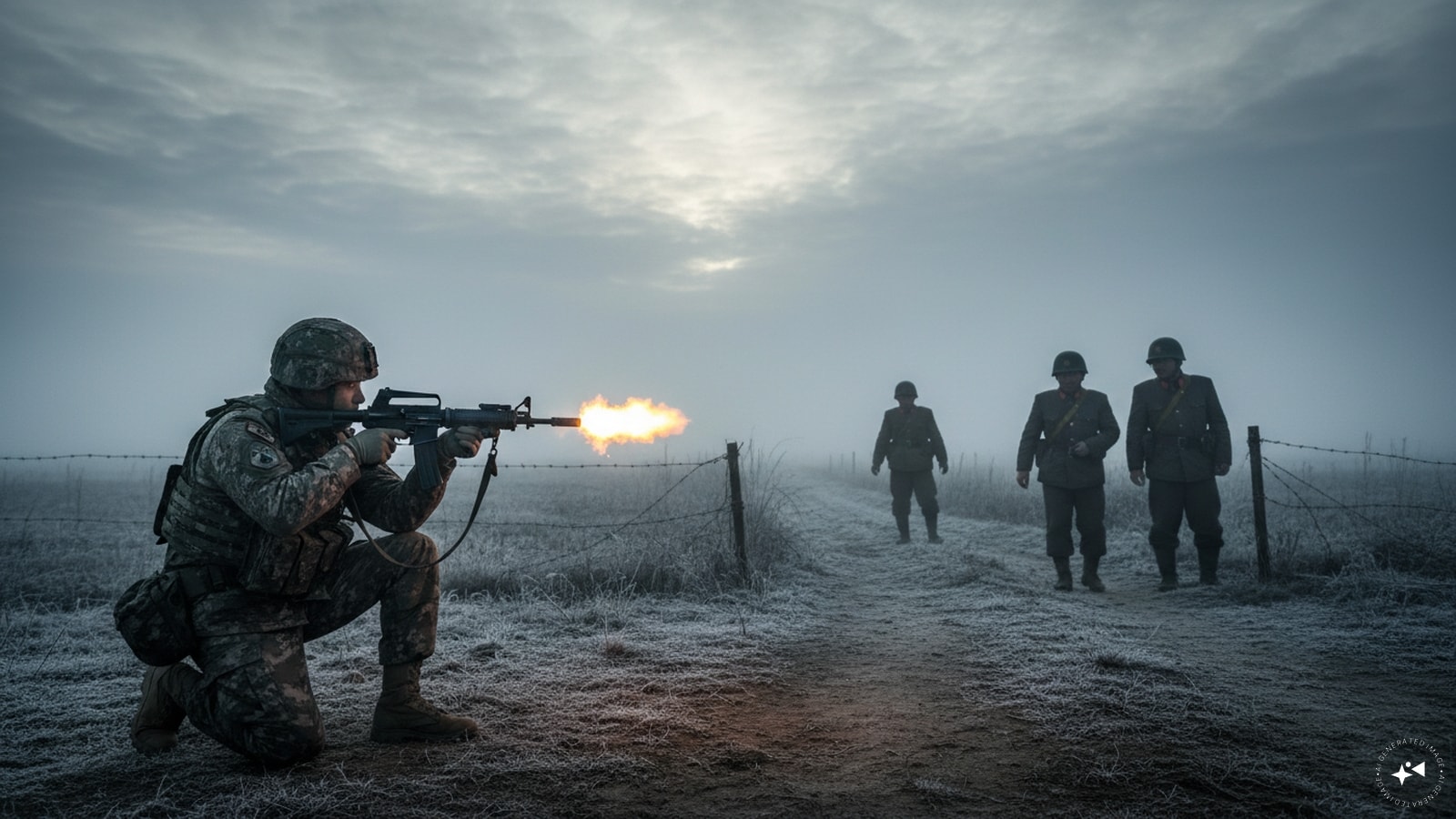
Border incursions along the Military Demarcation Line within the Korean Demilitarized Zone operate under strict tactical thresholds, institutionalized rules of engagement, and calculated signaling models. When North Korean personnel breach this demarcation boundary, triggering South Korean warning shots, the event is rarely a random tactical error. Instead, it functions as a diagnostic test of adversary readiness, a domestic mobilization tool, or a calculated pressure test designed to map the friction points in bilateral deterrence architecture. Understanding these incidents requires stripping away surface-level reporting to examine the structural incentives, friction costs, and kinetic escalation ladders governing the world's most heavily fortified border.
The Operational Anatomy of Demarcation Breaches
A physical crossing of the Military Demarcation Line violates the 1953 Korean Armistice Agreement, which established a two-kilometer-wide buffer zone for both the Democratic People's Republic of Korea and the Republic of Korea. When operational units approach or cross this line, military planners evaluate the incursion through three distinct operational variables: spatial depth, structural intent, and force posture.
Spatial depth measures the exact distance across the demarcation boundary. Shallow breaches of several meters typically occur during routine patrol reorientation, reconnaissance mapping, or deliberate probing operations. Deep breaches, conversely, signal high-risk reconnaissance or intentional crisis provocation.
Structural intent differentiates between accidental navigational drift and tactical probing. Accidental crossings usually involve isolated personnel navigating dense vegetation or obscured terrain markings under poor visibility conditions. Tactical probing involves organized squads moving with supporting cover fire or specialized observation equipment, designed specifically to measure the reaction velocity of opposing guard posts.
Force posture dictates the tactical response. The Republic of Korea Armed Forces operate under a graduated response matrix. Initial detection by thermal observation devices or radar triggers an automated alert to the nearest command post. Standard operating procedure mandates warning broadcasts via loudspeakers, followed by warning shots if the advancing personnel ignore acoustic directives. The kinetic threshold is crossed only when the breaching party exhibits hostile intent, returns fire, or refuses to withdraw after direct kinetic signaling.
The Cost Function of Tactical Provocations
Every border violation generates a quantifiable cost matrix for both state actors. For North Korea, the marginal utility of a border breach must outweigh the opportunity cost of potential kinetic retaliation and international resource depletion. Pyongyang often utilizes low-level border friction to achieve specific internal and external policy objectives without initiating full-scale conventional warfare.
Internal cohesion represents a primary variable in this cost function. Closed autocracies rely on perpetual external threat narratives to justify domestic resource allocation toward the military-industrial complex and suppress internal dissent. A localized border standoff provides state media with immediate framing material to reinforce siege mentality dynamics among the domestic populace.
External bargaining leverage operates as the secondary variable. By increasing friction along the Military Demarcation Line, North Korea imposes transaction costs on the security apparatus of South Korea and its primary ally, the United States. This friction forces allied intelligence agencies to reallocate analytical bandwidth and tactical assets, creating operational fatigue. Furthermore, controlled escalation serves as a signaling mechanism preceding major diplomatic negotiations, intended to establish a position of perceived strength before bilateral or multilateral talks.
The defensive cost for South Korea involves maintaining high-readiness posture across a 248-kilometer land and maritime border without suffering economic or psychological fatigue. Over-responding to minor incursions drains ammunition reserves and strains personnel, while under-responding degrades deterrence credibility. Seoul must therefore calibrate its warning shots and tactical deployments to inflict a precise deterrence penalty on Pyongyang, raising the expected cost of future incursions above any potential strategic gain.
Friction Points in Deterrence Architecture
Deterrence stability along the inter-Korean border relies on predictable signaling and clear channels of communication. When these channels degrade, the probability of horizontal escalation increases exponentially.
The first structural vulnerability is the erosion of confidence-building agreements. Historical pacts, such as the 2018 Comprehensive Military Agreement, previously established maritime buffer zones and no-fly areas designed to prevent accidental clashes. The systematic suspension or abandonment of these agreements removes critical guardrails, transforming minor navigational errors into high-stakes crises.
The second vulnerability involves command and control latency. Modern border surveillance relies on integrated sensor networks, combining seismic sensors, thermal imaging, and AI-assisted optics. While these systems reduce reaction time, they also increase the risk of false positives or premature tactical deployment. When front-line commanders possess delegated authority to fire warning shots without waiting for high-level authorization, the speed of tactical engagement outpaces diplomatic de-escalation mechanisms.
The third vulnerability is misinterpretation of tactical intent. In an environment characterized by deep mutual distrust, a routine maintenance patrol wearing standard field gear can be misinterpreted as an assault echelon. This perception gap stems from the absence of real-time military hotlines or functioning de-confliction frameworks, forcing both sides to rely on worst-case assumption modeling.
Strategic Outlook and Deterrence Calibration
Managing low-intensity border incidents requires shifting from reactive tactical containment to proactive structural stabilization. Military planners in Seoul must maintain a doctrine of proportional asymmetry, ensuring that any physical breach is met with immediate, unmistakable kinetic and electronic signaling that neutralizes tactical gains without crossing the threshold into total war.
Future stability depends on the re-establishment of verifiable communication channels at the tactical division level. Without direct, operational-level hotlines capable of functioning during active crises, the margin for error along the Military Demarcation Line remains dangerously narrow. Deterrence holds only when the cost of transgression is absolute and transparent; restoring that clarity is the primary imperative for operational commanders on both sides of the border.


