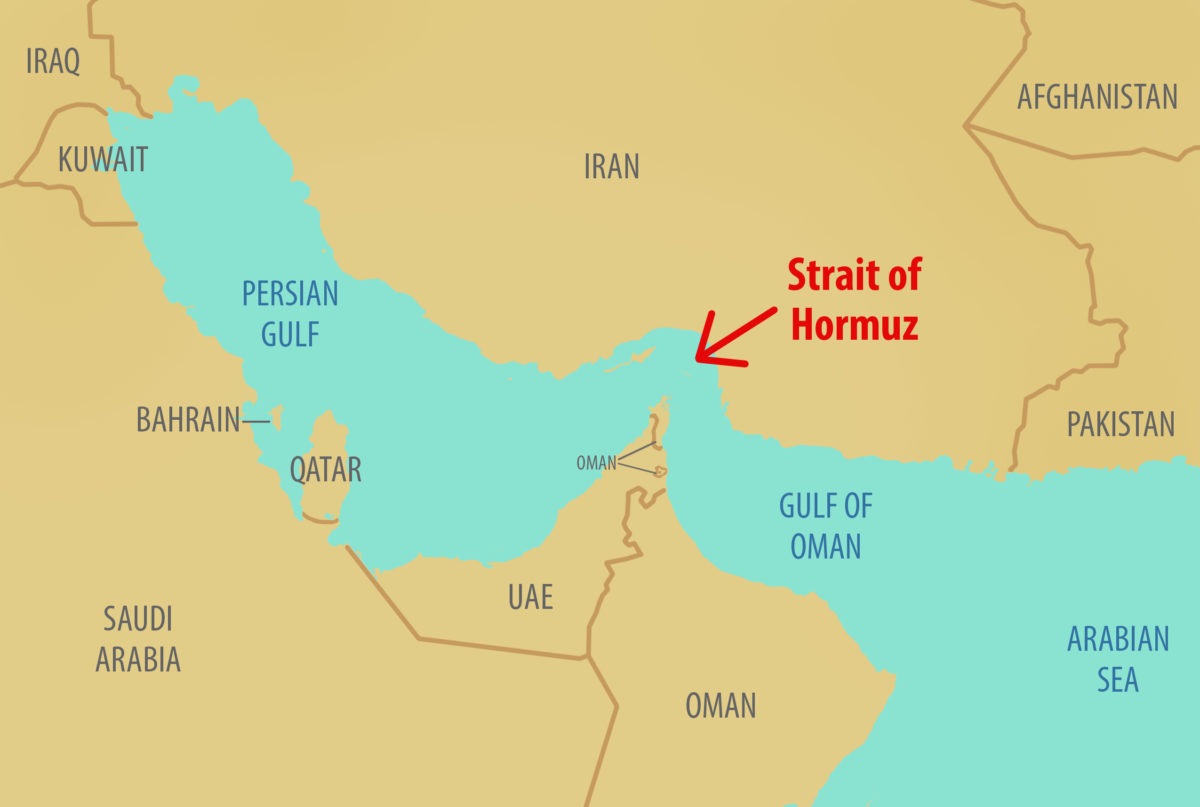
The financial press loves a good campfire story about the Strait of Hormuz. Every time a drone buzzes a tanker or a fast boat weaves through the Persian Gulf, the headlines scream about a global energy apocalypse. They treat the Strait like a fragile glass artery that, if snapped, would send the world back to the Stone Age.
The "lazy consensus" dictates that Iran holds the world’s throat. Traditional analysts point to the 20 million barrels of oil flowing through that 21-mile-wide gap and tell you that a "case-by-case" passage policy from Tehran is a death knell for the global economy.
They are wrong. They are looking at a 1970s map in a 2026 world.
The Strait of Hormuz isn't a chokepoint anymore. It’s a theater. And if you’re trading oil based on the threat of a "total shutdown," you aren't an investor; you’re an audience member paying for a ticket to a show that already ended.
The Myth of the Irreplaceable Artery
The core of the "Hormuz panic" rests on the idea that oil has nowhere else to go. This ignores the massive, expensive, and largely successful infrastructure pivot of the last decade.
Saudi Arabia’s East-West Pipeline (the Petroline) can move roughly 5 million barrels per day (mb/d) across the peninsula to the Red Sea, bypassing the Strait entirely. The United Arab Emirates spent billions on the Habshan–Fujairah pipeline, which dumps 1.5 mb/d directly into the Gulf of Oman. When you add in the capacity of the Iraq-Turkey pipelines and the increasing domestic refining capabilities within the Gulf, the "absolute" leverage Iran supposedly holds starts to look like a subtraction problem that Tehran loses.
In a total blockade scenario—which, let’s be clear, has never actually happened—the world doesn't lose 20 million barrels. It loses the convenience of 20 million barrels. The delta is roughly 12 to 13 million barrels of actual "trapped" crude. That is a hit, but it isn't the end of civilization.
Furthermore, the United States, once the victim of Gulf volatility, is now the world’s largest producer of crude. The math has shifted. The pain of a Hormuz disruption no longer centers on a gas line in Ohio; it centers on a refinery in Ningbo.
Why Iran Will Never Actually Close the Strait
The biggest flaw in the "case-by-case passage" alarmism is the assumption that Iran can afford to follow through.
Iran’s economy is a complex, struggling beast that breathes through the very water it threatens to muddy. A total closure of the Strait of Hormuz is not a tactical strike; it is an act of economic suicide.
- The China Factor: China is the primary buyer of Iranian "ghost" barrels. If Tehran shuts the Strait, they aren't just blocking the Americans or the Saudis; they are blocking their only meaningful patron. Beijing does not tolerate disruptions to its energy security. The moment Iran halts the flow of global energy, it loses its last diplomatic and economic shield.
- The "Case-by-Case" Bluff: The current rhetoric about vetting ships is a low-cost way to extract geopolitical concessions without actually firing a shot. It is the maritime equivalent of "slow-walking" an invoice. By creating friction, they drive up insurance premiums and freight rates, which acts as a shadow tax on their rivals.
- The Physical Impossibility: Actually closing the Strait requires more than a few speedboats. It requires a sustained naval presence against the combined weight of the U.S. Fifth Fleet and an increasingly motivated coalition of regional powers. Iran can harass. They can delay. They cannot close.
The Real Threat Is Not Oil Supply—It’s Insurance Math
If you want to be worried, stop looking at the barrels and start looking at the underwriters in London.
The "Hormuz Risk" is a financial construct. When Iran makes noise about case-by-case passage, the physical supply of oil rarely drops. Instead, the "War Risk" surcharges on shipping insurance skyrocket. I have seen traders lose millions not because a tanker was hit, but because the cost to move that tanker tripled overnight.
This is where the competitor's "case-by-case" narrative falls flat. They treat it as a supply chain issue. It’s actually a cost-of-capital issue. The "shocks" we see in crude prices during these tensions are 10% geopolitical reality and 90% algorithmic panic from funds that don't understand the difference between a skirmish and a blockade.
The Hydrogen and Renewable Buffer
We are also ignoring the "Electron Shield." In 2026, the global energy mix is more resilient than it was even five years ago.
The rapid electrification of transport in Europe and China has created a structural ceiling for how much damage a Gulf disruption can do. For every percentage point that EVs take from the global fleet, the "Hormuz Hammer" loses a few pounds of weight.
Additionally, the emergence of the "Middle Corridor" and increased rail connectivity across Eurasia means that land-based logistics are finally starting to compete with the slow, vulnerable crawl of VLCCs (Very Large Crude Carriers).
People Also Ask: "Will oil hit $200 if the Strait closes?"
This is the wrong question. The real question is: "How long can oil stay above $100 before global demand undergoes a permanent, structural collapse?"
If the Strait were truly blocked, the price spike would be violent but brief. Why? Because $150 oil in 2026 triggers an immediate, aggressive pivot to alternative energy sources and localized production that would never be reversed. High prices are the best cure for high prices. The Gulf nations know this. Iran knows this. They want the price at $85, not $185. At $185, their product becomes obsolete within a decade.
The Professional’s Reality Check
I’ve sat in rooms where "maritime security experts" get paid five-figure sums to draw red lines on maps. Most of them are selling fear because fear has a higher margin than nuance.
The nuance is this: Iran’s "case-by-case" policy is an admission of weakness, not a show of strength. It is a sign that they know they cannot win a total confrontation, so they are settling for being a nuisance.
If you are an investor, you should be fading the Hormuz noise. The "Hormuz Premium" is a tax on the uninformed. When the headlines get loudest, that’s usually the time the smart money is betting on the status quo.
The Strait of Hormuz is a ghost story told to keep energy markets jumping. But if you look at the actual plumbing of the global energy market—the bypass pipelines, the U.S. shale production, the Chinese EV adoption, and the sheer necessity of Iranian exports—the ghost has no teeth.
Stop watching the speedboats. Watch the pipelines. The world has already moved on, even if the headlines haven't.