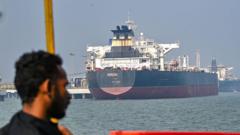
The security of India’s energy and trade corridors depends on a fragile equilibrium within the Strait of Hormuz, a maritime chokepoint handling approximately 30% of total global sea-borne oil trade. For New Delhi, the current diplomatic engagement with Tehran represents more than a bilateral courtesy; it is a critical mitigation strategy against a systemic risk. If the Strait is restricted or closed, the cost of landed energy in India rises non-linearly due to skyrocketing insurance premiums, freight surcharges, and the physical scarcity of crude. The Indian government’s objective is to secure a "freedom of navigation" guarantee that decouples its merchant fleet from the broader geopolitical friction between Iran and the West.
The Triad of Maritime Vulnerability
India’s exposure to the Persian Gulf can be quantified through three distinct vectors: energy dependency, trade volume, and the "War Risk" premium. Also making news in this space: The Jurisdictional Boundary of Corporate Speech ExxonMobil v Environmentalists and the Mechanics of SLAPP Defense.
- The Energy Import Dependency: Over 60% of India’s crude oil imports originate from the Middle East. Any disruption in the Strait of Hormuz forces a reliance on the Strategic Petroleum Reserve (SPR), which, while substantial, is designed for short-term shocks rather than prolonged maritime interdiction.
- The Logistics Bottleneck: The Strait measures only 21 nautical miles wide at its narrowest point. This physical constraint means that even minor naval posturing can lead to significant delays in Vessel Turnaround Time (VTT).
- Insurance and P&I Club Dynamics: When a region is declared a "listed area" by the Joint War Committee (JWC), shipowners face massive "Additional Premiums" (AP). For Indian refiners operating on thin margins, these costs are often passed directly to the consumer, triggering inflationary pressure across the domestic economy.
The Mechanism of De-escalation: India’s Diplomatic Lever
India occupies a unique position as one of the few global powers maintaining functional, high-level communication with both the United States and Iran. This "Strategic Autonomy" allows New Delhi to act as a stabilizing interlocutor. The specific logic of the current talks centers on the Commercial Neutrality Framework.
Under this framework, India seeks to establish that its vessels—many of which carry cargo essential for regional food security or are destined for non-aligned markets—should be granted safe passage regardless of the intensity of regional sanctions or kinetic conflicts. This is not a request for a favor; it is a negotiation based on reciprocal economic interests. Iran requires the Indian market for its non-sanctioned exports and views India as a primary gateway to the International North-South Transport Corridor (INSTC). Further details regarding the matter are covered by CNBC.
The INSTC as a Structural Hedge
The International North-South Transport Corridor is the primary structural response to Hormuz-dependency. By connecting Mumbai to Bandar Abbas and onward to Russia and Europe, India attempts to bypass the traditional maritime routes that are subject to Western naval dominance or regional volatility.
- Geographic Diversification: The INSTC reduces the transit time by 40% compared to the Suez Canal route, but its viability depends entirely on the stability of Iranian infrastructure.
- Chabahar Port Integration: India’s investment in the Shahid Beheshti terminal at Chabahar is a calculated move to create a maritime exit point that sits outside the Strait of Hormuz. This allows for the offloading of goods before they enter the high-risk zone of the Persian Gulf.
Quantifying the Cost of Friction
The economic impact of tension in the Hormuz route is often misunderstood as a simple supply-demand problem. In reality, it is a complex interaction of finance and law. When the Iranian Revolutionary Guard Corps (IRGC) conducts "inspections" or seizures, the primary damage is felt in the Legal Risk Profile of the route.
The "Cost of Friction" formula for an Indian Suezmax tanker can be expressed as the sum of:
$C_f = (P_w \cdot V_s) + (D_r \cdot C_o) + I_s$
Where:
- $P_w$ is the War Risk Premium percentage.
- $V_s$ is the total value of the ship and cargo.
- $D_r$ is the duration of the delay in days.
- $C_o$ is the daily operating cost of the vessel.
- $I_s$ is the secondary impact on refinery scheduling and inventory holding costs.
Even without a single shot being fired, the mere threat of interdiction increases $C_f$ to a level that can render specific trade contracts unviable. India’s diplomatic mission is designed to reduce $P_w$ by providing the global maritime community with the confidence that Indian vessels are "protected" through a diplomatic understanding.
The Resilience Strategy for Indian Refiners
Major Indian entities like Indian Oil Corporation (IOCL), Bharat Petroleum (BPCL), and Reliance Industries (RIL) have begun to internalize the risk of a Hormuz-linked supply chain disruption. Their strategy focuses on three pillars of resilience:
- Strategic Sourcing from the Atlantic Basin: Increasing imports from Brazil, Mexico, and the United States. This is a deliberate shift from the Persian Gulf, even if the crude grades are not always an identical match for Indian refinery configurations.
- Term Contract Flexibility: Shifting from Fixed-Term contracts to Spot Market purchases when the Persian Gulf risk is high, allowing for a pivot to alternate sources on short notice.
- Insurance Sovereignty: Exploring the creation of a domestic "Protection and Indemnity" (P&I) club that can provide sovereign-backed insurance for Indian vessels when global insurers withdraw or raise premiums to prohibitive levels.
The Geopolitical Constraint of the Quad
India’s membership in the Quadrilateral Security Dialogue (Quad) with the U.S., Japan, and Australia complicates its "Iran pivot." While the Quad focuses on the Indo-Pacific, its broader strategic stance is often in opposition to Iranian regional influence.
The Indian Ministry of External Affairs must maintain a "Dual-Track Diplomacy" where its alignment with the U.S. on Indo-Pacific security does not compromise its operational relationship with Tehran. This is not a contradiction; it is a recognition of regional realities. The U.S. views the Strait of Hormuz as a global security concern, while India views it as a domestic economic lifeline.
The Structural Inevitability of Diversification
Regardless of the success of current talks, the long-term trend for India must be a "de-risking" of the Hormuz route. This is being driven by:
- The Transition to Renewables: Reducing the overall import of crude oil over the next two decades.
- Pipeline Infrastructure: The theoretical (though currently stalled) Turkmenistan-Afghanistan-Pakistan-India (TAPI) pipeline, which would offer a land-based alternative to maritime energy transit.
- Strategic Storage Expansion: The construction of Phase II of the Indian Strategic Petroleum Reserve, which will add roughly 6.5 million metric tons of storage, significantly extending the "autonomy period" in the event of a total blockade.
The current diplomatic engagement with Iran is a tactical necessity, but it is not a permanent solution. The ultimate strategic objective is the creation of a maritime and energy architecture where the closure of any single chokepoint—be it Hormuz, Malacca, or Suez—cannot paralyze the Indian economy.
The most effective strategic play for New Delhi is the acceleration of the Chabahar-INSTC axis as a viable commercial alternative, combined with a persistent "commercial neutrality" status for its merchant fleet. This requires a shift from passive observation to active maritime security participation, potentially involving Indian Navy escorts for critical energy shipments if diplomatic assurances fail to stabilize the insurance markets.
The success of this strategy will be measured not by the absence of tension in the Gulf, but by the stability of the "Landed Cost of Crude" (LCC) in Mumbai. If India can decouple its LCC from the volatility of the Strait of Hormuz, it will have achieved a level of energy security that has eluded it for decades.