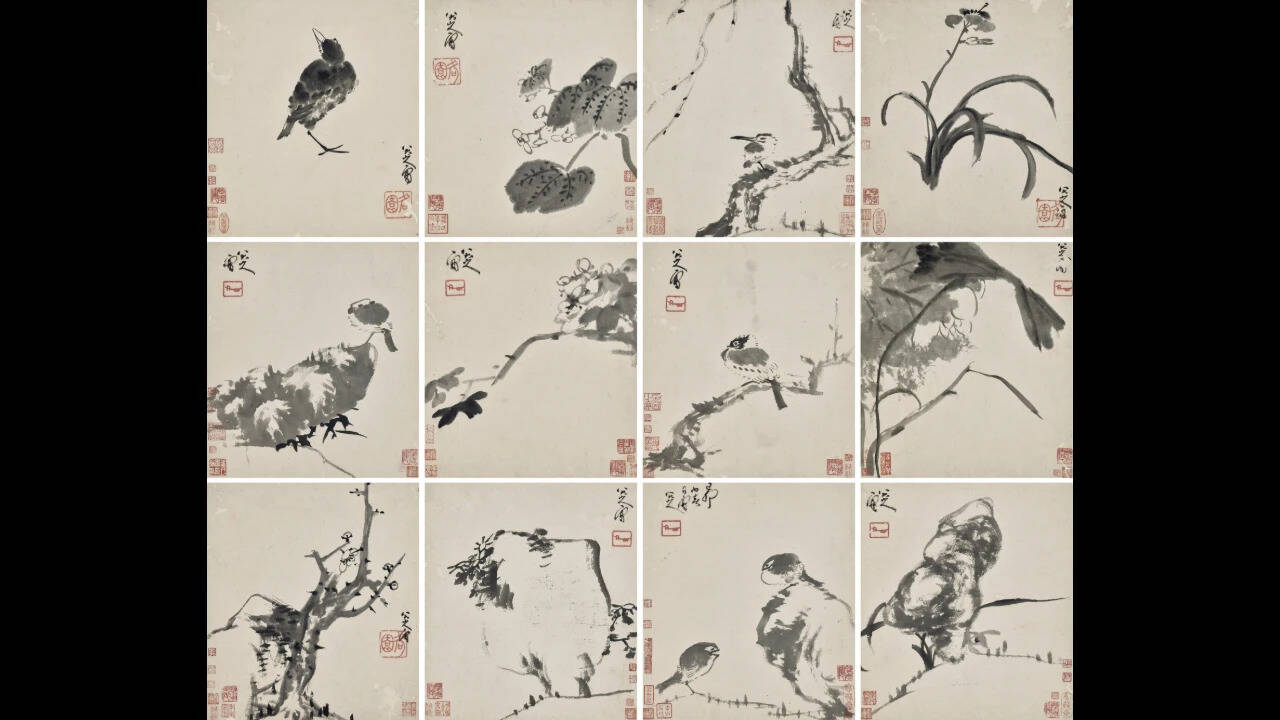
Everyone loves a fairy tale. A deposed Ming dynasty prince escapes execution, shaves his head, hides in a Buddhist monastery, paints twelve delicate leaves of birds and flowers, and three hundred years later, some billionaire drops Rs 75 crore on them.
It makes for great clickbait. It also completely obscures how the multi-billion-dollar Asian art market actually functions.
When mainstream outlets report on Zhu Da—known to history and high-net-worth collectors as Bada Shanren—selling a twelve-leaf album for roughly $9 million USD at auction, they treat it like a lottery ticket for dead geniuses. They focus on the romantic tragedy of the Ming collapse in 1644. They wax poetic about his eccentricities, his feigned madness, and his minimalist ink washes.
They miss the point entirely. You do not pay Rs 75 crore for a nice picture of a bird. You pay Rs 75 crore for an unassailable financial instrument disguised as traditional ink painting.
The Lie of Pure Aesthetic Value
Let us strip away the art history textbook nostalgia. If you walk into a major auction house in Hong Kong, Beijing, or New York thinking prices are driven by beauty, you will get eaten alive.
I have watched private buyers burn millions chasing "pretty" classical Chinese paintings with muddy histories, only to watch those same works fail to clear their reserve prices five years later. Meanwhile, a seemingly simple, twelve-page album by Bada Shanren commands generational wealth. Why?
Provenance is the actual asset. The ink on paper is merely the physical certificate of that provenance.
In the upper echelons of classical Chinese art, forgery is not an anomaly; it is a parallel industry that has existed for centuries. Master forgers like Zhang Daqian spent decades creating fake Bada Shanren and Shitao works so convincing they fooled major museum curators. Because the market is flooded with high-level fakes, genuine works with airtight, documented histories become hyper-scarce monopolies.
When a twelve-leaf album hits the block and fetches Rs 75 crore, the buyer is paying for the seals stamped in the margins by famous Qing dynasty collectors, the colophons written by renowned scholars, and the uninterrupted chain of custody documented in centuries-old catalogues. The competitor articles gushing over his "spiritual detachment" ignore the ruthless institutional verification that actually underpins that price tag.
Why the Monk Narrative is a Distraction
Mainstream coverage always leans heavily on Bada Shanren’s biography: the tragic royal descendant who retreated into Chan Buddhism to survive the Manchu conquest. It is a compelling story, sure. But framing his market dominance around his biography gets the causality backward.
Plenty of Ming loyalists became monks. Hundreds of them painted bamboo, rocks, and birds in protest of the Qing dynasty. Most of their works sell for a fraction of a percent of Bada Shanren’s prices, if they sell at all.
Bada Shanren is an anomaly because he fundamentally broke the visual grammar of Chinese literati painting, and later titans of modern art recognized it. Look at his compositions. They are radically asymmetrical. A tiny bird with a square, glaring eye sits perched on a rock that looks like it is defying gravity, surrounded by vast, suffocating emptiness.
- Traditional Literati Art: Dense, balanced, celebratory of nature's harmony, meant to soothe the Confucian scholar-official.
- Bada Shanren’s Execution: Unstable, psychological, aggressive, stripped of decorative fluff.
Centuries later, modern masters like Qi Baishi and Pan Tianshou explicitly credited Bada Shanren as the foundation of their own styles. When a modern collector buys Bada Shanren, they are not buying a relic of the 17th century. They are buying the apex predator of the entire modern Chinese art canon. You cannot understand 20th-century Asian modernism without owning a piece of the guy who invented its minimalist vocabulary.
The Economics of the Twelve-Leaf Album
Notice the format of the Rs 75 crore sale: an album of twelve leaves.
In Western art, value concentrates in massive, singular canvases. You buy one giant Rothko or one massive Basquiat. In classical Chinese art, the album format is an entirely different beast of liquidity and prestige.
A twelve-leaf album is essentially a curated, private exhibition bound into a single object. Unlike a hanging scroll, which is exposed to light, humidity, and air pollution whenever it is displayed, an album stays closed in a temperature-controlled vault, preserving the razor-sharp contrast of the ink on raw xuan paper or silk.
From a pure capital allocation standpoint, an album offers unmatched optionality:
- Divisibility of Prestige: Each leaf is a complete, standalone composition. While breaking up an intact historical album is considered a cardinal sin among serious collectors, the sheer density of twelve distinct masterpieces in one lot justifies institutional-level bidding.
- Preservation Arbitrage: Because albums spend 99% of their existence shut tight, their physical condition often embarrasses hanging scrolls from the same era. Better condition equals exponential price multipliers at auction.
- Cross-Cultural Liquidity: Traditional Chinese handscrolls require deep cultural literacy to read from right to left, unrolling section by section. A square album leaf of a bird or a lotus flower translates instantly to a Western contemporary collector's eye. It looks like minimalist abstraction. That cross-border appeal widens the bidding pool from regional Chinese tycoons to global mega-collectors.
Dismantling the Common Myths About Classical Art Investing
When headlines scream about Rs 75 crore paintings, retail investors and newly minted tech millionaires immediately ask the wrong questions. They want to know how to spot the next undervalued master or how to get into the classical market. Let us address the flawed premises behind those questions right now.
Is classical Chinese art a reliable hedge against inflation?
No, and anyone telling you otherwise is trying to sell you a lot from an upcoming auction. Fine art is wildly illiquid, carries absurd transaction costs—often 20% to 25% in buyer's premiums alone—and suffers from extreme cyclicality. When liquidity tightens in Hong Kong or mainland China, mid-tier classical paintings lose 40% of their value overnight. Only the absolute top 0.1% of trophy assets, like a museum-grade Bada Shanren album, hold their value during downturns because billionaires treat them like sovereign currency.
Why didn't a museum buy it instead of a private collector?
Public museums are structurally priced out of the top tier of the Asian art market. Acquisition budgets at major institutions—even heavyweights like the Metropolitan Museum of Art or the Palace Museum—cannot compete with the balance sheets of private industrialists and sovereign-backed corporate collections. Museums rely on tax-deductible donations from the very billionaires who win these auctions. The private buyer wins the gavel, holds the trophy for a decade to cement their social capital, and eventually donates it for a massive tax write-off and a wing named after their family.
Can you authenticate these works using modern scientific testing?
Scientific testing is practically useless here, and relying on it is a rookie mistake. Carbon dating can tell you the paper is from the 17th century, and pigment analysis can confirm the ink is period-appropriate. Neither can tell you if the painting was done by Bada Shanren or by his talented studio assistant using the exact same paper and ink three weeks later. Authentication at the Rs 75 crore level relies entirely on connoisseurship—comparing brushstrokes at a microscopic level—and unbroken historical documentation.
The Contrarian Reality: The Risks Nobody Mentions
Before you start idolizing the Rs 75 crore price tag as proof of an infallible market, look at the structural rot beneath the surface.
The classical Chinese art market has a massive generational cliff problem. The mega-collectors driving these nine-figure and ten-figure rupee valuations grew up steeped in classical calligraphy, poetry, and literati history. They understand the hidden political puns in Bada Shanren’s poetry. They can read the cursive script in the colophons without a dictionary.
The next generation of Asian wealth—the crypto founders, AI executives, and second-generation heirs—increasingly lacks that classical literacy. Many of them would rather drop $10 million on a contemporary digital piece, a rare watch, or a blue-chip Western contemporary artist than spend decades studying Ming dynasty brushwork.
Furthermore, the regulatory friction around moving cultural relics across borders is tightening every year. Exporting a 17th-century masterpiece out of mainland China is virtually impossible, creating a bifurcated market where a painting is worth one price in Beijing and a completely different price in New York or Geneva. You are not just buying an asset; you are buying geopolitical exposure.
How to Actually Read the Market
If you want to understand why a twelve-leaf album sells for Rs 75 crore without getting distracted by romantic fluff about Buddhist monks, stop reading lifestyle articles and start reading auction catalogues like a distressed-debt investor.
Look past the painting itself and audit the margins. Count the collector seals. Trace the ownership history backward from the current consignor. Check if the piece was published in authoritative 20th-century compendiums before the modern forgery boom exploded.
When Bada Shanren painted those birds and flowers over three hundred years ago, he was stripping away every unnecessary brushstroke to leave only raw, undeniable truth on the paper. Do the exact same thing when you look at the price tag. Strip away the fairy tale about the tragic prince, ignore the poetic fluff, and look at the cold, hard mechanics of scarcity, provenance, and power.
The art is priceless; the paper it is painted on is just a high-stakes ledger for the ultra-rich.


