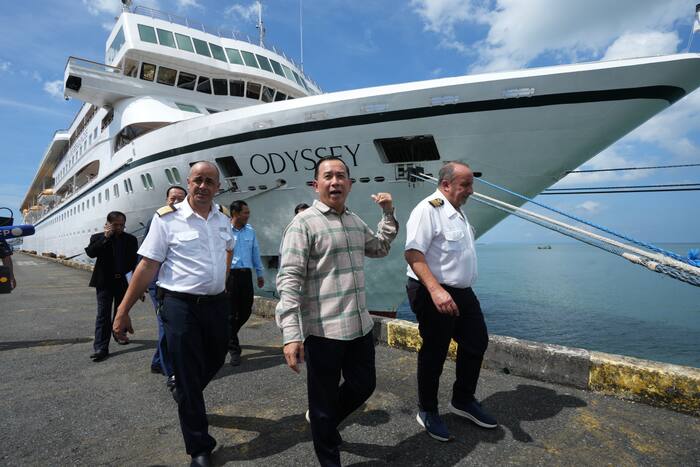
The travel press loves a victim. Give an editor a photo of a retired couple sitting on luggage at an airport terminal in Phnom Penh, and they will write three thousand words painting the cruise line as a mustache-twirling villain.
They got it completely backward.
When the Villa Vie Odyssey finally limped out of Belfast after four months of dry-dock delays, only to leave a handful of passengers behind in Cambodia a few weeks later, the mainstream coverage followed a predictable, lazy script. They framed it as a logistical failure, a broken promise, and a cautionary tale about corporate incompetence.
That narrative misses the actual story by a nautical mile.
The passengers left standing on the tarmac in Southeast Asia aren't victims of an unpredictable maritime accident. They are casualties of a fundamental misunderstanding of what they actually bought. They thought they were buying a luxury vacation. They actually bought fractional real estate on a thirty-year-old floating construction site, and they signed away their consumer protections to do it.
If you want to understand why this happened—and why it is going to keep happening across the residential cruise sector—you have to stop looking at the itinerary and start looking at the maritime law, the unit economics of aging tonnage, and the psychological blind spots of the people buying three-year world cruises.
The Illusion of the Residential Cruise
Let’s get our terminology straight. Standard cruising is hospitality. Residential cruising is asset management disguised as hospitality.
When you book a seven-day Caribbean itinerary with Royal Caribbean or Carnival, you are entering a heavily regulated, hyper-standardized consumer transaction. You are protected by strict Passenger Vessel Services Act rules, standardized CLIA (Cruise Lines International Association) passenger bills of rights, and companies with multi-billion-dollar balance sheets that can absorb the cost of a missed port by throwing onboard credit at the problem until the complaints stop.
Residential cruising—the model pioneered by The World and aggressively democratized by startups like Villa Vie Residences and the defunct Life at Sea Cruises—operates on a completely different financial architecture.
I’ve spent fifteen years watching maritime startups burn through investor capital trying to make this math work. Here is the dirty secret nobody puts in the glossy brochure: new-build residential ships are virtually impossible to finance.
A new mid-sized cruise ship costs north of $500 million. Banks will not underwrite a $500 million loan based on pre-sales of cabins to retirees who might die, default, or demand refunds before the keel is even laid. Therefore, residential cruise startups have only one viable path to market. They have to buy distressed, aging tonnage on the secondary market, slap a fresh coat of paint on the hull, and use customer deposits to fund the dry-dock retrofits required to keep the vessel legally seaworthy.
The Villa Vie Odyssey is the former Braemar, built in 1993. In maritime years, a thirty-one-year-old hull is a geriatric patient requiring constant, invasive surgery.
When passengers paid upwards of $100,000 to $300,000 for "endless horizons," they weren't buying a guaranteed schedule. They were acting as unsecured venture capitalists funding the mechanical resurrection of a 1990s cruise ship. The four-month delay in Belfast wasn't a freak occurrence; it was the inevitable result of tearing open a three-decade-old engine room and discovering that the steel, wiring, and rudder stocks needed far more work than the initial survey suggested.
Why Passengers Actually Got Left in Cambodia
Now, let's address the specific incident that drove the outrage cycle: the passengers left behind in Cambodia.
The mainstream narrative implies the ship callously abandoned paying customers on a whim. Reality is much colder and far more procedural.
In commercial shipping, schedules are dictated by port slot allocations, pilotage windows, tidal charts, and fuel burn calculations—not by the convenience of passengers who mistook a commercial vessel for a private yacht. When a ship is already running months behind its original master schedule, every single hour at the dock bleeds tens of thousands of dollars in port fees, bunker fuel, and cascading itinerary disruptions.
When the Odyssey docked in Sihanoukville, Cambodia, it was operating under tight operational constraints. Passengers who chose to travel overland to Phnom Penh or Siem Reap—often hours away from the port via notoriously unpredictable road infrastructure—were taking a calculated risk.
Here is the unvarnished truth about maritime contracts of carriage: the ship does not wait.
Whether you are on a $499 weekend booze cruise to Ensenada or a $250,000 three-year circumnavigation, the maritime contract is absolute. If you are not on the gangway at all-aboard time, the captain is legally and financially obligated to drop the lines and sail. The only exception is if you booked an excursion directly through the cruise line's own shore-excursion desk, in which case the operator assumes the liability of holding the vessel.
The passengers stranded in Cambodia weren't abandoned because the cruise line is evil. They were left behind because they treated a strict maritime schedule like a flexible hotel check-in, and the cruise line—already hemorrhaging cash from the Belfast delays—could not afford to burn another $50,000 waiting for independent travelers to clear Cambodian traffic.
Furthermore, let’s talk about the elephant in the terminal: visa and immigration compliance.
In Southeast Asia, maritime immigration protocols are notoriously rigid. Unlike Schengen Zone ports in Europe, where clearing customs is largely a formality, ports in Cambodia, Vietnam, and Thailand require exact manifest reconciliation before a vessel can receive port clearance to depart. If a passenger’s passport is held by port authorities for an overland excursion, or if a passenger misses the cutoff for outbound immigration stamping, the port authority will literally lock the ship's clearance until that passenger is officially disembarked from the manifest.
Once you are struck from the manifest so the ship can legally leave port, you cannot simply take a taxi to the next pier and walk back up the gangway. You have to re-enter the country's immigration system, secure new entry clearances, and meet the vessel at an approved international port of entry—all at your own expense.
Dismantling the "People Also Ask" Myths
Whenever a story like this hits the news cycle, prospective travelers flood search engines with the exact same anxious questions. Every single one of those questions is built on a flawed premise.
"How do I get a refund if my world cruise is delayed?"
You don't. Stop asking how to get a refund and start asking how to audit an escrow account before you wire six figures. In traditional cruising, your money sits in a merchant account protected by credit card chargeback rules and maritime bonding requirements (like the FMC bond in the United States). In residential cruising, your purchase is structured as a long-term lease, a club membership, or a fractional ownership agreement. Your capital is immediately deployed to pay shipyard bills, buy fuel, and service debt. By the time a delay happens, the cash is already welded into the hull of the ship. Trying to get a refund from a residential cruise startup is like trying to get a refund from a homebuilder after they've already poured the concrete foundation.
"Are residential cruises safe and reliable?"
Define "safe" and define "reliable." Mechanically, yes—classification societies like DNV or Lloyd’s Register will not allow a vessel to leave port unless its safety systems, lifeboats, and hull integrity meet strict SOLAS (Safety of Life at Sea) standards. That is literally why the Odyssey sat in Belfast for four months; the regulators refused to sign off until the mechanical issues were fixed. Reliability, however, is non-existent. If you define reliability as arriving in Tokyo on a specific Tuesday in November, residential cruising is a terrible product. If you define it as eventually seeing the world over a multi-year timeline without caring which month you arrive in a given port, it works fine.
"What happens if a cruise ship leaves you behind in a foreign country?"
You become an undocumented or improperly documented tourist in a foreign jurisdiction, and the cruise line's legal obligation to you instantly evaporates. You are responsible for flights, hotels, food, visa penalties, and catch-up logistics. Your standard travel insurance policy—the kind you buy for a two-week European vacation—will almost certainly deny the claim if you missed the ship while traveling independently.
The Structural Flaw Nobody Wants to Admit
To be entirely fair to the critics, the residential cruise industry has a massive transparency problem, and my own defense of maritime contract law has a glaring blind spot: marketing deception.
Cruise startups sell the dream of effortless, Turnkey global living to a demographic—predominantly retirees aged 60 to 80—that has spent its entire life relying on standard consumer protections. When you show a 72-year-old retired schoolteacher a rendering of a pristine infinity pool overlooking the Norwegian fjords, you are priming them to expect Ritz-Carlton service levels.
You are not preparing them for the reality of commercial shipping.
Imagine a scenario where an airline sold you a three-year unlimited flight pass, forgot to mention that the planes were built in 1993, delayed your first flight by four months for engine replacements, and then left you stranded in Bangkok because you stood in the wrong customs line. You would rightfully demand the Department of Transportation shut them down.
Yet in maritime law, thanks to centuries-old admiralty statutes and flags of convenience (the Odyssey is flagged in the Bahamas, putting it under Bahamian maritime jurisdiction, not American or British consumer law), operators can legally bury waivers in sixty-page contracts that strip passengers of almost every right they take for granted on land.
The industry relies on the asymmetry of information. The operators know that a thirty-year-old ship will experience rolling mechanical failures, itinerary changes, and port cancellations. The buyers think those disruptions are rare anomalies rather than the baseline operating reality.
How to Actually Buy Into a World Cruise Without Getting Burned
If you are still determined to sell your house and live at sea, stop acting like a tourist and start acting like a distressed-debt investor. The dream isn't dead, provided you strip away the marketing fluff and protect your downside.
- Demand Third-Party Escrow Verification: Never wire a deposit directly to an operating account. If a residential cruise operator cannot show you a legally binding, third-party escrow agreement governed by a reputable maritime law firm—where funds are only released upon verified, post-dry-dock sea trials—walk away immediately. Remember Life at Sea Cruises? They took tens of millions in deposits for a ship they hadn't even closed on yet, collapsed, and left buyers fighting in court for pennies on the dollar.
- Audit the Ship’s Classification History: Before you buy a cabin, pull the vessel's IMO (International Maritime Organization) number. Look up its Port State Control inspection records via the Paris MoU or Tokyo MoU databases. If the ship has a history of detentions for fire safety, propulsion failures, or crew wage disputes, no amount of fresh carpet in the atrium is going to save your itinerary.
- Never Leave the Port City Independently on Tight Turnarounds: If the ship is only in port for 12 to 24 hours, do not book an independent overland trip three hours away from the pier. Book the ship-sponsored excursion, eat the 40% markup, and treat it as an insurance policy. If you insist on independent travel, only do it during multi-day port stays, and make sure you are back in the port city the night before departure.
- Buy Medevac and "Missed Connection" Riders Separately: Standard travel insurance caps out at 30 to 90 days per trip and excludes vessels undergoing major refits or operating under non-standard itineraries. You need an annual expat medical policy (like Cigna Global or IMG) paired with a high-limit evacuation membership (like Medjet) that covers commercial repatriation regardless of why you were separated from the vessel.
- Keep Your Cash Liquid: Never buy a "lifetime" cabin upfront on a startup vessel. Pay-as-you-go segment leases—even if they cost 20% more per day—preserve your ultimate leverage: the ability to walk off the gangway in the next port and never come back if the management team proves incompetent.
The media wants you to feel sorry for the people stuck in Cambodia because outrage generates clicks. Keep your sympathy.
The real lesson of the Villa Vie Odyssey isn't that cruise lines are heartless. It is that when you hand over your life savings to live on an aging ship under a foreign flag without reading the fine print, you aren't a passenger anymore. You're a bagholder.