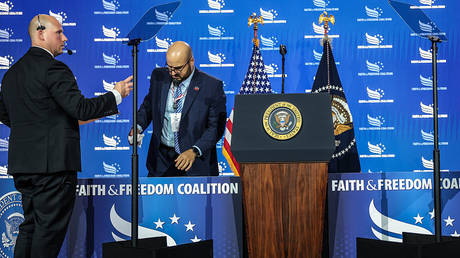
The mainstream media is treating the federal investigation into Donald Trump’s longtime teleprompter operator like the structural collapse of modern finance.
They want you to look at Gabriel Perez—the staffer who allegedly turned his early access to presidential speeches into a cool $100,000 on Kalshi’s "mention markets"—and see a dangerous new frontier of lawlessness. They want you to believe that prediction markets are a broken, easily manipulated playground for insiders. Also making waves recently: Why Everything You Know About the Red Sea Shipping Crisis is Wrong.
They have the story completely backward.
This scandal is not a failure of prediction markets. It is their ultimate proof of concept. More details regarding the matter are covered by Bloomberg.
If a low-level staffer tried to pull off a similar information-asymmetry play in traditional financial markets or corporate Washington, he would still be counting his cash on a beach somewhere. Instead, he got caught almost instantly by a platform’s automated compliance algorithms.
The system did not break. The system worked perfectly.
The Blind Eye of Wall Street vs. Kalshi's Glass House
Let's look at the actual mechanics of what happened. Perez had a massive information advantage. He saw the text of major addresses, including the State of the Union, before they hit the airwaves. He went on Kalshi and bet on whether specific economic terms, campaign slogans, or geographic names would be uttered. He won.
Then, the platform's surveillance team noticed anomalous buying patterns, froze his account, secured $90,000 of the profits, and handed the entire data package to the Commodity Futures Trading Commission (CFTC).
Compare this to the standard operating procedure on Wall Street.
Every single day, corporate executives, hedge fund managers, and sitting members of Congress trade stocks right before major policy shifts, earnings reports, and regulatory approvals. They hide behind complex options chains, dark pools, and layers of plausible deniability. The Securities and Exchange Commission (SEC) takes months, sometimes years, to build a single insider trading case, usually relying on wiretaps or a disgruntled co-conspirator turning state's evidence.
Yet, a teleprompter operator placing a few five-figure bets on an open ledger gets flagged, interviewed, and suspended within a matter of weeks.
Traditional markets are built on opacity. Prediction markets are built on absolute transparency. When every trade is recorded on a clear public ledger, trying to cheat the system is like trying to rob a bank while wearing a neon jacket with your social security number printed on the back.
Dismantling the Rigged Market Myth
Critics are already using this incident to demand that regulators shut down political prediction contracts entirely. They ask the classic, deeply flawed question: Are prediction markets too vulnerable to manipulation to be trusted?
This question fundamentally misunderstands why these platforms exist.
Prediction markets do not exist to be fair, polite forums where everyone has the exact same information at the exact same time. They exist to aggregate disparate pieces of information and translate them into accurate probabilities. They are designed to extract truth from the chaos of human behavior.
When an insider enters the market, they are doing something incredibly useful: they are correcting the price.
Imagine a scenario where the public believes there is only a 10% chance a politician will mention a specific tariff policy during a speech. An insider knows for a fact that the policy is in the draft. They buy up the "Yes" contracts. The price moves from 10 cents to 80 cents.
What just happened? The market became more accurate. The public now has a real-time indicator that the event is highly likely to occur. The insider provided value to the price discovery mechanism.
The fact that the insider cannot legally keep the cash due to platform terms of service and federal fraud laws is a separate, legal issue. But from a pure data perspective, the market did exactly what it was engineered to do: it extracted the truth from someone who possessed it.
The Mention Market Honeypot
The media is particularly obsessed with "mention markets"—contracts where users bet on the exact wording used by public figures. Major brokerages have even shied away from these specific contracts, calling them too volatile and prone to manipulation.
They are missing the point. Mention markets are not a systemic threat to global finance; they are the ultimate honeypot for low-level greed.
In a standard financial market, an insider trade can destroy a company’s valuation or wipe out retail investors who are left holding the bag. In a mention market, the stakes are self-contained. If a rogue speechwriter or a tech guy tries to game the system to make a few thousand bucks, they are gambling against sophisticated market makers who are actively looking for weird volume spikes.
I have seen traditional financial institutions blow millions of dollars trying to build internal surveillance systems that can catch rogue traders before the damage is done. Most fail because the underlying asset classes are too fragmented. Kalshi’s system isolated the anomaly immediately because the scope of the contract was so tightly defined.
The Hypocrisy of Washington's Moral Panic
The White House was quick to call the operator's conduct a "disgrace" and put him on unpaid administrative leave. Federal regulators are rushing to show they are on top of the situation.
This sudden burst of ethical outrage from the political establishment is breathtakingly hypocritical.
Capitol Hill is a machine fueled by non-public information. Lawmakers regularly sit on committees that determine the fate of defense contracts, green energy subsidies, and banking regulations, all while maintaining active stock portfolios. They pass laws that move markets, and their personal net worth miraculously outpaces the S&P 500 year after year.
Yet, the federal apparatus is mobilizing because a guy running a teleprompter tried to scrape $90,000 out of a political betting site.
The real reason the establishment hates prediction markets has nothing to do with protecting retail investors from insider trading. They hate them because these platforms strip away the narrative control that politicians rely on. Prediction markets do not care about spin, press releases, or carefully managed media campaigns. They care about cold, hard probabilities. They expose what the smart money actually thinks long before the polls open or the votes are counted.
Stop treating this investigation like a crisis. It is a victory lap. The open ledger caught the thief before he could even withdraw the funds. If only the rest of global finance operated with the same ruthless efficiency.
For a breakdown of the specific timeline and the regulatory reaction to this unprecedented breach of campaign data, you can view this NBC News report on the Perez investigation, which outlines how the White House responded to the sudden suspension of their veteran tech staffer.