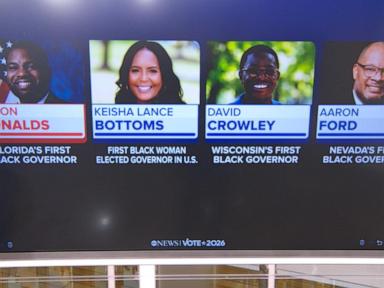
Every two years, cable news anchors hyperventilate over a laundry list of historic milestones on election night. The first Gen Z representative. The first openly LGBTQ+ governor in a traditionally conservative state. The first immigrant from a specific region to hold a federal seat.
The celebratory segments practically write themselves. Producers splice together emotional victory speeches, slap a "Historic Firsts" graphic on the lower third, and declare that democracy has turned a corner. For another perspective, consider: this related article.
They are selling you a comforting fiction.
The obsession with demographic firsts in American midterm elections is the laziest form of political journalism. It mistakes symbolic representation for structural power. By focusing entirely on who won the seat, the mainstream media actively ignores how the institutional machinery actually operates once the swearing-in ceremony ends. Further coverage on this matter has been published by BBC News.
I have spent over a decade watching grassroots coalitions pour millions of dollars and millions of volunteer hours into electing historic candidates, only to watch those same representatives get neutralized within six months of arriving in Washington or their state capitals. The celebratory headlines fade by Wednesday morning. The legislative stagnation lasts for years.
If you want to understand what actually happens during a midterm cycle, stop counting demographic milestones and start tracking committee gavels, campaign finance pipelines, and gerrymandered district maps.
The Trap of Symbolic Representation
The standard media narrative treats a "historic first" as the finish line. In reality, it is barely the starting gun—and the track is rigged against freshmen lawmakers.
Consider the actual mechanics of the United States House of Representatives or the Senate. Power on Capitol Hill is not distributed equally among 435 representatives or 100 senators. It is hoarded by party leadership, committee chairs, and the seniority system. A newly minted congressperson—regardless of how historic their victory might be—enters the chamber at the absolute bottom of the food chain.
They do not control what bills reach the floor. They do not write the omnibus spending packages. They do not dictate the subpoena schedules for oversight committees.
When a media outlet runs a glowing profile celebrating the "most diverse Congress in history," they rarely mention that the people holding the actual levers of legislative appropriation—the Chairs of Ways and Means, Appropriations, and Armed Services—almost always remain the exact same entrenched establishment figures who have held power for thirty years.
Political scientists have studied this phenomenon extensively. Researchers like Nicholas Carnes, author of White-Collar Government, have demonstrated that while racial, gender, and generational diversity in legislatures has steadily climbed, economic diversity has flatlined. Over half of the members of Congress are millionaires. A freshman lawmaker might break a demographic barrier on paper, yet they are immediately absorbed into an institutional culture funded by the exact same corporate PACs and high-dollar donor networks as their predecessors.
The result is predictable. You get a brand-new face defending the exact same status quo.
Why Safe Seats Manufacture "Firsts"
Here is the dirty secret behind most midterm "firsts" that cable news panels refuse to explain: the overwhelming majority of historic breakthroughs do not happen in competitive swing districts. They happen in heavily gerrymandered, deep-blue or deep-red safe seats.
Let's look at the math of modern redistricting.
Thanks to hyper-accurate voter data and sophisticated mapping software, state legislatures draw congressional boundaries with surgical precision. Roughly 85 to 90 percent of House seats are functionally uncompetitive in the general election. The real race happens in the primary, often decided by a tiny fraction of the electorate—sometimes less than 15 percent of registered voters.
When an incumbent retires in a D+25 or R+25 district, the primary becomes a sprint to the ideological base. In that environment, breaking a demographic barrier is a massive electoral advantage. Candidates market their identity as proof of authenticity. They win the primary, coast through a meaningless general election in November, and instantly become national media darlings.
Does this shift the ideological balance of power in the country? Not by a single inch.
If a progressive woman of color replaces a progressive white man in a safe urban district, or a conservative female veteran replaces a conservative male businessman in a safe rural district, the floor votes remain identical. The party whips count the exact same yeses and noes. The media celebrates a revolution, while the legislative math remains completely unchanged.
True political disruption only occurs when a nontraditional candidate flips a purple district that was structurally hostile to their platform. Those victories are extraordinarily rare, yet they are lumped into the exact same highlight reels as candidates who won uncontested general elections.
The Illusion of the Generational Shift
Every midterm cycle brings breathless coverage about the "youth wave" finally arriving in Congress. When Maxwell Frost became the first member of Generation Z elected to the House in 2022, the coverage treated him like the vanguard of an imminent generational takeover.
Look at the actual numbers.
The median age of the U.S. House of Representatives hovers around 58 years old. The median age of the Senate sits around 65. Electing one, two, or even five lawmakers under the age of 30 does not alter the gerontocratic reality of American governance. It merely lowers the average age by a fraction of a decimal point.
More importantly, young lawmakers face a brutal institutional choice the moment they take the oath of office: assimilate or be marginalized.
To get placed on a desirable committee—like Energy and Commerce or Financial Services—a young lawmaker has to prove they are a "team player." In Washington, being a team player means two things:
- Never breaking ranks on procedural votes.
- Spending four hours a day in a call-center cubicle near the Capitol dialing wealthy donors for the party's campaign committee.
I have watched firebrand twenty-something candidates run on dismantling the establishment, only to spend their first term begging lobbyists for checks so they can pay their party dues. By the time they accumulate enough seniority to actually chair a subcommittee, they are middle-aged and thoroughly institutionalized.
Are Voters Asking the Wrong Question?
If you search online after any midterm election, the trending queries follow a predictable script: Who made history in the midterms? How diverse is the new Congress? Which barriers were broken?
These questions stem from a fundamental misunderstanding of how political change works. Voters have been conditioned to view elections like casting calls for a television show. If the cast looks like America, the thinking goes, the show will automatically reflect America's interests.
That is a dangerously naive premise.
The right question to ask on the morning after a midterm election is not "Who broke a barrier?" The right question is: "Who controls the rules committee, and which industries funded the winners?"
Consider the difference between descriptive representation and substantive representation—a distinction political theorists like Hanna Pitkin laid out decades ago.
- Descriptive representation means a politician shares your background, race, gender, or age.
- Substantive representation means a politician advances policies that materially improve your life, regardless of what they look like.
History is littered with examples where the two diverged violently. A working-class voter in the Rust Belt gains nothing from a historic demographic milestone if the newly elected representative votes to gut labor protections or greenlight trade deals that offshore local manufacturing. Conversely, a senator who shares zero demographic traits with a marginalized community can still champion transformative civil rights or healthcare legislation if the political pressure is applied correctly.
When media outlets prioritize descriptive milestones over substantive policy tracking, they train voters to accept symbolism as a substitute for material results.
The Fundraising Filter That Neutralizes Outsiders
To understand why "historic firsts" rarely disrupt the system, you have to follow the money before a single ballot is cast.
Running a competitive federal campaign in the modern era requires millions of dollars. Unless a candidate is independently wealthy, they cannot survive without the blessing of national fundraising networks—organizations like EMILY's List, the Club for Growth, ActBlue bundlers, or WinRed mega-donors.
These gatekeepers act as an ideological filter.
They actively recruit candidates who fit a marketable demographic profile because "historic firsts" generate massive earned media and small-dollar viral donations. However, those same gatekeepers ruthlessly weed out candidates who threaten the core economic interests of their major underwriters.
Imagine a scenario where two candidates run in a high-profile primary. Both represent an underrepresented group. Candidate A supports structural tax reform that would hit private equity firms and tech monopolies. Candidate B uses progressive or populist rhetoric on social issues, emphasizes their historic identity, and quietly assures donors they will protect existing tax loopholes.
Candidate B will receive millions in super PAC backing, prime speaking slots at the national convention, and glowing profiles in major newspapers. Candidate A will be starved of oxygen and smeared as "unelectable."
When Candidate B wins in November, the headlines will scream about another barrier shattered. The private equity firms and tech monopolies will pop champagne. The system did not bend to accommodate an outsider; it co-opted the outsider's identity to insulate itself from real reform.
Admitting the Counter-Argument: When Firsts Actually Matter
To be completely intellectually honest, dismissing every historic milestone as meaningless cynicism would be an overcorrection. There are specific, measurable ways in which breaking barriers alters the political ecosystem—even if the immediate legislative output looks underwhelming.
First, presence changes the closed-door conversation. Legislative deals are rarely struck on the House floor; they are hammered out in leadership offices and caucus meetings. When women, minorities, and LGBTQ+ lawmakers are physically in those rooms, certain regressive compromises become socially and politically impossible to propose. You cannot casually trade away a community's rights when a member of that community is sitting across the table staring at you.
Second, role-model effects are real. Empirical studies in political behavior show that when young people see someone who shares their background holding high office, their political efficacy increases. They are more likely to vote, more likely to volunteer, and more likely to run for local office themselves a decade later.
Third, executive firsts carry massive unilateral weight. There is a massive difference between a freshman legislator and a governor, attorney general, or mayor. A governor holds line-item veto power, commands the state National Guard, appoints judges, and controls state regulatory agencies. When a barrier is broken in an executive mansion rather than a legislative chamber, the capacity for immediate, tangible policy disruption is exponentially higher.
The mistake is treating a freshman House member from a safe district with the exact same reverence as a barrier-breaking governor who actually holds executive authority.
How to Audit a Midterm Election Like an Insider
If you want to strip away the media spin and see whether a midterm election actually shifted the tectonic plates of power, use a ruthless audit framework. Ignore the victory speeches and track these four metrics instead:
1. Track Committee Assignments, Not Floor Speeches
Viral floor speeches generate fundraising emails, not laws. Wait until January when the new Congress organizes. Look at who gets seated on the "A" committees: Appropriations, Ways and Means, Energy and Commerce, and Financial Services in the House; Finance, Appropriations, Judiciary, and Armed Services in the Senate. If the historic newcomers are relegated to low-power committees like Small Business or Veterans' Affairs while the old guard keeps the purse strings, nothing has changed.
2. Audit the Campaign Debt and Donor Roll
Open up the Federal Election Commission (FEC) filings thirty days after the election. Look at how much debt the newly minted historic winners are carrying. A freshman lawmaker with $500,000 in campaign debt is effectively owned by the lobbyists and PACs who will host debt-retirement fundraisers for them during their first six months in office. Check the percentage of their funding that came from small-dollar donors (under $200) versus corporate PACs and max-out individual checks.
3. Measure Primary Turnout vs. General Election Margins
Whenever a pundit claims a candidate "energized a brand-new coalition," check the raw vote totals against the previous midterm cycle. Did the candidate actually expand the electorate by bringing in non-voters, or did they simply win a low-turnout primary and coast on partisan demographics? True political realignment leaves a footprint in raw turnout numbers, not just percentage margins.
4. Watch the First "Must-Pass" Vote
Every Congress eventually hits a crisis—a debt ceiling standoff, a government shutdown deadline, or a massive defense authorization bill. Watch how the barrier-breaking freshmen vote when party leadership twists their arms. Do they use their leverage as a voting bloc to extract concrete policy concessions for their constituents, or do they fold quietly in exchange for a photo op at the White House?
Stop Clapping for the Cast and Read the Script
The obsession with midterm firsts persists because it is profitable for everyone involved. It gives news networks easy, emotionally resonant storytelling without requiring them to explain complex tax policy or procedural gridlock. It gives political parties a shiny shield to deflect criticism when they fail to deliver on their core economic promises. And it gives voters a quick dopamine hit that makes them feel like progress is inevitable just because the calendar turned.
Real political power is never handed over voluntarily with a commemorative plaque and a cable news segment. It is wrestled away through sustained, unglamorous organizational warfare—controlling redistricting commissions, primarying entrenched incumbents in safe seats, and withholding votes until concrete legislative demands are met.
Until voters start judging politicians by the bills they kill and the budgets they pass rather than the demographics they represent, the establishment will gladly keep serving you historic firsts every two years.
Turn off the highlight reels and check the roll call votes.