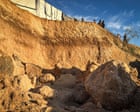
Mainstream coverage of the Gaza landslide wants you to look at the mud, cry for the victims, and move on to the next tragedy. That is journalistic malpractice.
When reporters frame a fatal collapse in an active warzone purely through emotional witness accounts of "horrifying" weather and bare-handed rescue attempts, they are selling a comforting lie. They want you to believe this was an act of God. A sudden, unpredictable freak of nature where the earth simply gave way.
It was not. Landslides in densely populated, heavily bombarded urban environments are rarely natural disasters. They are delayed structural failures.
I have spent years analyzing post-conflict urban infrastructure and geotechnical engineering failures in shattered cities. Every single time a slope gives way after months of heavy ordnance, the press treats it like an isolated weather event. They interview the grieving neighbors. They describe the frantic digging. They completely ignore the physics of soil liquefaction, subterranean hollowing, and systemic drainage collapse that guaranteed the ground would fail months before a single drop of rain fell.
If you want to understand why people were buried alive, stop looking at the rain clouds and start looking at the foundations beneath them.
The Myth of the Freak Accident
Standard breaking news operates on a lazy consensus. Something terrible happens, cameras point at the rubble, and the narrative defaults to immediate human drama. Witnesses recount the sound of rushing earth. Rescuers describe clawing through debris without heavy machinery.
Those accounts are true, and they are tragic. They are also completely insufficient for explaining why the ground moved.
Geotechnical engineering does not care about news cycles. Soil has a measurable shear strength—the internal resistance that keeps a hillside, an embankment, or a rubble mound from sliding down a slope. Under normal conditions, urban soil is stabilized by engineered retaining walls, deep root systems, compacted foundations, and functional stormwater drainage.
In Gaza, every single one of those stabilizing mechanisms has been systematically obliterated.
When you subject an urban landscape to sustained kinetic bombardment, you do not just destroy the buildings above ground. You send massive seismic shockwaves through the subsurface. You fracture water mains. You rupture sewage networks. You shatter the concrete retaining structures holding back millions of tons of displaced earth and pulverized masonry.
Then, you pile millions of tons of uncompacted rubble onto slopes that were never engineered to bear that load.
Calling the resulting collapse a "landslide" is technically accurate in the same way calling a demolished building a "sudden elevation change" is accurate. It strips away the chain of causality. It turns an engineered catastrophe into a meteorological footnote.
The Physics of Weaponized Terrain
To understand the mechanics of what happened on the ground, you have to look at three distinct geotechnical failures happening simultaneously.
1. Subsurface Saturation and Piping
Intact cities move water away from soil. Broken cities trap it. When municipal water pipes and stormwater drains are crushed by heavy munitions or the weight of tracked armored vehicles, millions of gallons of water leak directly into the subsoil.
This triggers a phenomenon known as internal erosion or piping. Water flowing unchecked through fractured soil washes away the fine silt and clay particles that bind the earth together. Invisible subterranean voids form beneath the surface. The ground looks solid from above until the roof of that underground cavity can no longer support the weight above it. When heavy rain finally hits, it does not cause the collapse; it simply acts as the final ounce of weight on an already broken scale.
2. Surcharge Loading from Uncompacted Rubble
Modern warfare generates staggering volumes of debris. According to United Nations environmental assessments, the conflict in Gaza has generated tens of millions of tons of rubble—more than the debris left behind by the battle for Mosul or the bombing of Aleppo.
Desperate populations and makeshift clearing operations inevitably push this debris toward the edges of camps, roads, and natural depressions. In engineering terms, this creates surcharge loading. You are placing massive dead weight on the crest of slopes that have zero lateral reinforcement. Unlike natural soil, pulverized concrete and twisted rebar do not interlock cleanly. They create loose, porous mounds that absorb rainwater like a sponge, doubling their weight within hours while offering almost zero internal friction to hold themselves together.
3. Seismic Micro-Fracturing
Every high-explosive detonation creates a localized earthquake. Repeated blasts do not just crater the impact zone; they propagate shear waves through the surrounding strata. Over months, this cyclic loading breaks down the natural cementation of clay and sand layers. The soil loses its cohesion. It becomes brittle, fractured, and primed for rapid mass wasting the moment pore water pressure increases.
Why Witness Accounts Miss the Bigger Threat
The competitor’s coverage focuses heavily on the immediate rescue struggle—people digging with bare hands because heavy excavators, fuel, and structural shoring equipment do not exist on site.
This highlights a brutal operational reality that mainstream reporting glosses over: secondary collapse risk.
In professional Urban Search and Rescue (USAR), governed by standards set by organizations like INSARAG (International Search and Rescue Advisory Group), the absolute first rule of trench and landslide rescue is shore-before-you-dig. Unstable earth does not slide once and settle. It fails in progressive retrogressive slumps.
When civilians rush into a fresh slide zone with shovels and bare hands, they are stepping onto a hair-trigger. Removing debris from the toe of a landslide removes the only remaining buttress holding back the upper slope. Without hydraulic shores, trench boxes, or ground-penetrating radar to detect shifting mass, the rescuers are operating inside a death trap.
Media outlets love the heroism of bare-handed rescue because it makes for gripping copy. They rarely ask why an entire population has been reduced to Neolithic recovery methods in the twenty-first century. The lack of heavy lifting gear is not an incidental detail of the tragedy. It is a direct multiplier of the death toll. In structural collapses, survival rates plummet past the 24-hour mark. Without cranes, concrete cutters, and pneumatic lifting bags, a survivable burial becomes a guaranteed suffocation.
Dismantling the "Unavoidable Tragedy" Narrative
When readers search for news about the Gaza landslide, they are usually asking a simple question: How did this happen?
If the answer they get is "heavy rain and unstable ground," they are being fed a half-truth. Let's look at the actual questions people should be asking—and the blunt answers that polite journalism avoids.
Was this predictable?
Yes. Completely. Any geotechnical engineer looking at satellite imagery of the region's topography, combined with hydrological data and rubble distribution maps, could have flagged these exact failure zones months ago. When you destroy drainage infrastructure in a coastal strip with sandy-clay soils and pile millions of tons of debris onto sloped terrain, mass wasting is a mathematical certainty during the wet season.
Why didn't people move away from unstable slopes?
Because there is nowhere flat, reinforced, and empty left to go. Displacement orders, perimeter buffer zones, and the sheer footprint of destroyed urban blocks have compressed hundreds of thousands of people into marginal land—coastal dunes, agricultural gullies, drainage basins, and the edges of rubble fields. People do not pitch tents at the base of an unstable debris pile out of ignorance. They do it because every square meter of safe, drained, level ground is already occupied or uninhabitable.
Can humanitarian aid fix this?
Not with tarps and food parcels. You cannot tarp your way out of a geotechnical failure. Preventing the next fatal slide requires heavy civil engineering: bulldozers to grade slopes to a safe angle of repose, excavators to clear blocked drainage channels, millions of tons of aggregate to stabilize roadbeds, and industrial pumps to lower the water table. Until heavy machinery, fuel, and construction materials are allowed to operate at scale, every rainstorm is an active threat to life.
The Blind Spot in Modern Conflict Reporting
The real failure of conventional disaster coverage is that it treats war and environment as separate beats. One desk covers the airstrikes and troop movements; another desk covers the weather and humanitarian struggles.
In reality, modern urban warfare is an environmental wrecking ball that alters the physical geology of a city for decades.
Think about a scenario where a major metropolitan area experiences a 7.0 magnitude earthquake, followed immediately by a complete blockade on cement, steel, fuel, and heavy machinery. Now imagine that instead of aftershocks tapering off, the ground continues to shake every single day for over a year. By the time the winter rains arrive, the city is no longer a collection of buildings; it is an unstable mountain of loose sediment perched over shattered water pipes.
That is the reality on the ground. Yet, when the inevitable happens and a slope collapses onto sleeping families, the headlines default to passive, fatalistic language. People are "buried in a landslide," as if the earth itself decided to attack them out of nowhere.
There is a massive downside to challenging this narrative, and it is worth stating plainly: acknowledging the structural inevitability of these collapses removes the comfort of helplessness. If a landslide is a freak weather event, no one is responsible, and nothing could have been done. If a landslide is the predictable physical consequence of destroying urban drainage, blocking heavy rescue equipment, and compressing civilians onto marginal slopes, then every single death is an avoidable policy failure.
What Actually Needs to Happen Next
If aid agencies, municipal engineers, and international observers want to prevent the next mass burial, they have to stop treating landslides as isolated emergencies and start treating them as an ongoing civil engineering crisis.
- Immediate Slope Hazard Mapping: Satellite radar interferometry (InSAR) can detect millimeter-level ground movement before a catastrophic failure occurs. Remote sensing teams outside the territory must map high-risk rubble mounds and saturated embankments immediately and transmit clear evacuation perimeters to local communities.
- Gravity Drainage Restoration: You do not need high-tech infrastructure to relieve pore water pressure. Crews need basic hand tools, corrugated piping, and gravel to cut trenches at the top of slopes, diverting surface runoff away from unstable debris piles before it can infiltrate the soil.
- Bans on Toe-Excavation: Community leaders and local emergency teams must enforce strict exclusion zones at the base of steep rubble heaps. Digging into the bottom of a debris pile for firewood, scrap metal, or shelter space undercuts the slope and triggers immediate collapse.
- Prioritization of Heavy Plant Equipment: Humanitarian negotiations cannot treat excavators, front-end loaders, and fuel as secondary logistics. Heavy earthmoving equipment is life-saving medical gear when millions of people are living beside unstable mountains of pulverized concrete.
Stop reading stories about the Gaza landslide as tales of tragic weather. Look at the soil mechanics. Look at the shattered infrastructure. Look at the empty space where heavy rescue machinery should be standing.
The earth did not just give way. It was broken, saturated, overloaded, and left to fall.