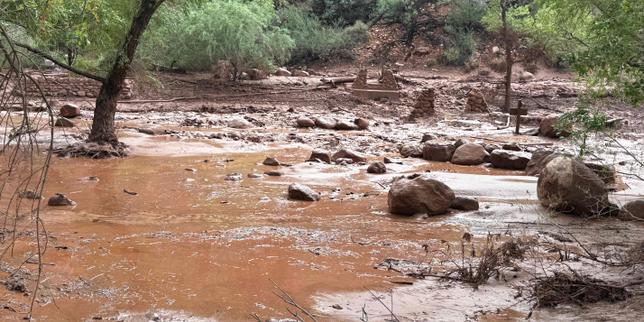
Every monsoon season, the internet fills with the same breathless panic porn. Footage of muddy torrents tearing through the Grand Canyon drops online, accompanied by dramatic narration about nature's fury and unpredictable wrath. News outlets clutch their pearls, tourists gasp, and the consensus narrative writes itself: flash floods are random acts of God, sudden strikes of misfortune that defy human planning.
It is a comforting delusion. It absolves everyone involved of responsibility. For an alternative view, check out: this related article.
I have spent decades watching travelers treat America’s most unforgiving landscapes like theme park attractions, expecting a managed, sanitized experience complete with perimeter walls and helpful attendants. When the predictable happens—when water drops fifty miles away, funnels into a narrow slot canyon, and turns a dry bed into a hydraulic battering ram—we act shocked. We blame the weather.
We should be blaming our collective refusal to understand basic hydrology. Further reporting on this matter has been published by AFAR.
The Lazy Consensus of Unpredictability
The standard media narrative relies on a lazy falsehood: that flash floods in the Grand Canyon are sudden, invisible killers that appear out of nowhere. Meteorologists and hydrologists know better. Flash floods do not materialize from thin air. They are the mathematical certainty of simple inputs. Rain falls on impermeable sandstone plates miles upstream, gathers speed in steep tributaries, and channels into narrow gorges with zero warning only for those who refuse to look at the radar or understand desert topography.
Call it what it actually is: an information failure masked as a tragedy.
When a video of a Grand Canyon flash flood goes viral, viewers marvel at the sheer speed of the water. They talk about walls of water moving faster than a running man. But physics explains every single second of that footage. Dry desert soil cannot absorb heavy precipitation quickly. It acts like concrete. Water sheds off the plateaus instantly, pooling into dry washes called arroyos. If you are standing in a slot canyon with vertical red rock walls and zero escape routes during a monsoon advisory, you are not the victim of a random act of nature. You are the victim of poor risk management.
Why the Tourism Industry Lies to You
Park authorities and tourism boards walk a tightrope. They want millions of visitors pumping cash into local economies, which means they are incentivized to downplay extreme risks. They post small warning signs at trailheads, buried beneath disclaimers, while continuing to market the park as an awe-inspiring playground for everyone.
Imagine a scenario where the National Park Service replaced its polite informational brochures with blunt reality checks at every entrance gate: If it rains forty miles away, this canyon will become a blender. Do not enter if you cannot read a weather map.
Ticket sales would plummet. So instead, we get institutional coddling. Visitors are told to "stay aware" and "respect the environment," vague platitudes that mean nothing to someone who thinks a hike is just a longer walk in the park. True expertise in wilderness survival is built on cynicism, not optimism. You must assume the environment is actively trying to kill you until proven otherwise.
The Anatomy of a Flash Flood
Let us break down the actual mechanics that the viral videos leave out. A flash flood is defined as a rapid surge of water occurring within six hours of a causative event—usually heavy rainfall. In the Grand Canyon region, thunderstorms build over the high plateaus during the summer monsoon season.
Consider these operational facts:
- A thunderstorm twenty miles away can dump two inches of rain in thirty minutes.
- That water has nowhere to go but down, funneling into narrow tributaries like the Little Colorado River or various side canyons.
- Water velocity in a narrow canyon can easily exceed fifteen miles per hour, generating thousands of pounds of force per square foot. At that speed, moving water acts like liquid concrete. It picks up boulders, trees, and debris, turning the flood into a moving battering ram.
You cannot outrun it. You cannot swim against it. If you are caught at floor level in a slot canyon when the wall of water hits, your survival odds approach zero. Yet, thousands of hikers ignore storm clouds hovering over distant mesas every single year because they assume they are safe as long as the sun is shining directly overhead.
The Real Problem with Modern Adventurers
We have engineered risk out of everyday life, and it has rotted our hazard assessment skills. Modern humans live in climate-controlled boxes, drive cars with automatic braking, and expect digital safety nets everywhere. When they step into the wild, they bring that same sense of artificial security with them. They trust the ecosystem to play fair.
The wilderness does not care about your itinerary, your vacation days, or your social media aesthetic.
When a flash flood hits the Grand Canyon, the commentary always pivots to how terrifying the footage is. Change the perspective. Look at the hubris required to ignore a monsoon forecast because you drove six hours to hike a specific trail. Look at the systemic failure of tour operators who lead groups into high-risk drainage zones during peak storm windows just to keep customers happy and invoices paid.
What You Should Do Instead
Stop treating outdoor exploration like a passive consumer experience. If you want to survive the American Southwest during monsoon season, you need to operate with the paranoia of a backcountry hydrologist.
- Check the regional watershed, not just the local weather app at your exact GPS coordinates. A blue sky above your head is irrelevant if a severe cell is dropping water upstream in your drainage basin.
- Memorize escape routes before you ever step foot inside a canyon. If a canyon has sheer walls and no established scramble routes to high ground every hundred yards, turn around.
- Treat every dry wash as a potential chute. Never pitch a tent or linger in a riverbed, regardless of how dry it looks or how peaceful the weather feels.
The next time you see dramatic footage of a brown wall of water obliterating a peaceful desert canyon, stop marveling at the fury of the storm. Look closer at the human decisions that put cameras—and people—right in the path of basic arithmetic. Nature isn't angry. It's just doing math. Stop standing in its way.