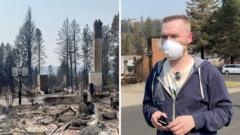
Every time a wildfire scorches a neighborhood in Spokane, the media machinery spins up the exact same predictable script. Cameras zoom in on charred foundations. Reporters interview weeping homeowners standing in front of smoking ruins. The headlines scream about apocalyptic devastation and unprecedented weather anomalies. Everyone nods solemnly, blames carbon emissions, points a finger at rising global temperatures, and waits for federal relief funds to materialize.
It is a comforting narrative. It is also a complete deflection from reality.
I have spent the last fifteen years analyzing municipal infrastructure, land use policy, and catastrophic risk models. I have watched cities repeat the exact same structural errors while hiding behind meteorological scapegoats. Climate change acts as an accelerant, yes. But pretending that global weather trends are the sole author of neighborhood destruction in eastern Washington ignores the basic mechanics of urban planning. We are not just fighting nature; we are fighting decades of municipal malpractice, outdated building codes, and political cowardice.
Stop blaming the sky for decisions made in air-conditioned city council chambers.
The Lazy Consensus of Catastrophe
The mainstream coverage of Spokane wildfires relies on a singular, lazy premise: that these events are unprecedented acts of god tearing through blameless communities. This framework assumes that suburbs sprout organically and that destruction is a random lottery distributed by dry winds and lightning strikes.
That premise is false.
Wildfires do not randomly select neighborhoods. Neighborhoods are systematically built in high-risk ignition zones because cheap land sits directly adjacent to dense, fire-prone ponderosa pine forests and dry grasslands. When developers push outward into the wildland-urban interface, they are not expanding the frontier of the American dream; they are constructing kindling boxes in a blast furnace.
Look at the historical data. The topography of Spokane County features deep canyons, rolling hills, and prevailing winds that funnel air like a blowtorch. This is not a newly discovered meteorological phenomenon. It has been true for centuries. Yet, municipal authorities continue to approve subdivision layouts that feature single-access roads, narrow winding streets that choke evacuation traffic, and wooden framing sitting beneath overhanging pine branches.
When a fire rips through these areas, commentators act surprised. I am not surprised. I am exhausted by the predictability of human stupidity.
The Zoning Trap Nobody Wants to Talk About
To understand why Spokane neighborhoods burn, you have to look past the smoke and examine the municipal code. For decades, city planners and county commissioners have prioritized rapid, low-density expansion over resilient infrastructure.
Low-density sprawl requires exponential miles of electrical lines, water pipes, and roads to service a fraction of the population. More miles of overhead power lines cutting through dry brush mean more ignition points. More sprawling cul-de-sacs mean slower emergency response times.
Instead of forcing developers to build defensible spaces, install underground utilities, and use non-combustible building materials like heavy-gauge metal roofing and fiber-cement siding, local governments caved to real estate lobbies. They traded long-term community survival for short-term property tax revenue.
When a neighborhood burns down, the insurance industry absorbs the initial financial shock, taxpayers fund the federal disaster response, and local governments simply rezone the exact same parcels to be rebuilt the exact same way. It is a continuous loop of institutional insanity.
The Hard Physics of Defensible Space
Let us talk about what actually stops a fire, because the public discourse treats wildfire mitigation like a mystical art form rather than a matter of basic physics.
A home does not typically burn down because a wall of solid flame rolls over it. Homes ignite because of embers. Millions of burning brands carried by the wind land on flammable pine needles packed in gutters, ignite cedar shake roofs, or catch dry ornamental bark mulch sitting six inches away from a vinyl-sided living room wall.
Fire mitigation is not about hugging trees or hoping for rain. It is a strict geometric equation.
Within the first thirty feet of a structure, you must eliminate combustible materials entirely. That means no flammable vegetation, no firewood stacks against the foundation, and no wooden decks cantilevered over steep slopes. This is called the home ignition zone, a concept pioneered by wildfire researchers like Jack Cohen decades ago.
Yet, walk through a typical Spokane suburb nestled against the hills. You will see lush, thirsty lawns right up to the front door, towering pine trees brushing against second-story windows, and wood-fenced yards connecting every house on the block like a fuse on a stick of dynamite.
When homeowners landscape for aesthetics while completely ignoring the physics of combustion, they turn their personal properties into loaded weapons pointed at their neighbors.
Dismantling the Relief Myth
Another uncomfortable truth: federal disaster relief funds and insurance payouts often act as a perverse incentive for bad behavior.
Imagine a scenario where a homeowner builds a large, beautiful home right in the middle of a high-risk brush zone, bypasses expensive fire-hardening upgrades to save money upfront, and relies on the state to bail them out when the inevitable happens. If the house burns down, federal aid and insurance rebuild it. The risk is externalized to taxpayers, while the reward of living in a scenic, wooded enclave is privatized by the homeowner.
This moral hazard prevents real change. Why should a developer spend an extra twenty percent per home on ignition-resistant materials if the market does not penalize them for cutting corners? Why should a local government enforce strict zoning laws if voters punish politicians who restrict property rights in the name of safety?
Until we make high-risk living financially accountable to the people choosing to live there, neighborhoods will keep burning.
The Counter-Intuitive Blueprint for Survival
If we actually want to stop treating Spokane wildfires as tragic inevitabilities and start treating them as manageable engineering challenges, we have to flip the current paradigm on its head.
First, we must stop subsidizing risk. Insurance companies should drastically hike premiums or deny coverage entirely for homes built in high-hazard zones that refuse to meet strict, modern hardening standards. If the free market actually priced risk accurately, building a wooden shack in a dry canyon would be financially impossible.
Second, municipalities need to mandate retroactive home hardening. Instead of just regulating new construction, local ordinances should require existing homes in vulnerable corridors to clear defensible space, replace combustible roofing, and screen attic vents with fine mesh to block wind-driven embers.
Third, we need to embrace higher-density, fire-smart infill housing inside existing urban cores rather than allowing further outward creep into the wilderness. Building up, not out, protects both human lives and natural ecosystems.
The next time a fire sweeps through eastern Washington and the media turns on the cameras to capture the tears, do not look at the weather report. Look at the building codes. Look at the property lines. Look at the political cowardice that chose a quick tax dollar over structural survival.
Nature is doing what nature has done for millennia. It is time we stopped acting like the victims of our own bad design.