Whispers travel faster than truth across the 38th parallel.
When a authoritarian leader goes dark for days, the world stops looking at what is happening and starts guessing at what comes next. Satellite operators re-orient their lenses toward airfield tarmac. Intelligence agencies in Seoul and Washington analyze thermal signatures and encrypted radio chatter. On social media, the rumor machine spins up its predictable, frantic rhythm: heart failure, botched surgery, palace coup, death.
Then, precisely when the crescendo of speculation reaches a fever pitch, Pyongyang delivers its counter-punch. Not with an official press release. Not with a defensive denial.
With a photograph.
The Choreography of Absolute Power
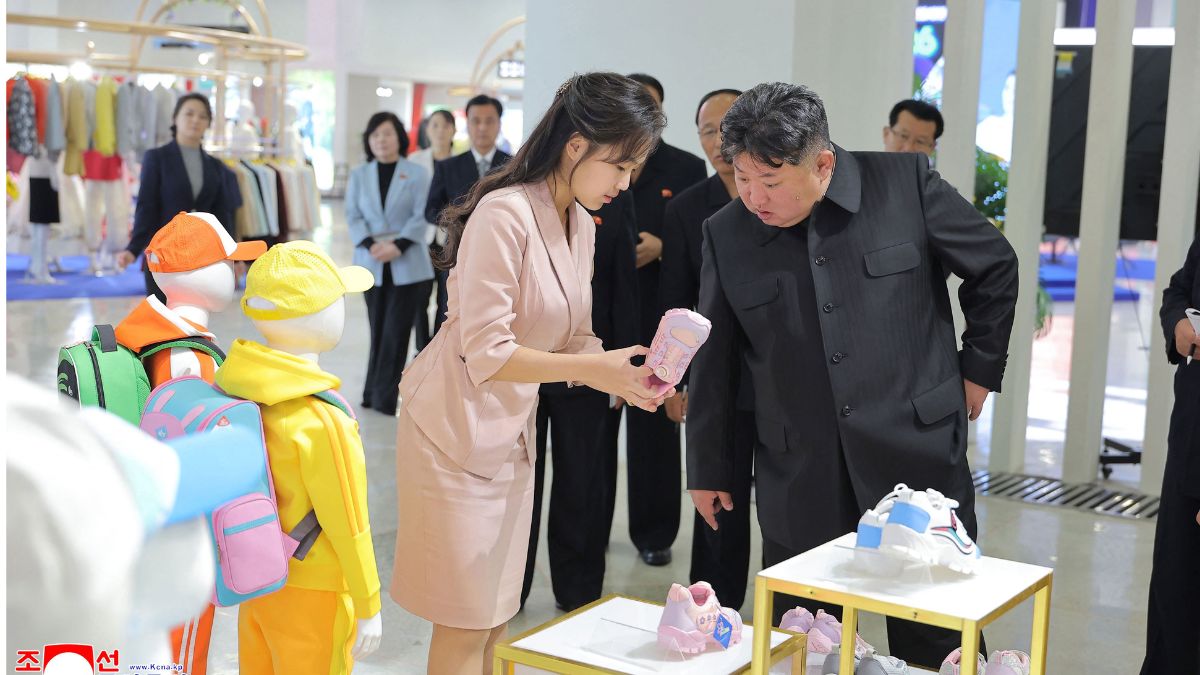
Picture the hall. It is massive, brightly lit, and lined with row after row of garment racks, mannequins, and pristine textiles. High-end winter coats, tailored jackets, and patterned dresses sit under cold fluorescent lights. It could be a trade center in Milan or a fashion week exhibition in Shanghai, except for the heavy silence that hangs in the air and the small group of men trailing behind a single family.
Kim Jong Un walks through the aisle of the Pyongyang Clothing Exhibition. He is alive. He is smiling. He is wearing his signature dark outerwear, touching fabric, gesturing toward displays of everyday apparel.
Beside him stands his daughter, Ju Ae, wrapped in a plush coat with a fur-trimmed collar, her hair meticulously styled. Around them, notebook-bearing general officers and party cadres hunch forward in posture so rigid it looks painful. Every pen tip touches paper. Every nod is synchronized.
To the untrained eye, it is an mundane cultural visit—a leader inspecting domestic light industry. To the analysts sitting thousands of miles away, every square inch of the frame is a calculated message.
The rumor of death is dead. The spectacle has replaced it.
Why the Theater Matters
To understand why a simple clothing expo becomes international news, you have to understand the peculiar mechanics of total political control.
Information in North Korea does not flow; it is metered out like rations during a famine. When the supreme leader vanishes from public view for weeks at a time, it creates an informational vacuum. In that silence, external media constructs narratives filled with mortal peril. The regime knows this. They do not fight the rumors immediately; they allow them to swell, letting the global apparatus exhaust itself on speculation.
When the photos finally drop via the Korean Central News Agency, the psychological shift is instant. The foreign press corps moves from obituaries to image analysis overnight.
Metaphorically, it is a game of geopolitical peek-a-boo, but the stakes involve nuclear arsenals and the stability of East Asia.
Consider what the regime accomplishes in a single gallery release:
- State of Health: Kim is seen standing, walking unaided, and engaging with his surroundings, neutralizing claims of physical incapacitation.
- Economic Normalcy: Choosing a clothing expo over a military parade signals domestic stability, projecting an image of a state focused on consumer goods and public welfare.
- Dynastic Continuity: By placing Ju Ae directly in the center of the frame, the regime reinforces a line of succession that looks decades into the future.
Control is not maintained merely through force. It is maintained through the absolute projection of continuity.
The Quiet Elevation of the Daughter
Look closely at the composition of the imagery. Ju Ae was once described merely as the leader's "beloved child" when she first appeared at a missile test firing. Today, her positioning in state media has evolved into something far more deliberate.
She does not stand behind her father. She stands alongside him.
While senior military officials—men with chestfuls of medals who have survived decades of purges—stand at a respectful distance, a young girl walks adjacent to the center of power. She inspects the garments. She shares low-spoken observations with the leader. The state media cameras capture her not as a passive observer, but as an essential element of the tableau.
Her presence transforms a standard health-reassurance photo shoot into a long-term strategic statement. If the rumors of Kim’s ill health were meant to imply immediate vulnerability, the state responds by showing a dynasty that feels secure enough to showcase its next generation.
Power here is not just practiced; it is inherited, stage-managed, and framed down to the millimeter.
The Reality Behind the Silk and Leather
Outside the polished hall of the exhibition center, winter in the peninsula is unforgiving. Beyond the curated displays of modern coats and colorful textiles, millions of ordinary citizens navigate severe economic hardships, systemic shortages, and rigid state control.
The contrast between the reality on the ground and the images broadcast to the world is stark. Inside the hall, abundance is staged. Outside, survival is quiet, persistent, and grueling.
The clothing expo photos are designed as much for internal consumption as for foreign intelligence services. For the citizen viewing the state television broadcast, the message is simple: the center holds. The leader is healthy, the state is providing, and the future is secured.
It is an illusion built on light, space, and strict discipline, but in totalitarian politics, illusion is a primary tool of governance.
The Endless Loop
The rumors will surface again. Six months from now, or perhaps a year, Kim Jong Un will skip another high-profile anniversary or disappear from public view for three consecutive weeks. The headlines will restart. The satellite imagery will be analyzed. The speculative obituaries will be drafted once more.
And eventually, a new batch of photographs will arrive in newsrooms around the globe.
Perhaps next time it will be a tractor factory, a weapon test, or a newly completed housing development. The venue does not matter. The dynamic remains unbroken.
A leader stands under the harsh lights. A daughter walks by his side. A roomful of officials write furiously in their small notebooks. And the world watches, trying to decipher the human truth hidden behind a wall of staged perfection.


