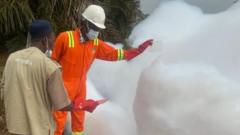
Crowds gathering around a mountain of white foam on a highway are not witnessing a miracle, a weather anomaly, or a harmless curious event. They are standing inside a concentrated plume of toxic surfactants, industrial runoff, and hazardous waste.
Yet mainstream coverage treats events like the recent Nigerian highway foam incident as a quirky viral spectacle. Media outlets run headlines about "mysterious suds" and "bemused onlookers," framed with the lighthearted tone reserved for street performers or unusual clouds.
This lazy framing is dangerous. It masks a brutal truth about industrial negligence and public health failures.
The Chemistry of Bad Media Coverage
When heavy rains mix with high concentrations of linear alkylbenzene sulfonates—the active agents in industrial detergents—and face violent physical churning from traffic or drainage overflow, foam forms. It is high-energy chemical aeration.
It is not mysterious. It is not natural. It is untreated industrial effluent discharge.
When journalists label toxic industrial waste as "mysterious," they grant immediate immunity to the polluters. If the cause is framed as unknown, no factory is held accountable. No environmental agency is forced to issue immediate containment orders. No local municipal authority has to answer for broken drainage infrastructure.
Instead of demanding answers from nearby manufacturing units or chemical processing facilities, coverage focuses on the crowd's reaction. Smartphone footage replaces toxicological investigation.
I have spent years tracking industrial discharge incidents across fast-growing industrial corridors. The pattern is always identical. A facility dumps excess chemical agents during high-rainfall events to dilute their output under cover of storm conditions. The storm drainage system overloads. High velocity fluid mechanics whip the surfactant-laden water into massive, thick white clouds that billow onto public roads.
And instead of fleeing corrosive, skin-irritating, pulmonary-damaging aerosolized chemicals, people run toward it with camera phones raised.
The Illusion of Innocence
Surfactants reduce the surface tension of water. Industrial-grade variants do far more than create bubbles; they bind with heavy metals, polycyclic aromatic hydrocarbons, and micro-pathogens lurking in unpaved road dust and open drainage channels.
When that foam breaks down or gets kicked up into aerosols by passing trucks, those bound contaminants enter the human respiratory system. Skin contact can trigger severe dermatological reactions, chemical burns, or systemic absorption of toxic compounds.
The public reaction in these videos reveals a deep breakdown in public safety signaling.
- The Spectacle Bias: Modern internet culture trains people to view physical anomalies primarily as content opportunities rather than potential chemical threats.
- Regulatory Silence: Local agencies fail to deploy immediate hazmat barriers, traffic diversions, or public warnings, leaving citizens unaware of the hazard.
- Informational Vacuum: Sensational media coverage fills the void with vague speculation rather than factual warnings about chemical exposure.
Imagine a scenario where an overhead high-voltage power line snaps and whips across a major thoroughfare, sparking furiously. Would the public rush to wade through the sparks? Would news outlets publish lighthearted stories about "mysterious lightning on the asphalt"?
Of course not. High-voltage electricity has clear, well-understood danger signals. Chemical runoff does not enjoy that clarity because it looks like bath bubbles.
Fixing the Response Model
Solving this requires dismantling the lazy consensus that these incidents are minor civic novelties.
Public health authorities must treat unexpected foam eruptions on public roadways as active industrial spills until proven otherwise. That means immediate site isolation, air and water sampling, and clear, plain-language warnings pushed to surrounding communities.
Environmental regulatory bodies must map nearby chemical manufacturing, soap production, and industrial washing operations adjacent to storm channels. Surfactant levels in urban drainage do not reach high-volume foaming thresholds by accident. Tracking the molecular signature of the discharge back to the pipe source is routine chemistry; the only missing ingredient is institutional will.
Stop treating chemical contamination as viral street art. Put down the camera, back away from the runoff, and start asking which facility dumped its toxicity directly into your community.


