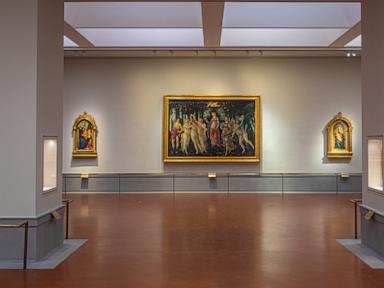
Florence is choking on its own success. The Uffizi Gallery recently shifted Sandro Botticelli’s twin masterpieces, The Birth of Venus and Primavera, into larger, dedicated rooms to solve a persistent crisis: crowd stagnation. For decades, the museum’s layout forced thousands of daily visitors into a bottleneck, creating a hazardous, loud viewing environment that reduced Renaissance masterpieces to mere backdrops for selfies. This spatial overhaul goes beyond simple room reassignments. It is a calculated, high-stakes gambit to manage human traffic, protect priceless canvas fibers, and salvage the decaying psychological experience of viewing art under the weight of mass tourism.
The structural changes seem straightforward on paper. By breaking up the original, cramped Botticelli suite and spreading his works across larger galleries, the Uffizi has effectively increased the breathing room around each painting by more than double.
But museums are machines for looking. When a machine handles millions of bodies a year, layout mechanics dictate human behavior.
The Mechanics of the Gallery Bottleneck
To understand why the Uffizi had to dismantle its previous arrangement, you have to look at the geometry of tourist frustration. In the old layout, Room 10-14 clustered Botticelli’s major works into a single, continuous sequence. This design assumed an idealized version of a museum visitor: someone who moves systematically from left to right, spending exactly two minutes per piece before moving on.
That visitor does not exist.
Instead, The Birth of Venus acts like a physical gravitational well. Casual tourists, tour groups with extended flags, and smartphone-wielding influencers all freeze in front of the canvas. Because Primavera hung in close proximity, the two crowds bled into one another. The result was a permanent state of gridlock. Art historians could not get close enough to examine the brushwork. Security guards spent their shifts shouting at patrons to step back. The air quality in the room plummeted, driving up relative humidity and threatening the delicate stability of the 15th-century tempera panels.
Old Layout: [Botticelli Room] -> Includes Venus + Primavera -> High Crowding & Stagnation
New Layout: [Expanded Wing]  -> Separated Galleries         -> Continuous Fluid Movement
The new strategy relies on spatial dispersion. By placing the paintings in massive, high-ceilinged spaces further down the hallway, the museum architects have weaponized the architecture itself to thin out the crowd. Visitors must now walk a greater distance between the two masterworks. This structural pause forces a natural filtering mechanism. It breaks up the dense packs of tour groups, allowing individual viewers to find pockets of empty space.
The Microclimate Threat to Renaissance Tempera
Art is fragile, but the air around art is downright volatile. The hidden driver behind this architectural migration is the raw physics of museum conservation. Every human body radiates heat and exhales moisture. When five hundred people crowd into a confined gallery space, they fundamentally alter the microclimate.
- Humidity Spikes: Rapid increases in moisture cause the wood backing panels of early Renaissance art to expand and contract, risking paint flaking.
- Carbon Dioxide Accumulation: High CO2 levels combined with localized moisture can form mild acidic compounds on exposed surfaces over decades.
- Particulate Matter: Clothing fibers, skin cells, and outdoor dust kicked up by thousands of shoes settle directly onto the protective varnishes.
By moving The Birth of Venus to a room with significantly more cubic meters of air, the Uffizi’s environmental control systems can finally do their jobs. The specialized heating, ventilation, and air conditioning units do not have to fight sudden, localized spikes in temperature caused by fifty people rushing the canvas at once. The air remains stable because the volume of the room dilutes the human impact.
The Devaluation of the Silent Encounter
There is a deeper cultural rot that this layout modification attempts to cure, or at least mask. The modern museum visit has shifted from an aesthetic experience to a transactional one. The goal is no longer to look at the painting; the goal is to document that you were in the presence of the painting.
This shift has ruined the concept of scale. Primavera is a massive, complex allegory featuring dozens of distinct botanical species and intricate mythological staging. It requires distance to comprehend, followed by close-up inspection to appreciate the details. When a room is packed shoulder-to-shoulder, both viewing distances become impossible. You cannot step back without bumping into a tripod. You cannot step forward without blocking someone else's camera line.
The new arrangement restores the physical distance required for actual contemplation. Security barriers have been pushed back slightly, but the wider perimeter allows more people to view the piece simultaneously from a distance of ten feet. This does not eliminate the selfie-takers, but it prevents them from completely paralyzing the experience for everyone else.
The Unresolved Reality of the Blockbuster Economy
Let's be clear about the limits of this architectural intervention. Spreading out the paintings does not reduce the number of tickets sold at the gate. The Uffizi remains an institution trapped by its own fame. As long as the global travel industry treats Florence as a checkbox destination, the galleries will operate at peak capacity.
This renovation is a triage measure, not a permanent cure for overtourism. It solves the immediate, localized danger of crowd crushing inside the Botticelli rooms. It creates a more dignified flow of human traffic. Yet, it simultaneously highlights the ongoing struggle facing classic European institutions. They must choose between acting as sacred repositories for human heritage or functioning as high-throughput processing plants for global tourism.
The Uffizi has optimized the machine. The rooms are grander, the air is cleaner, and the movement is smoother. But the tension between the quiet reality of 15th-century paint and the loud demands of 21st-century tourism remains embedded in the very plaster of the walls.