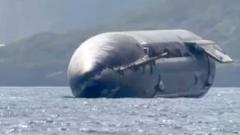
Every time a booster arcs over the horizon and casual observers gasp at a glowing trail in the sky, the mainstream media treats it like a UFO sighting. The headlines breathlessly gawk at the pretty lights off Christmas Island, treating a routine orbital insertion like an act of divine intervention. It is lazy journalism built on technological illiteracy.
Stop treating industrial logistics like a fireworks show.
The lazy consensus in the media is that these visible transit events are awe-inspiring anomalies. They write about them as if SpaceX is casually painting the stratosphere for our entertainment. That framing misses the entire point of what is happening overhead. When you spot a Starship hot-staging or a Falcon 9 second stage burning out over the Pacific, you are not looking at a spectacle. You are looking at an execution notice served to every legacy aerospace contractor still trying to bill cost-plus margins to governments that should know better.
I have spent the last decade watching legacy aerospace executives sweat through their bespoke suits while trying to justify why a single rocket component costs more than a commercial airliner. They stare at telemetry feeds of reusable hardware sticking landing burns on autonomous droneships, and they still call it a fluke. They are missing the forest for the trees because acknowledging the reality of what is flying over Christmas Island means admitting their entire business model belongs in a museum.
The Economics of the Streak in the Sky
Let us dismantle the wonder. What the public calls a glowing jellyfish or a brilliant plume is actually the exhaust signature of orbital mechanics ruthlessly cutting costs per kilogram to low Earth orbit.
When a rocket traverses the regional airspace near remote territories, it leaves behind an ionized gas cloud illuminated by a sun that has already set relative to the surface observer. It is physics, not magic. But look closer at the financial implications of that light show. Every time that trajectory occurs, another brick falls out of the wall protecting United Launch Alliance, ArianeGroup, and the bloated remnants of traditional defense procurement.
The common public question is: How is it possible for a private company to launch so frequently that these sightings are becoming routine?
The premise of the question is already flawed. The shock shouldn't be that they are launching often. The shock should be that anyone ever tolerated paying twenty times more for single-use hardware in the first place. SpaceX did not reinvent rocket science; they simply remembered that rockets are transport trucks, not Fabergé eggs.
Legacy Aerospace Model:  Design -> Build Once -> Pray -> Scrap -> Bill Taxpayers
The Disruptive Model:    Design -> Fly -> Crash -> Fix -> Fly Again -> Repeat Daily
When you look at the Christmas Island sighting, you are looking at flight rate dominance. Traditional agencies plan missions with the solemn gravity of a cathedral dedication. SpaceX treats orbital payloads like a bus schedule. If a bus breaks down, you fix the axle and send it back out. You do not write a congressional report and commission a three-year study on wheel integrity.
Dismantling the Launch Cadence Fallacy
Critics love to point out the environmental noise or the occasional anomaly as proof that the current cadence is reckless. This is a manufactured panic.
Imagine a scenario where commercial aviation operated like 1970s space programs: every time a Boeing 747 landed, it was dismantled, melted down, and a brand-new plane was built for the next flight across the Atlantic. Ticket prices would be five million dollars per seat, and people would write poetry about the rare moments a plane actually left the ground.
That is how absurd traditional spaceflight was before reusability stopped being a PowerPoint concept and started becoming a daily operational reality.
The booster stage you saw streaking past the equator isn't an environmental catastrophe; it is the inevitable stabilization of a frontier market. The emissions from a methane or kerosene launch are a rounding error compared to global shipping, commercial aviation, or the cement industry. Yet, pundits clutch their pearls over rocket plumes while ignoring the systemic inefficiency of the entire global supply chain beneath them. They focus on the exhaust trail because confronting the economic obsolescence of legacy manufacturing requires actual analytical effort.
The Real Threat Overhead
Here is the uncomfortable truth that aerospace lobbyists do not want whispered in congressional hearing rooms: frequency breeds reliability, and reliability breeds monopoly.
By normalizing these trajectories over international waters and island chains, the operational tempo reaches a velocity where no competitor can catch up using legacy methods. You cannot iterate toward a reusable heavy-lift architecture by holding design reviews for six months. You iterate by blowing up prototypes on concrete pads in South Texas and looking at the telemetry before lunch.
The sighting off Christmas Island is a symptom of a much larger, systemic throat-slitting of old-world manufacturing norms. Every bright arc across the dark expanse of the Pacific represents another nail in the coffin of bureaucratic complacency.
The next time you see a headline marveling at a rocket lighting up the twilight, stop looking at the pretty colors. Look at the balance sheet. Look at the launch manifest. Look at the panic in the boardrooms of companies that thought they had a monopoly on the heavens.
They are not fireworks. They are warning shots.