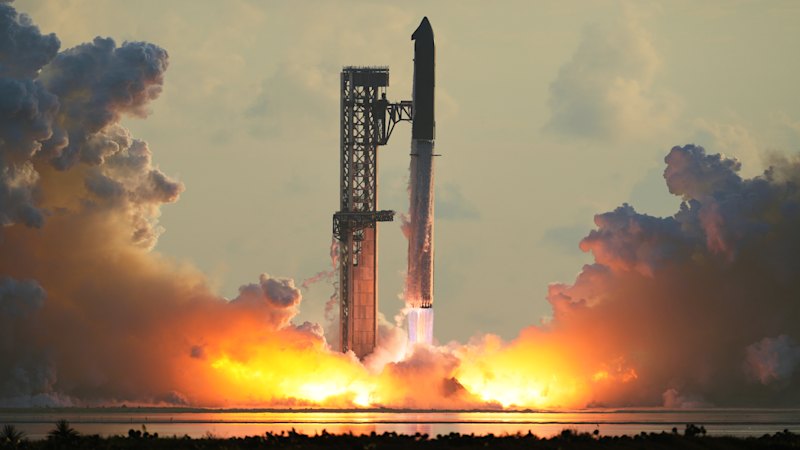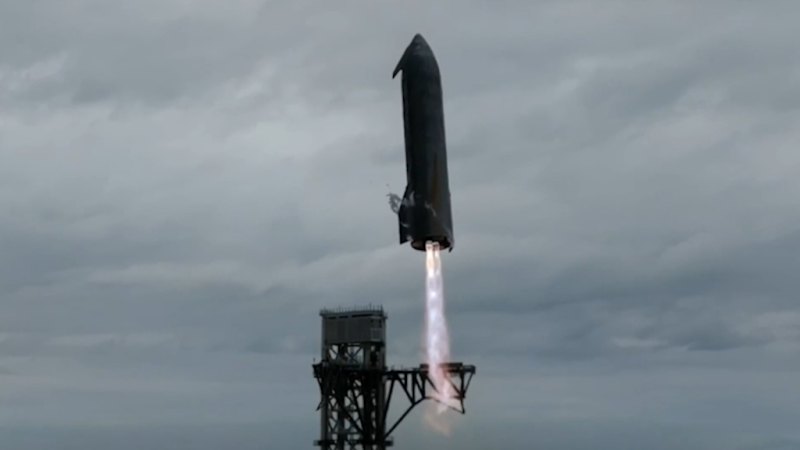
Most people thought Elon Musk was losing his mind when he first talked about catching descending orbital boosters with giant mechanical arms attached to a launch tower. It sounded like science fiction. Rockets are supposed to splash down gently in the ocean on landing legs or burn up in the atmosphere. They are not meant to be plucked out of the sky like a baseball caught by an outfielder.
Yet, SpaceX actually pulled it off.
When the Starship flight test successfully steered its Super Heavy booster right back to the launch mount at Starbase in Boca Chica, Texas, and watched the tower's giant steel chopsticks pin the rocket against the side of the structure, the aerospace industry changed forever. Reusability went from being an impressive party trick with Falcon 9 landing legs to an industrial-scale manufacturing revolution.
Let us look at why this matters, how they managed it, and why traditional aerospace companies are still scrambling to catch up.
The Engineering Madness Behind the Chopsticks
If you want to understand why catching a rocket with a tower is so absurdly difficult, you have to look at the physics of a skyscraper-sized metal cylinder falling out of the upper atmosphere.
A Super Heavy booster stands over 230 feet tall. When it returns from space, it is basically an empty aluminum-lithium tank moving at supersonic speeds, guided by grid fins that bite into thin air. At the very last second, a subset of its Raptor engines relight to perform a suicide burn. This maneuver slows the vehicle down from thousands of miles per hour to a dead hover right next to the exact spot it launched from.
Traditional landing legs add massive amounts of dead weight. Every pound of structural leg you bolt onto the bottom of a booster is a pound of cargo you cannot send to the Moon or Mars. By stripping away the legs entirely and shifting the landing support mechanism back to the ground infrastructure, SpaceX stripped tons of parasitic mass off the rocket.
The launch tower, affectionately nicknamed Mechazilla by the internet, does the heavy lifting. The mechanical pins, or "chopsticks," do not just grab the rocket blindly. They intercept the vehicle right below the grid fins, where the structural load rings are thickest, locking onto hard points designed to handle the brutal G-forces of launch.
Why Ocean Landings Were a Dead End
For years, SpaceX conditioned us to expect ocean drone ship landings. Falcon 9 boosters land softly on autonomous barges floating hundreds of miles offshore. It works brilliantly, but it has severe scaling limitations.
A drone ship landing requires a massive fleet of support vessels, specialized port facilities, weeks of transit time to drag the booster back to land, and intense refurbishment cycles. Saltwater is a rocket engine's worst enemy. Every single ocean landing exposes sensitive turbomachinery and heat shields to corrosive brine.
Catching the rocket dry at the launch site cuts turnaround time from months to potentially hours. Imagine landing an airliner, parking it at the gate, refuel, and sending it back out on the same day. That is the operational model SpaceX is trying to build for interplanetary travel.
If you want to launch multiple times a day to sustain a permanent base on Mars, waiting three weeks for a barge to chug back up the Gulf of Mexico just will not cut it.
The Margin for Error Is Basically Zero
People forget how close things can go wrong. The guidance computer has milliseconds to calculate wind shear, fuel slosh, engine gimbal limits, and structural harmonics. If the booster drifts a fraction of a meter too far left or right, it misses the pins, strikes the tower, and triggers a multi-million-dollar fireball that could take out the entire launch complex.
SpaceX tested this relentlessly through computer simulations, thousands of abort scenarios, and smaller-scale drop tests. Even so, the sheer audacity of executing it on the very first scheduled attempt where regulatory approval finally aligned left seasoned engineers holding their breath.
The software has to account for thermal expansion, shifting center of gravity as the tiny remaining pools of liquid oxygen and methane slosh around, and unpredictable coastal Texas crosswinds. There is no human pilot in the loop who can manually override fast enough if things go sideways. It is entirely autonomous.
What This Means for the Rest of the Space Race
Competitors like Blue Origin and various national space agencies are currently forced to rethink their entire roadmaps. Building a reusable rocket that lands on legs is suddenly looking like mid-century technology.
When your primary rival can catch a booster out of the air and stack a Starship on top of it within an hour for a quick relaunch, traditional development timelines look glacial. Competitors are no longer just fighting to build a heavy-lift rocket; they are fighting an infrastructure war. You cannot easily retrofit a traditional concrete pad with giant mechanical catch arms without tearing down the whole site and starting over.
SpaceX built Starbase with this exact architecture in mind from day one. They suffered through countless failures, regulatory hurdles, and blown-up prototypes to test the control algorithms in real flight conditions.
The catch at the launchpad marks the official end of the disposable rocket era and the beginning of true aviation-style operations for deep space hardware. We are watching the rules of orbital mechanics get rewritten in real time, and the barrier to entry for the rest of the world just got impossibly high.