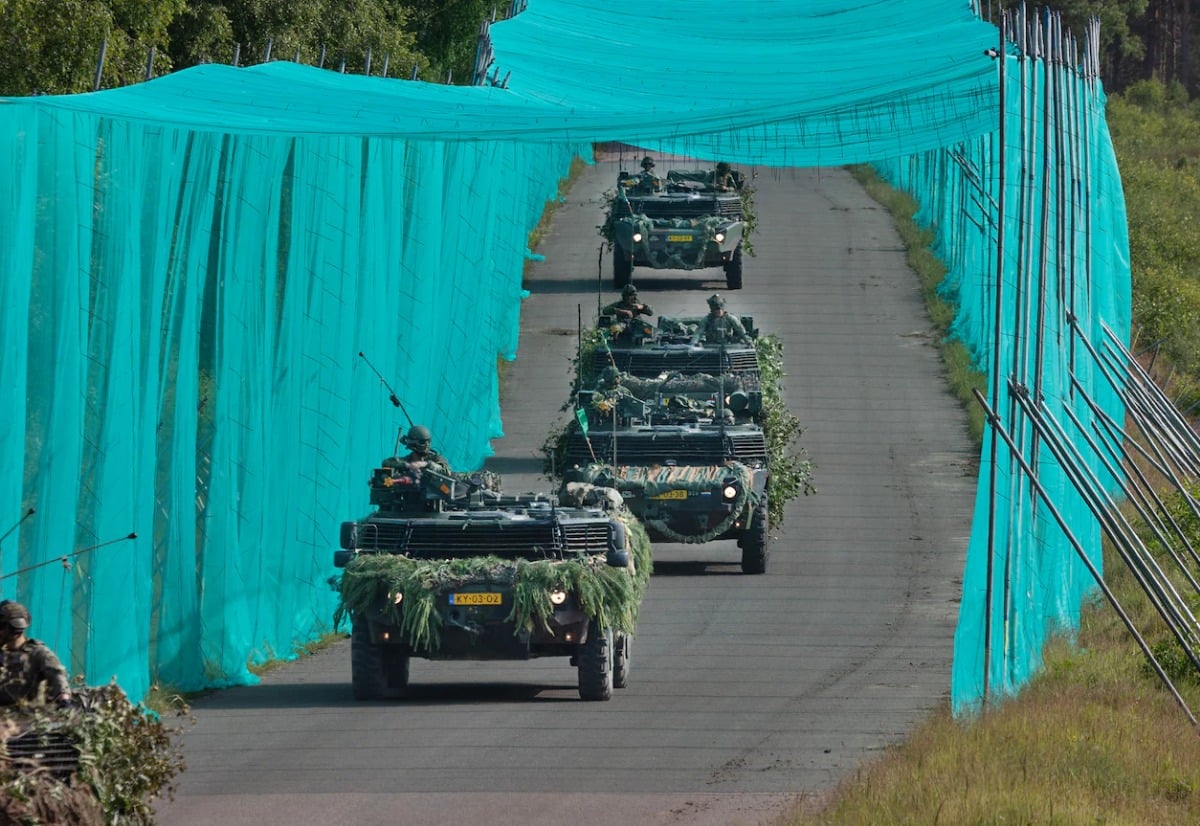
The rain in Lithuania does not fall; it hovers. It turns the pine forests into a gray soup and coats the inside of a soldier’s collar with a damp, freezing grit that stays for days.
Corporal Bram van Dijk—a hypothetical composite of the young men currently shivering in the Baltic woods—wipes the condensation from the lens of his night-vision optics. He is twenty-four years old. Back home in Utrecht, his friends are arguing over rent prices, drinking craft beers by the canals, and worrying about their corporate internships. Here, Bram is listening to the distant, rhythmic thud of simulated artillery.
He is one of 7,000 Dutch troops currently deployed across Eastern Europe. They are not fighting a war. They are practicing for one that everyone hopes will never happen.
For decades, the Royal Netherlands Army was structured for a completely different century. It was a lean, highly specialized force designed for peacekeeping missions in distant deserts or stabilization efforts in fractured states. High-tech, localized, and limited. But history has a cruel habit of waking up from its slumber.
The cold truth of modern European defense is no longer about asymmetric warfare or counter-insurgency. It is about mass. It is about armor. It is about the terrifying, industrialized scale of a state-on-state invasion.
The Arithmetic of Deterrence
To understand why 7,000 soldiers from a nation known for bicycles and windmills are digging trenches in the Baltic mud, you have to look at the map through a different lens.
Consider a simple mathematical reality. In the event of a theoretical breakthrough along the Suwałki Gap—the narrow strip of land connecting Poland and Lithuania—NATO forces would have hours, not days, to establish a wall of steel. The Dutch military isn't just participating in an exercise; they are testing the limits of their own logistics.
Moving thousands of troops, hundreds of armored vehicles, and tons of ammunition across a continent requires more than just a green light from parliament. It demands a flawless choreography of rail networks, border crossings, and mechanical reliability.
If a single Boxer armored vehicle breaks down on a two-lane highway in northern Poland, the entire column stalls. If the digital communication networks fail to sync with German or Lithuanian command structures, the defense fractures before a single shot is fired.
This exercise is designed to break those systems in a controlled environment so they do not break when the stakes are absolute.
The Weight of the Invisible Threat
There is a psychological toll to this kind of preparation. It is the burden of the unseen.
When soldiers train for a specific, localized threat, the objective is clear. You take the hill. You secure the compound. But when you train to deter a near-peer adversary—a military machine capable of electronic warfare, cyber disruption, and mass rocket artillery—the enemy is everywhere and nowhere.
During the drills, Dutch communication lines suddenly go dark. GPS signals flicker and die, replaced by static. This isn't a technical glitch. It is the simulation teams mimicking reality.
Imagine trying to navigate a forty-ton combat vehicle through an unfamiliar forest in the pitch black without a digital map. You rely on paper, a dim red flashlight, and the instincts of a driver who has had four hours of sleep in the last forty-eight.
The sophistication of modern warfare means the frontline is no longer just a trench; it is the entire electromagnetic spectrum. The Dutch troops are learning to operate in the blind, to embrace the chaos, and to find certainty when every instrument tells them they are lost.
Beyond the Iron and Steel
The true strength of a military does not reside in the specifications of its hardware. A CV90 infantry fighting vehicle is an impressive piece of engineering, but it is useless without the human element holding the line.
The Dutch integration into NATO’s enhanced Forward Presence is a political statement wrapped in a military reality. It signals to adversaries that an attack on Vilnius or Riga is treated exactly the same as an attack on Amsterdam or Rotterdam.
But for the soldiers on the ground, the grand strategy fades into the background. Survival and readiness shrink to the size of a squad. It becomes about keeping the diesel engines warm, ensuring the radio batteries don't freeze, and trusting the person standing watch next to you.
The local population watches these maneuvers with a mixture of relief and somber realization. For residents of the Baltic states, the sight of Dutch armor rumbling through their villages is not a theoretical exercise in geopolitics. It is a tangible reminder that they are not alone in the dark.
The forest eventually goes quiet as the exercise draws to a close. The simulated artillery falls silent, leaving only the sound of dripping water and the low idle of heavy engines.
Corporal van Dijk packs his gear into the back of his vehicle. His hands are raw, his boots are ruined, and the exhaustion settles deep into his bones. He will return to the Netherlands soon, back to the safety of a nation insulated by geography and history.
But the mud on his uniform will take a long time to wash out, a reminder of the thin line that separates the quiet comfort of home from the brutal realities of the eastern frontier.


