The air does not taste like oxygen anymore. It tastes like ash, wet cardboard, and a century of stored sunlight burning down to nothing.
Stand on the edge of the peat swamps in Indonesian Borneo, and you do not just smell the fire. You feel it in the back of your throat, a dry, metallic reminder that the earth is breathing differently this season. Out here, deep inside the ancient river basins where the forest floor is essentially a giant, waterlogged sponge of decayed vegetation, fire does not act like normal fire. It does not crackle through the treetops with bright, leaping flames. It creeps. It burrows downward, eating through meters of accumulated carbon beneath the surface, smoldering in the dark for weeks, invisible until a sudden plume of white smoke breaks through the roots of a collapsing ironwood tree. Discover more on a connected subject: this related article.
And right in the path of that slow-moving subterranean monster sits Camp Leakey.
Not a Hollywood set. Not a corporate compound. A collection of weathered wooden boardwalks, mosquito nets, and open-air platforms perched on the edge of the Tanjung Puting National Park. For decades, this research station has served as the ground zero of our understanding of Pongo pygmaeus—the Bornean orangutan. It is the place where Birutė Galdikas first mapped the complex, solitary emotional worlds of our orange-furred cousins, proving that we share this planet with creatures capable of profound grief, deep maternal devotion, and a quiet, contemplative intelligence that stares back at you with unsettling depth. Further reporting by TIME delves into related perspectives on this issue.
Now, the orange glow on the horizon is not an orangutan. It is flame.
The Anatomy of an Invisible Crisis
To understand why a fire in Borneo matters to someone sitting thousands of miles away in a concrete-and-glass metropolis, you have to throw out every standard metric of ecology and look at the soil beneath your feet.
Peat swamp forests are the lungs of the earth that nobody talks about. While the Amazon gets the headline glory for its towering green canopy, Southeast Asian peatlands are hyper-efficient carbon vaults. They have spent millennia locking away carbon dioxide beneath standing water. When the rains come, the system functions. When the rains fail—prolonged by shifting climate cycles, drained for illegal palm oil plantations, or fractured by adjacent canal-digging—that ancient sponge dries out.
Dry peat is not dirt. It is coal waiting for a spark.
When human error or deliberate slash-and-clear agriculture ignites the dry scrub at the forest edge, the fire crosses boundaries that humanity drew on maps but nature ignores. It slips beneath the surface. Firefighters can hose down the surface flames until the water runs clear, but forty centimeters down, the earth is still baking at hundreds of degrees, chewing through the root systems of trees that were seedlings when Columbus crossed the Atlantic.
Consider what happens to the residents when this occurs.
Orangutans do not panic and flee in a straight line. They are arboreal creatures. Their entire universe is vertical. When the canopy starts to choke with acrid smoke, they climb higher, coughing, disoriented, their lungs burning from the sulfurous haze. When the canopy itself begins to scorch, they are forced to descend to a forest floor they instinctively fear—a floor that is literally turning into a pizza oven.
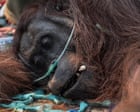
Field researchers and local guides tell stories of young orangutans wandering out of the smoke haze directly into human camps, not with aggression, but with the bewildered, stumbling gait of refugees. Their amber eyes are clouded with soot. Their hands are blistered. They reach out not to attack, but for water. For anything that stops the burning.
The Cost of Silence
We treat these events as distant tragedies. We look at satellite maps showing red thermal dots blooming across Kalimantan and Sumatra like a skin rash, click our tongues at the tragedy of it all, and scroll down to the next sports score or stock ticker.
That detachment is a luxury we invented. It is not real.
Every hectare of peat forest that burns releases millions of tons of carbon into an atmosphere that is already gasping for balance. The local fires in Indonesia have, in bad El Niño years, eclipsed the total daily carbon emissions of the entire United States industrial economy. The smoke does not respect national borders; it drifts across the Java Sea, chokes the skies over Singapore and Kuala Lumpur, and forces schools to close and hospitals to fill with children struggling for breath.
And at Camp Leakey, the threat is existential. This is not just a collection of buildings; it is an irreplaceable archive of behavioral data spanning fifty years. If the research station burns, we lose the continuous generational tracking of wild orangutan families—data that allows scientists to watch how wild primates adapt, or fail to adapt, to a rapidly shrinking world. We lose the physical infrastructure that protects one of the last truly wild strongholds left on the planet.
Why does it keep happening?
The answer is as old as civilization and as cold as economics. Palm oil. Paper pulp. The relentless global hunger for cheap vegetable fats and disposable packaging has turned the periphery of these national parks into a war zone of drainage canals and cleared land. Canals drain the water out of the swamps to make way for agriculture. Drained swamps dry out. Dry swamps burn.
It is a self-fulfilling prophecy written in charcoal and greed.
Standing in the Smoke
I have never stood inside Camp Leakey during a fire, but I have stood in the residual smoke of a Bornean dry-season burn, and it changes you. It strips away the comforting illusion that nature is something happening out there, separate from us, protected by a neat green border on a Google map.
The heat is oppressive, yes, but the silence is worse.
Normally, a rainforest is an auditory wall of sound—the high-pitched shrieks of gibbons, the guttural croak of hornbills, the endless, vibrating hum of millions of insects turning sunlight into life. When the fires close in, the sound changes. The birds leave. The insects drop silent or die in the grass. The forest holds its breath.
And in that heavy, suffocating stillness, the caretakers and local Dayak firefighters do something extraordinary. They do not wait for international aid packages or high-level climate summits. They haul heavy pumps through knee-deep muck. They dig trench lines with rusted shovels. They wet down the perimeter boards of the research station, working in shifts until their eyes are bloodshot and their skin is caked in black grime.
They are fighting for a ghost of the future. They are defending a place that proves humans can study nature without destroying it.
The Unfinished Story
The flames in Borneo will eventually go out. They always do—usually when the monsoon finally breaks the drought, turning the smoldering peat bogs back into mud and standing water.
The fires will stop, but the fundamental question will not.
When the smoke clears and the charred skeletons of dipterocarp trees stand like burnt matches against a gray sky, we will have to decide what kind of world we are willing to finance. Are we content to let the ancient forests of Southeast Asia be nibbled away at the edges until nothing is left except isolated zoos disguised as national parks? Or will we recognize that the health of a swamp in Kalimantan is directly connected to the air in our own lungs, the stability of our own climate, and the moral integrity of our species?
The orangutan does not write petitions. It does not file lawsuits or lobby governments. It simply looks at us through the smoke, holding onto a charred branch, waiting to see if we remember who we share this earth with.
The fire is still burning. The rest is up to us.