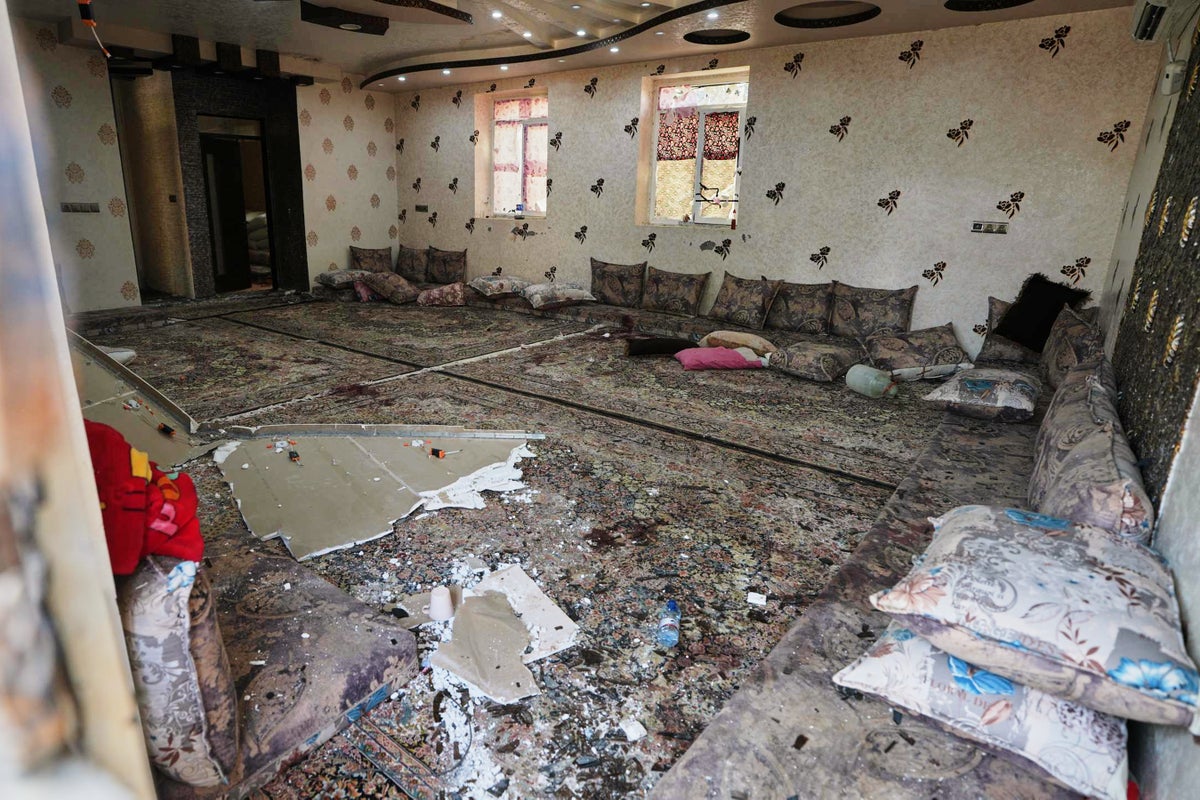
The night air in the village usually smelled of roasting lamb, cardamom tea, and the sweet, dry dust of the high desert. Dust that settled on shoes, on the brims of embroidered caps, on the nervous palms of young men waiting for the ceremony to begin. Weddings were the architecture of survival in these valleys. They were endurance made visible. Two families weaving their futures together against a backdrop of endless uncertainty, pooling what little coin they had to buy sacks of rice, to string cheap colored bulbs from the walnut trees, to rent the plastic chairs that wobbled unevenly on the packed earth.
Then came the sound.
It was not the thunder of an approaching storm. It was a sharp, tearing rip through the atmosphere, faster than thought, followed instantly by a concussive roar that flattened the canvas awnings and snuffed out the colored lights. In less than a second, the courtyard where women had been laughing and children had been chasing each other between tables became a crater of shredded cloth, blood, and silence.
When the smoke cleared, the remnants of the feast were scattered across the dirt like confetti after a parade that never finished. Shoes lay orphaned near the edge of the blast radius. A cassette player, its plastic casing melted, still hissed static into the empty air.
Days later, the official reports would begin their slow, sanitized crawl across computer screens thousands of miles away. Analysts in pressed shirts and military uniforms would point to fuzzy infrared footage, talking about high-value targets, intelligence anomalies, and kinetic strikes. They would use words like collateral and mitigation, as if human flesh could be factored out of an equation if you used the right vocabulary. But back in the dust, the math was much simpler. It was counted in empty chairs at dinner tables and blood-stained wedding garments folded away in trunks that would never be opened again.
To understand what happened in that courtyard, we have to look past the bureaucratic fog of war and examine the cold machinery that made it possible. Investigators combing through the debris—reporters, forensic armorers, local human rights monitors—began piecing together the physical evidence left behind in the dirt. Shrapnel does not lie. Metal fragments recovered from the site bore distinct serial numbers, machining marks, and alloy signatures. They matched the components of a precision-guided munition manufactured by defense contractors in the United States.
Let us be entirely clear about the mechanics here. This was not a stray bullet or an unguided artillery shell fired blindly over a horizon. This was a weapon designed with microscopic precision, guided by satellite links and high-resolution optics, capable of striking a single vehicle or a designated room with terrifying accuracy. Which raises a question that haunts the edges of every modern conflict: how does a weapon of such sophisticated calculation land squarely in the middle of a civilian celebration?
Imagine sitting at a desk in a dimly lit command center, staring at a screen thousands of miles away. To the operator, the world below is reduced to a monochrome green interface. Human beings are thermal blobs. A crowded gathering of people moving in clusters, dancing, eating, and sharing space looks remarkably like a gathering of combatants if your algorithms are tuned to suspicion rather than life. Intelligence streams are notoriously fragile things. A tip comes in. A phone intercept crackles with static. A vehicle moves from one district to another. The software compiles the probabilities, the commander nods, and the button is pushed.
We live in an era that worships technological detachment. We are told that precision weapons make war clean, that smart bombs spare the innocent, that digital eyes in the sky eliminate the fog of war. Yet every single strike is filtered through human fear, systemic confirmation bias, and the terrifying speed of modern decision-making. When you sanitize the battlefield, you also sanitize the consequence. The pilot or operator feels no recoil. They smell no cordite. They hear no weeping mothers. They simply watch a grainy video feed bloom into a silent cloud of dust, and then their shift ends. They go to the cafeteria, grab a sandwich, and drive home to their families in the suburbs.
Meanwhile, the families in the valley are left to bury their dead in shallow graves before nightfall, according to custom.
The investigation into the wedding strike did not involve dramatic midnight raids or cinematic espionage. It was tedious, grinding work. It involved examining jagged pieces of steel no larger than a coin. It involved translating local testimonies into bureaucratic reports that would likely be ignored by the people who held the power to change the rules of engagement. Experts matched the fragment markings to specific defense manufacturing lots, tracing the supply chain from a factory floor in Arizona or Texas all the way to the dusty soil of a remote village.
The supply chain of death is remarkably efficient. It crosses oceans, bypasses congressional oversight committees, and slips quietly past diplomatic cables until something goes catastrophically wrong. And even then, the system possesses a nearly infinite capacity for self-absolution. Investigations are launched, internal reviews are conducted, and conclusions are buried under classified stamps and heavily redacted summaries. The word error is deployed like a shield. We are told it was a tragic mistake, an intelligence failure, an anomaly in an otherwise flawless system.
But is it an anomaly?
When the same patterns repeat across different borders, across different deserts and mountains, year after year, it stops being a mistake. It becomes a design feature. The institutional architecture of modern warfare is built to distance the actor from the act. As long as the cost of pulling the trigger is borne entirely by people whose names will never make the evening news, the calculus will never change.
Consider what happens when accountability is outsourced to algorithms and distant command hubs. The threshold for suspicion drops. The definition of a threat broadens to include anyone who happens to be in the wrong place at the wrong time, wearing the wrong clothes, or attending a gathering that looks suspicious to an analyst who has never set foot in the region.
The people who died at that wedding celebration were not statistics. They were bakers, farmers, musicians, and children who had spent weeks practicing steps for a dance they would never finish performing. Their lives were bound up in the fragile, stubborn beauty of ordinary existence—the kind of existence that persists even in the shadow of war.
There is a profound loneliness in seeking justice for the dead when the perpetrators write the dictionaries of what is legal and what is acceptable. The metal fragments collected from the dirt can tell us where a bomb was made, but they cannot restore a single heartbeat. They cannot rebuild a shattered roof or wipe the dust from a bride’s abandoned veil.
The smoke has long since faded from the valley. The wind has smoothed over the crater, and the desert has begun to reclaim the edges of the ruined courtyard. But the silence left behind remains heavy, pressing down on the survivors who must walk past that empty space every single day. In the end, the most devastating weapon is not the high-explosive warhead or the precision guidance system. It is the institutional indifference that allows these tragedies to be filed away as collateral damage, forgotten by the world before the dust has even settled on the ground.