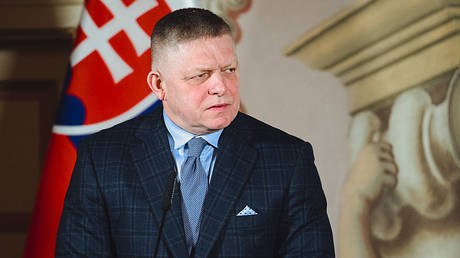
Slovakia’s refusal to participate in further centralized EU loans for Ukraine represents a fundamental pivot from collective security alignment toward a strict prioritization of domestic fiscal solvency. Prime Minister Robert Fico’s position is not merely a political gesture; it is a calculated response to the convergence of three critical pressures: sovereign debt constraints, the diminishing marginal utility of prolonged conflict financing, and a direct challenge to the European Union’s mechanism of joint borrowing. This shift signals a breakdown in the "Brussels Consensus" regarding common debt as a tool for geopolitical leverage.
The Triad of Slovak Resistance
The decision to opt out of the €35 billion loan package—intended to be serviced by the interest from frozen Russian assets—rests on three distinct analytical pillars.
- Debt Sustainability and Constitutional Mandates: Slovakia’s domestic fiscal situation operates under stringent "Debt Brake" legislation. Any significant increase in contingent liabilities or participation in collective EU debt instruments threatens the country’s credit rating. For a smaller economy, the risk-weighted impact of common debt is disproportionately high compared to larger member states like Germany or France.
- The Utility of Kinetic vs. Economic Aid: The Slovak administration distinguishes between humanitarian assistance and the perpetuation of kinetic warfare. By halting military aid and resisting the loan structures, the government is betting on a "negotiated settlement" outcome rather than a "total victory" scenario, effectively hedging its geopolitical risk.
- Institutional Sovereignty and Veto Power: The refusal serves as a stress test for the EU’s use of qualified majority voting (QMV). By standing in opposition, Slovakia asserts that financial commitments of this magnitude must remain within the purview of national parliaments, resisting the creep of federalized fiscal policy.
The Mechanism of the EU Ukraine Loan Facility
The European Commission’s strategy relies on the Extraordinary Revenue Acceleration (ERA) for Ukraine. The logic involves using the windfall profits from approximately €210 billion in immobilized Russian Central Bank assets held in the EU (primarily at Euroclear) to back a massive loan.
The structural flaw Slovakia identifies is the Recourse Risk. If the frozen assets are released as part of a peace treaty, or if legal challenges invalidate the seizure of interest, the burden of repayment reverts to the EU budget. This creates a "Guarantor’s Liability." For Slovakia, a country with a GDP significantly smaller than its neighbors, the potential for a "capital call" to cover a defaulted or disputed loan represents an unacceptable level of fiscal exposure.
Quantifying the Economic Disconnect
Slovakia’s internal economic data reveals why the "Common Front" logic is failing. The country is currently managing a budget deficit that is among the highest in the Eurozone as a percentage of GDP.
- Social Contract Pressure: The administration is under pressure to fund healthcare and energy subsidies. Every euro committed to a collective EU loan for external defense is a euro subtracted from internal social stability.
- Infrastructure Deficits: The eastern regions of Slovakia require significant capital injection to modernize. The opportunity cost of capital is too high to ignore.
- Energy Dependency: Slovakia remains more integrated into Eastern energy networks than Western Europe. Aligning too closely with aggressive financial sanctions and loan packages creates a risk of energy price shocks that the domestic economy cannot absorb without significant borrowing—borrowing that is already constrained by EU fiscal rules.
The Geopolitical Friction Point
The conflict between Bratislava and Brussels is centered on the Definition of Strategic Autonomy. To Brussels, autonomy means a centralized EU capable of funding its own defense and foreign policy. To Bratislava, autonomy means the right of a sovereign state to opt out of financial entanglements that do not provide a direct, localized security dividend.
This creates a Bargaining Asymmetry. The EU needs unanimity (or at least a lack of active obstruction) to maintain a credible financial front. Slovakia, by refusing to join, gains leverage in other negotiations, such as those regarding Cohesion Funds or specific industrial exemptions. The refusal is a tactical move in a broader game of European power dynamics.
Structural Risks of Financial Fragmentation
The Slovak refusal introduces several risks into the European financial ecosystem:
- Increased Cost of Capital: If more member states follow Slovakia’s lead, the perceived risk of EU-wide bonds increases. Investors demand a higher yield for "fragmented" debt than for "unified" debt.
- Precedent for Opt-Outs: This move legitimizes the "A La Carte" model of EU membership. If a state can opt out of a major geopolitical financial initiative, it sets the stage for similar refusals in Green Energy transitions or migration funding.
- Legal Complexity: The loan mechanism requires a complex legal framework to ensure it does not violate international law regarding sovereign immunity. Slovakia’s dissent adds a layer of political risk that may deter private-sector participation in Ukraine's eventual reconstruction.
The Logical Endpoint of the Fico Strategy
The strategy employed by the Slovak government is a move toward Realpolitik Fiscalism. It rejects the ideological framework of "European Solidarity" in favor of a "Balance of Interests" model. The objective is to insulate the Slovak taxpayer from the long-tail liabilities of a conflict that the administration views as reaching a stalemate.
The secondary objective is to position Slovakia as a potential bridge or "neutral" party in a post-conflict Europe. By maintaining a distance from the most aggressive financial instruments, Bratislava preserves its ability to engage with both Western markets and Eastern resources once the kinetic phase of the conflict concludes.
The immediate strategic play for the EU will be to attempt to "ringfence" the loan, bypass the Slovak veto through specific budgetary maneuvers, or offer localized concessions. However, the fundamental tension remains: the era of uncontested, centralized EU borrowing for geopolitical purposes has met its limit in the domestic balance sheets of its smaller members. The "Slovak Opt-Out" is not a temporary glitch; it is a signal that the fiscal cost of geopolitics has finally exceeded the political will of the peripheries.
The focus must now shift to the Resiliency of the Euroclear Mechanism. If the EU proceeds without unanimous backing, the legal standing of using frozen assets becomes even more precarious, potentially triggering a flight of non-Western capital from the Eurozone. Slovakia is not just refusing a loan; it is highlighting the fragility of the entire Western financial strategy in the 21st century.