The sound does not begin with an explosion. It begins with a low, rhythmic thrumming, a mechanical buzz that cuts through the thick humidity of a June night in Kyiv. It sounds like an overgrown moped engine suspended in the clouds. To anyone else, it might be an annoyance. To the four million people living in the Ukrainian capital, it is the sound of an impending lottery where the ticket is your life.
When the air raid sirens wail a few minutes later, the sound becomes a physical pressure against the chest.
In a small apartment on the eastern edge of the city, a woman named Olena—a composite of the thousands who lived through this exact dawn—does not scream. She does not panic. Panic is a luxury for those who still have a sense of novelty about war. Instead, she performs a sequence of actions that have become as instinctual as breathing. She grabs a pre-packed backpack by the door. She wakes her seven-year-old son with a hand over his mouth so he does not startle. They move to the corridor, placing two walls between themselves and the windows.
Outside, the sky splits open.
The Geography of Air Defence
The official reports from the local military administration will later summarize the night in a handful of sparse, clinical words: Air attack on Kyiv. At least two injured. Debris falling in the Dnipro district.
But facts stripped of their skin do not tell the story of what happens when a city is forced to look at its own sky as an enemy. Kyiv is protected by one of the most sophisticated, multi-layered air defence networks in human history. It is a invisible dome woven from American Patriots, German IRIS-T systems, and mobile groups of soldiers standing on rooftops with Soviet-era searchlights and shoulder-fired missiles.
When a Russian cruise missile or an Iranian-designed Shahed drone enters this airspace, a silent, invisible chess match begins at three times the speed of sound.
The defense systems work by intercepting the threat in mid-air. It is an engineering miracle. But a missile destroyed at ten thousand feet does not simply vanish into thin air. The laws of physics remain absolute, even in a war zone. Momentum cannot be deleted. What goes up must come down, shattered into jagged pieces of burning aluminum, unspent rocket fuel, and razor-sharp shrapnel.
This is the cruel paradox of modern air defense. To save the city from a direct strike on a power plant or an apartment block, the threat must be broken apart. But those broken pieces have to land somewhere.
On this particular night, they landed on a residential street.
The Weight of Metal
Consider the anatomy of a fragment. A piece of a destroyed missile the size of a laptop computer, falling from the upper atmosphere, carries enough kinetic energy to slice through a concrete roof like a hot knife through butter. It smells of scorched wiring and sulfur.
When the debris struck the Dnipro district, it did not hit a military outpost. It hit the quiet rhythm of ordinary lives.
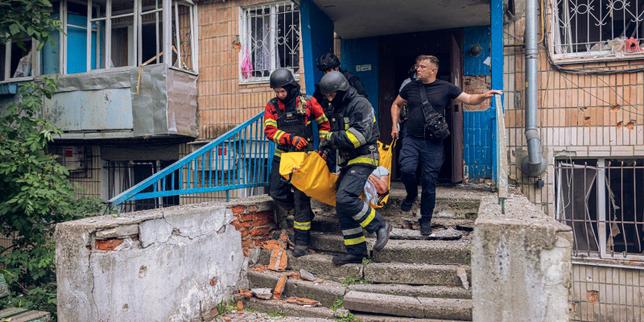
Two people were injured. In a city of millions, two is a statistical anomaly, a minor detail tucked into the lower paragraphs of an international news feed. But look closer at what those two injuries mean. They mean a man who was asleep at 4:00 AM is suddenly awake, his bedroom wall collapsed across his legs, his skin peppered with microscopic shards of shattered window glass. They mean a woman who was running for the shelter is struck by a piece of scorching metal no larger than a coin, leaving her with deep burns and a trauma that will outlast the physical scars by decades.
The administrative reports do not mention the third casualty of these nights: the collective nervous system of an entire population.
Living under a sky that regularly rains fire alters human biology. Cortisol levels remain permanently elevated. The brain adapts to a state of hyper-vigilance where every sudden slam of a car door, every rumble of a passing truck, and every thunderstorm is interpreted as an incoming strike. Sleep becomes fragmented, broken into ninety-minute intervals between the alarms.
Yet, the city moves forward. This is the most jarring aspect of contemporary Kyiv for any outside observer. By 8:00 AM, the air raid has ended. The emergency crews have swept the blackened metal from the asphalt. The broken glass has been shoveled into neat piles by municipal workers in orange vests.
And people go to work.
The Architecture of Defiance
They walk past the scarred buildings with coffees in their hands. They open their laptops in cafes that are powered by generators because the grid is still recovering from previous attacks. They buy flowers from vendors who set up their stalls right next to the cordoned-off impact zones.
This is not a lack of feeling. It is a deliberate, militant refusal to let the chaos dictate the terms of their existence. If you stop going to work, if you stop opening your shop, if you let the fear paralyze you, then the drone that was shot down three hours ago has achieved its purpose anyway. The strategy of modern terror bombing relies less on the physical destruction of targets and more on the psychological collapse of the civilian population.
The defense of Kyiv is therefore two-fold. It is maintained by the operators sitting in dark command posts, watching green blips on radar screens and launching million-dollar interceptors into the night. But it is also maintained by the barista who sweeps up the glass from her storefront and immediately begins brewing espressos for the people on their way to the office.
We often look at conflict through the lens of grand strategy, maps with shifting red lines, and geopolitical alliances. We discuss the delivery of weapon systems as if they were pieces in a board game.
But the real stakes are found in the small spaces. They are found in the corridor where Olena sits with her arm around her son, reading him a story from a phone screen with the brightness turned down low so as not to draw attention. They are found in the smell of ozone that lingers over a residential street as the sun rises, painting the sky in pale pinks and blues that look entirely too peaceful for what they just witnessed.
The sirens will eventually sound again. The thrumming will return to the air. The lottery will resume its spin. But until that moment arrives, the city breathes, rebuilds, and waits for the next dawn.