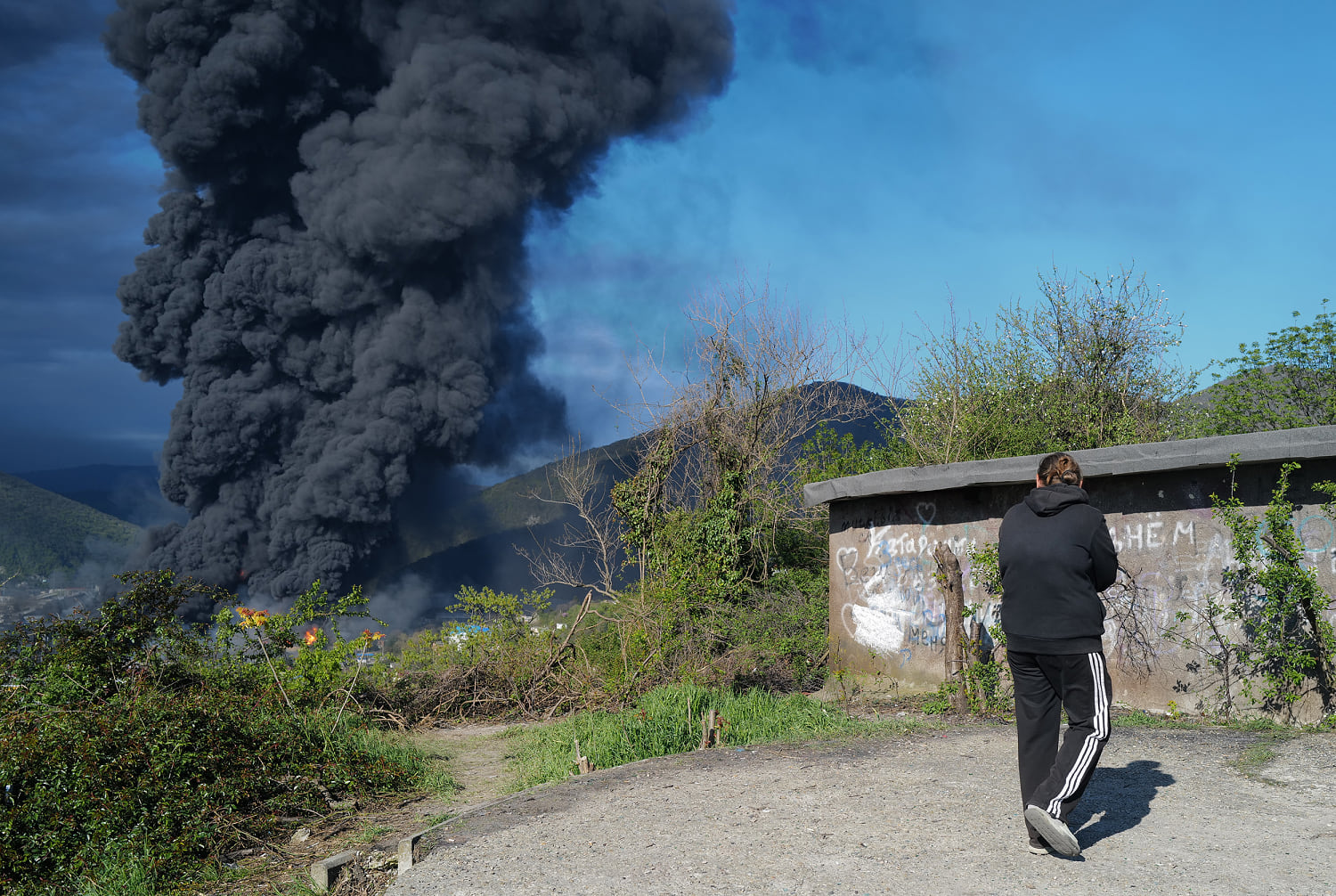
The laundry on the line was the first casualty. White sheets, hung out to catch the salt-tinged breeze of the Black Sea, didn’t dry under the sun. Instead, they curdled. By noon, they were marbled with oily, translucent spots that smelled of a mechanic’s floor and old nightmares. This is not a metaphor. It is the sensory reality for the people of Tuapse, a town where the horizon has turned into a chemical furnace.
For decades, the rhythm of life here was dictated by the tides and the slow hum of the oil refinery. It was the town’s heartbeat, a massive industrial lung that inhaled crude and exhaled the promise of stability. But war has a way of turning a neighbor into a threat. When Ukrainian drones found their mark on the export terminals and storage tanks, they didn't just hit infrastructure. They punctured the sky.
The Midnight Rain
Consider a father—let’s call him Mikhail—standing on his balcony in the early hours of the morning. He isn't looking for stars. He is watching for the dull, orange glow that indicates the air he breathes is about to change. When the strikes hit the Tuapse refinery, the explosion wasn't just a sound. It was a physical weight. The shockwave rattled the windows, but the silence that followed was far more terrifying.
Then came the rain.
It wasn't water. It was an aerosolized mist of heavy hydrocarbons, a slick of unrefined product cast into the atmosphere by the sheer heat of the blast. As the fire roared at the terminal, the wind carried a plume of toxic particulates over the residential blocks. People woke up to find their cars coated in a sticky, iridescent film. The grapes in the backyard gardens, usually the pride of the Black Sea summer, were suddenly dripping with petroleum.
This is the invisible front line. There are no soldiers in the streets of Tuapse, but the war is inside the lungs of every child waking up with a dry, metallic cough.
A Chemistry of Despair
The science behind this "oil rain" is as brutal as it is simple. When millions of gallons of oil ignite, the combustion is rarely complete. Massive amounts of soot, sulfur dioxide, and nitrogen oxides are heaved into the air. But the real danger lies in the Volatile Organic Compounds (VOCs). These are the ghosts of the petroleum industry. They are invisible, often sweet-smelling, and profoundly carcinogenic.
Benzene doesn't care about your politics.
In the heat of a refinery fire, these chemicals bond with moisture in the air. When the temperature drops, they fall. They settle on the soil where the local markets get their tomatoes. They seep into the groundwater. They coat the skin of the stray dogs that roam the docks. The local authorities might issue a dry statement about "localized environmental incidents," but the residents know better. You can’t scrub this kind of damage off with soap and water.
The Black Sea itself, once a playground for Soviet elite and modern tourists alike, is now a collection point for this fallout. The oily sheen on the waves isn't just an eyesore; it is a suffocating blanket for the local ecosystem. Small fry and dolphins don't have the luxury of evacuation.
The Erosion of the Mundane
The most insidious part of an environmental catastrophe born of conflict is how it rots the everyday. We often think of war as a series of grand, tragic moments—explosions, sirens, retreating lines. We forget the slow erosion.
In Tuapse, the erosion looks like a woman scrubbing her windowsill for the fourth time in a day, her rags coming away black. It looks like the closed windows in the height of a humid summer because the air outside tastes like burning rubber. It is the constant, nagging anxiety of wondering if the water from the tap is safe to wash the baby.
There is a specific kind of psychological exhaustion that comes with living in a "target zone." Every time a drone is spotted, the fear isn't just of the blast. It is a fear of the aftermath. The residents have become unwilling experts in the viscosity of oil and the direction of the wind. They watch the weather reports not for rain, but for dispersal patterns.
The Invisible Stakes
Why does this matter to someone who has never heard of a small port town on the Black Sea? Because Tuapse is a preview. It represents the collision of high-tech modern warfare and the fragile, aging industrial backbone of our world. We have built our civilizations on top of powder kegs, and we are now seeing what happens when those kegs are systematically dismantled.
The "oil rain" is a physical manifestation of a broken world. It is the point where geopolitical strategy meets the kitchen table. When an export terminal is hit, the spreadsheets in London or New York might show a flicker in the price of Brent Crude. But in the streets of the town, that "flicker" is a child being told they can’t play outside because the air is toxic.
The stakes aren't just energy security or territorial integrity. The stakes are the fundamental right to exist in a space that doesn't poison you.
The Cost of Silence
There is a heavy silence that follows these strikes. Information is tightly controlled. State media focuses on the heroism of the firefighters, while independent reports are filtered through the fog of war. In this vacuum, the people of the Black Sea coast are left to their own devices. They exchange tips on Telegram about how to clean petroleum off of brickwork or which masks actually filter out the smell of sulfur.
They are living in a shadow world. They are the collateral damage of a conflict that views their town as a coordinate on a map rather than a place where people fall in love, raise families, and hang their laundry out to dry.
The fires eventually go out. The black smoke dissipates into a grey haze. But the oil stays. It stays in the silt of the harbor. It stays in the floorboards of the houses. Most importantly, it stays in the memory of a population that realized their sky could turn against them at any moment.
Mikhail stands on his balcony again. The refinery is quiet for now, a charred skeleton against the deep blue of the sea. He looks at his hands, stained with a soot that won't quite wash away, and wonders when the next cloud will come. The laundry is gone. The line is empty. The wind has picked up, but nobody is opening their windows.
The sun sets over the Black Sea, reflecting off a surface that shouldn't be that shiny, a mirror of grease and salt, waiting for the next spark to ignite the horizon.


