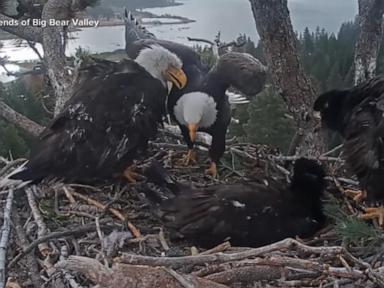
For millions of people scattered across continents, daily life began with the click of a tab. They did not check the stock market or the morning weather first. Instead, they opened a live stream window peering into a towering Jeffrey pine overlooking Big Bear Lake in the San Bernardino National Forest. There sat Jackie.
She was not merely a bird. She was a fixture of domestic routine for an invisible global village.
Imagine waking up in a cramped Tokyo apartment, brewing coffee while the morning sun has barely scraped the horizon, and watching a wild raptor adjust her wings against a blanket of mountain snow half a world away. That digital window connected strangers through shared breath and quiet anticipation. When Jackie and her mate, Shadow, built their fortress of sticks, defended it against rival intruders, and weathered brutal freezes, watchers felt it in their bones. They were witnesses to raw, unfiltered survival.
Then came July.
The forest floor does not care about digital audiences. Nature is indifferent to the millions of human hearts invested in its drama. Found grounded, thin, and dehydrated after a grueling territorial defense, Jackie was pulled from the wild and rushed into human custody. Patient 26-519 entered the sterile, quiet confines of the Ojai Raptor Center.
What followed was a three-week vigil that tested the limits of modern veterinary medicine and collective grief.
Inside the clinic, a specialized team fought a silent war against collapsing biology. Severe anemia dragged her red blood cells down to terrifying depths. Specialists from across the country weighed in. Even Spirit, an ambassador eagle stationed miles away at the California Living Museum Zoo, offered a lifeline through a desperate blood transfusion. For a brief, agonizing moment, the needle ticked upward. Hope flared across message boards and social media feeds. People dared to exhale.
Biology, however, has its own cold arithmetic.
A body that has spent a lifetime mastering the fierce winds of the San Bernardino peaks cannot always be reassembled by human hands. Complications compounded. Blood clots settled stealthily into her wing and kidney. Her bone marrow faltered. The vital spark that had weathered blizzards and raised generations of eaglets began to dim.
In the quiet hours of August 9, 2026, the struggle ended.
The silence left behind in the digital chat rooms was deafening. Thousands who had spent years tracking every feather drop and fish delivery were suddenly forced to reckon with an empty sky. Yet, the story does not simply evaporate into grief.
Consider what happens next in the valley. Nature abhors a vacuum, even an emotional one. Observers tracking the nest have already spotted new wings passing through the canopy, including a young banded eagle known as KD1 landing near Shadow. Life presses forward with absolute, unyielding momentum, indifferent to the tears shed by those who loved a creature they could only ever touch through a screen.
Jackie's physical form has since traveled to the National Eagle Repository, destined to honor cultural and ceremonial traditions for indigenous communities. Her legacy, however, remains etched into the digital consciousness of a modern world that desperately craves connection to the wild. She forced millions to look up from their glowing rectangles and remember that we share this fragile earth with forces far greater than ourselves.
The nest high above the lake is changing. The air is quiet. But every time the wind whips through the pine needles of Big Bear, the ghost of its most famous resident lingers, reminding us why we cared so deeply in the first place.