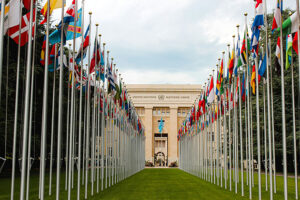
In December 1966, representatives from dozens of nations gathered in New York to draft a document intended to change the world. They signed the International Covenant on Civil and Political Rights. Article 22 of that treaty set down a clear, unyielding line: everyone has the right to freedom of association.
It sounded definitive. It felt historic. Yet for six decades, that clause sat on the page like a promissory note no one could actually cash.
Picture a nurse in a crowded municipal hospital. Call her Elena. Every night, she watches staffing levels drop while patient rosters double. She talks with her colleagues in whispered exchanges near the supply closet. They decide to form a union, not to bring down the management, but simply to demand enough hands on deck to keep patients alive.
The next morning, her supervisor calls her into a back office. There are no heavy-handed arrests or public scenes. Instead, the director hands her a transfer notice to an isolated facility three hours away. Her pay stays the same. Her title remains intact. On paper, no violence occurred. No law was broken. But the message is delivered with surgical precision: speak together, and your life will be quietly disassembled.
For sixty years, international law looked at Elena’s situation and shrugged.
Legal systems across the globe maintained a narrow, rigid definition of what it meant to violate collective rights. Unless a government locked up union leaders or explicitly outlawed assembly, international monitors rarely intervened. The subtle weapons—bureaucratic red tape, subtle retaliation, blacklisting, and administrative exile—remained invisible to the global institutions tasked with protecting working people.
That quiet silence finally broke.
The Shell Game of Modern Control
The United Nations Human Rights Committee recently issued a definitive interpretation of Article 22, fundamentally redefining how global bodies monitor rights at work. They spent years analyzing cases from across continents, sifting through mountains of evidence where workers were crushed not by batons, but by legal loopholes.
Governments and corporations have perfected the art of passive suppression. They learned that direct suppression creates martyrs, whereas administrative quicksand creates resignation.
Consider how easy it is to dismantle a group without ever firing a bullet. A government simply increases the registration requirements for an independent association. They require eighty percent of a sector's workforce to sign their full names, physical addresses, and tax numbers on a public registry before recognition is granted.
If workers sign, their employers receive the list. If they do not sign, the group is declared illegal.
It is a trap. A legal, highly polished trap.
Under the new UN interpretation, these procedural barriers are recognized for what they truly are: intentional violations. The committee established that freedom of association does not merely exist when a group forms. It must exist throughout the group's lifetime. Protectable action includes the right to organize, negotiate, strike, and operate without fear of indirect retaliation.
Why a Sixty Year Gap Happened
To understand why it took six decades to reach this point, look at how power structured itself after the Second World War.
When the original covenant was drafted in 1966, the geopolitical landscape was fractured along ideological fault lines. Western nations prioritized individual liberties like voting and free speech. Eastern bloc nations emphasized state-managed labor systems. Freedom of association became a bargaining chip—a phrase both sides agreed to write down because both believed they could define it to suit their own domestic interests.
The wording was left intentionally vague. Vagueness keeps signatures on a document, but it leaves human beings unprotected in the real world.
Decades passed. Labor markets shifted. The rise of precarious gig work, subcontracting, and remote labor fractured the traditional workplace. The factory floor—where hundreds of workers stood shoulder to shoulder and realized their collective power—was replaced by isolated contractors staring at individual screens.
As the structure of work evolved, tactics of suppression evolved with it. Algorithms now track worker sentiment. Union organizers are flagged by automated scheduling systems that deliberately split up vocal employees. Subcontractors are dropped the moment their teams begin discussing collective terms.
The old legal frameworks were completely blind to these mechanisms. They were built to spot a nineteen-fifties police line, not a twenty-first-century algorithmic schedule tweak.
The Cost of Isolation
When individuals are stripped of their ability to act together, the consequences extend far beyond the workplace.
Humans are fundamentally social creatures who rely on collective strength to balance asymmetric power. When a single worker stands alone against an enterprise with billions in capital or a state with endless legal resources, the outcome is predetermined.
The result is a pervasive, silent exhaustion.
When people realize that joining forces with their neighbors or colleagues will lead to quiet ruin, they stop trying. They turn inward. Social trust erodes. Democratic institutions wither from the ground up because the basic muscle memory of collective action—meeting, debating, compromising, and standing together—atrophies.
The UN Human Rights Committee’s decision directly addresses this psychological reality. By expanding the definition of interference to cover indirect intimidation, economic coercion, and administrative harassment, the ruling shifts the burden of proof.
States can no longer point to the absence of physical violence as proof of compliance. They must now demonstrate that citizens can organize without facing structural ruin.
What Real Protection Looks Like
The new standard sets clear boundaries for what nations must guarantee if they claim to respect fundamental human rights.
- Immunity from administrative harassment. Governments cannot use arbitrary registration delays, onerous auditing requirements, or legal fees to starve an organization out of existence.
- Protection against economic retaliation. Employers cannot use demotions, sudden shifts in scheduling, or contract terminations to punish workers who attempt to form collective groups.
- The right to meaningful action. Association is not an abstract hobby. Groups have the explicit right to bargain, strike, and advocate publicly without state interference.
- Coverage for non-traditional labor. Freelancers, gig workers, and informal laborers inherit these protections regardless of how their contracts are classified under domestic law.
This is a fundamental recalibration. It strips away the legalistic excuses that allowed states to praise human rights on the international stage while dismantling them at home.
The Long Road Ahead
Legal interpretations do not fix broken systems overnight. A statement from a UN committee in Geneva does not instantly stop a supervisor from cutting an organizer's hours in a logistics warehouse half a world away.
International law is slow. It relies on pressure, embarrassment, and the gradual alignment of domestic courts with global standards.
Yet, words matter. They provide the legal scaffolding for activists, lawyers, and ordinary citizens fighting uphill battles in hostile courts. When Elena faces her transfer notice today, her legal team can point to a clear global consensus: her rights were violated the moment her collective voice was targeted.
The treaty signed sixty years ago was a hollow promise to millions who tried to stand together and found themselves isolated instead. The invisible ink on that document has finally been made visible.
Rights do not survive because they are written down on parchment in air-conditioned halls in New York or Geneva. They survive only when ordinary people use them to protect one another in the dark, uncomfortable places where power actually lives.