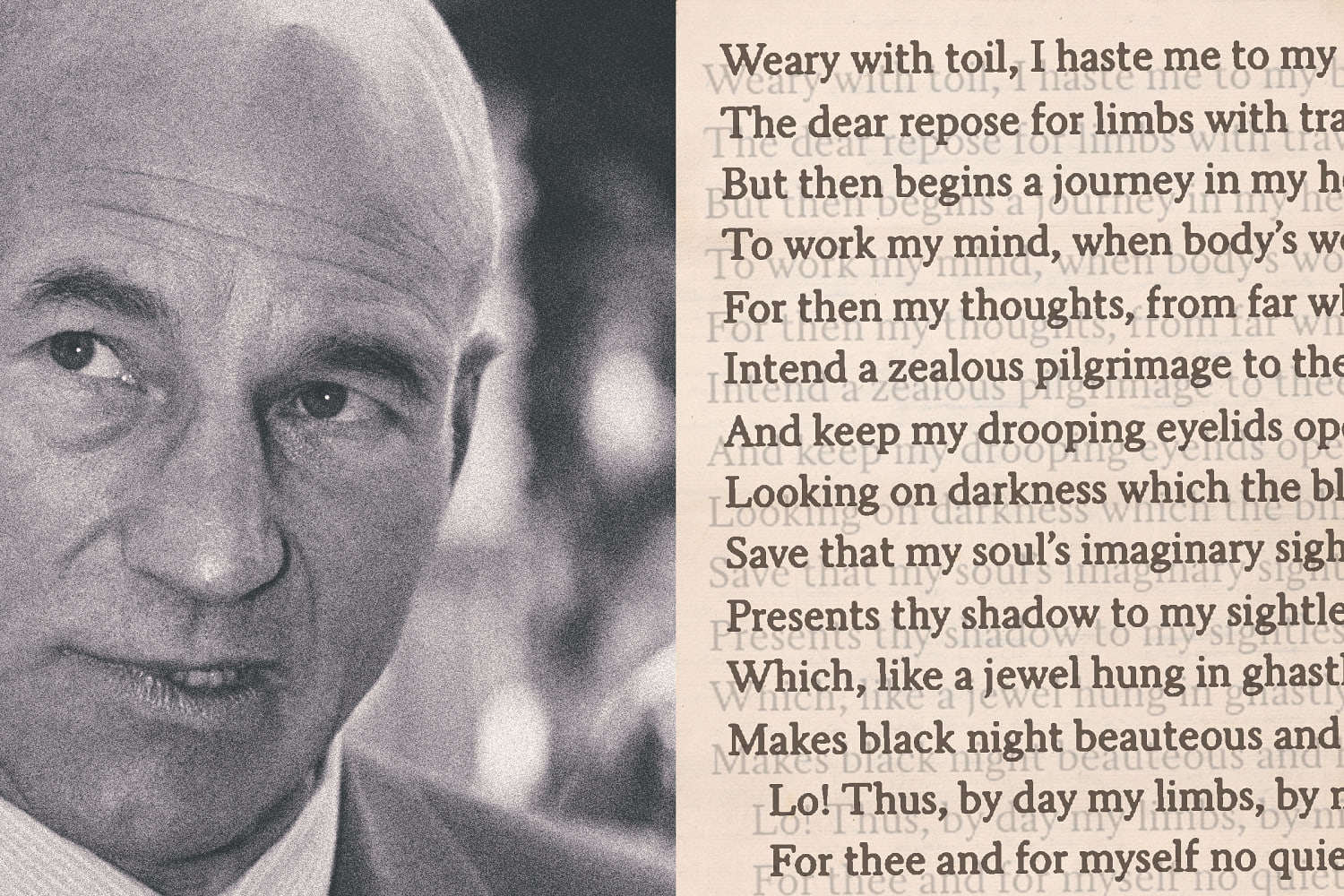
You can't code gravity. When Sir Patrick Stewart steps onto a stage and delivers a line from Hamlet or Macbeth, the air in the room changes. It's a weight, a sudden shift in atmospheric pressure born from decades of human heartbreak, triumphs, and the literal sweat of theatrical repetition.
Lately, tech executives love pairing classical actors with generative artificial intelligence. They want to show that software can master the heights of human expression. They drag out the Bard of Avon as the ultimate fitness test for large language models. The narrative is always the same. They claim algorithms can now decode the deep emotional resonance of William Shakespeare.
They're wrong. It's a massive misunderstanding of what makes art hit you in the gut.
The intersection of Patrick Stewart, AI, and Shakespeare reveals a glaring truth. Tech companies are trying to automate soul, and it's failing. Resistance to this machine-made art isn't just futile; it's entirely necessary.
The Illusion of Machine Eloquence
Large language models are brilliant statistical mimics. If you feed Google's Gemini, OpenAI's GPT-4, or Anthropic's Claude the entire First Folio, they will spit out perfectly metered iambic pentameter. They understand the rules of the game. They know that a sonnet requires fourteen lines and a specific rhyme scheme.
But structure isn't art.
When a machine generates a Shakespearean soliloquy, it predicts the most likely next word based on a mathematical probability distribution. It doesn't know what it feels like to fear death. It has never looked into the eyes of a lover and felt the terrifying sting of jealousy.
Patrick Stewart spent years with the Royal Shakespeare Company long before he ever captained the Starship Enterprise or led the X-Men. His performances carry the weight of a living, breathing human existence. When he speaks Shakespeare, he pulls from his own childhood memories in Yorkshire, his relationships, and his deep understanding of human frailty.
An AI doesn't have a childhood. It has a training set.
The software can mimic the cadence of a tragedy, but it misses the subtext. True acting lives in the spaces between the words. It's the hesitation before a line, the slight crack in a voice, or the sudden drop in volume that forces an audience to lean forward. AI text generators smooth out these imperfections. In doing so, they kill the drama.
Why Shakespeare Resists the Algorithm
Shakespeare wrote for the stage, not the page. His words were meant to be spoken aloud by actors navigating a physical space in front of a live, unpredictable audience.
"To be, or not to be, that is the question."
An algorithm reads that line as a sequence of tokens. It analyzes the syntax. It notes the historical frequency of the phrasing.
An actor reads that line and makes a choice. Do they deliver it with profound exhaustion? Anger? A quiet, chilling calm?
That choice depends on the specific production, the director's vision, and how the actor feels that night. It relies on human agency. AI lacks agency. It relies on a temperature setting—a randomized variable injected into the code to simulate creativity. Randomness is not the same as intention.
The Royal Shakespeare Company actually experimented with digital technologies and digital avatars in past productions, such as their 2016 staging of The Tempest. They used real-time motion capture to create a digital Ariel. But notice the crucial detail. The technology served the actor. The performance was still grounded in the real-time physical movements and vocal choices of a human being on stage.
When tech platforms try to flip this dynamic—making the AI the creator and the human just a passive consumer or a voice actor reading a script—the result feels hollow. It becomes corporate content instead of culture.
The Flaw in the Data-Driven Monologue
Silicon Valley operates on the assumption that everything can be optimized. If you gather enough data, you can perfect the output.
This logic falls apart when applied to classical theatre. Shakespeare is inherently messy. The texts we have today are filled with historical ambiguities, printer errors from the 17th century, and words that have completely shifted meaning over four hundred years.
Human actors spend weeks in rehearsal rooms debating these ambiguities. They argue over punctuation. They try a line twenty different ways to find the hidden truth beneath the surface.
AI doesn't debate. It averages.
By pulling from thousands of existing commentaries and past performances, the machine creates a composite. It gives you the most generic, universally agreeable version of a text. It strips away the radical, idiosyncratic interpretations that make a performance memorable. You don't get Patrick Stewart's legendary intensity. You get a museum gift shop postcard version of it.
The Creative Path Forward
We need to stop asking whether AI can write like Shakespeare or act like Patrick Stewart. It can't. The real question is how human creators can protect the sanctity of live, unpredictable performance in a culture flooded with synthetic media.
If you are a writer, an actor, or a creator, don't try to beat the machines at their own game. Don't try to be perfectly polished or hyper-prolific. Lean heavily into your flaws, your strange specificities, and your lived experiences.
- Emphasize live experiences. Seek out and support physical theatre, live readings, and unedited spaces where things can go wrong. The thrill of live performance is the inherent risk of failure.
- Reject the corporate vocabulary. Stop calling art "content." Stop treating stories as "assets" to be scaled. Use language that honors the labor of human imagination.
- Focus on subtext. When creating, focus on what is unsaid. Write characters who lie, who contradict themselves, and who make irrational choices that defy mathematical logic.
The machine might copy the text. It might even mimic the voice. But it will never possess the heartbeat. Keep your focus on the messy, glorious reality of human connection, and let the software play with the empty shells of words.