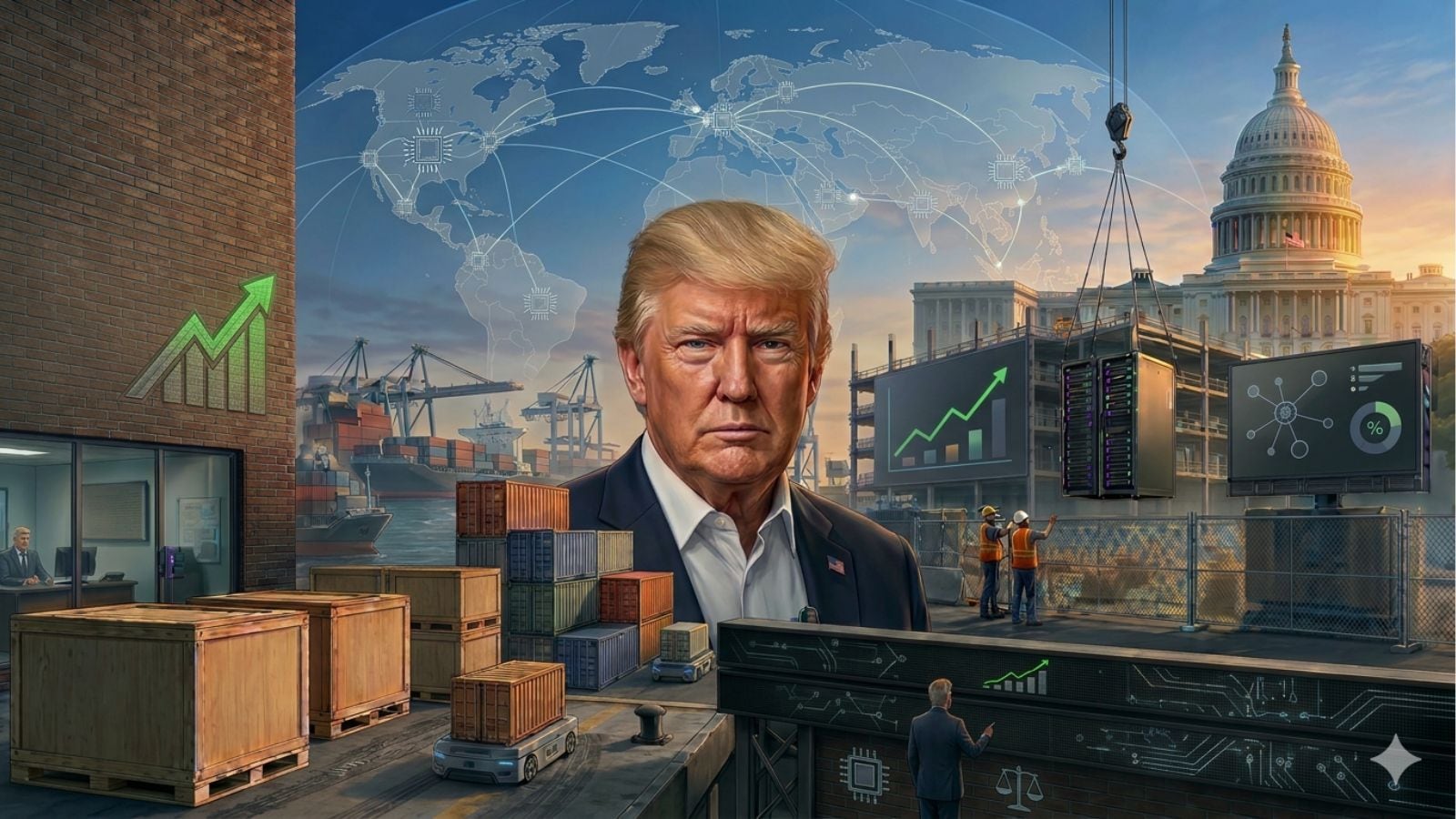
The hum in the basement of a nondescript data center in Northern Virginia doesn’t sound like a financial crisis. It sounds like a swarm of digital bees, a steady, physical vibration that rattles the marrow of your bones if you stand too close to the server racks. This is the heartbeat of the AI boom. It is also the sound of a deepening hole in the American ledger.
For decades, the political rhetoric surrounding trade has focused on the tangible. We talked about steel. We talked about cars. We talked about grain flowing out of the Midwest and cheap plastic toys flowing in from ports in Shenzhen. But the new deficit isn't made of steel or plastic. It is made of heat, electricity, and the specialized glass-and-metal slabs known as H100s. For a different view, read: this related article.
The math of the modern era is shifting. We are witnessing a peculiar phenomenon where the more "intelligent" our economy becomes, the more we seem to owe the rest of the world.
The Invisible Import
Consider a mid-sized software firm in Indianapolis. Let's call the lead architect Sarah. Sarah isn't thinking about the balance of trade when she pulls an API key to integrate a new large language model into her company’s customer service portal. She is thinking about efficiency. She is thinking about the fact that her team can now do the work of forty people with only four. Similar insight on this trend has been provided by The Verge.
But every time Sarah’s code "thinks," a chain reaction occurs that crosses oceans.
To power the intelligence Sarah uses, her provider needs chips. While the designs for those chips often originate in high-end offices in Santa Clara, the physical manifestation of that genius—the actual silicon—is almost exclusively a product of international trade. When we import the hardware necessary to run the AI revolution, the numbers on the national balance sheet tick upward.
The president looks at these numbers and sees a leak. In the traditional view of economics, a trade deficit is a sign of weakness, a suggestion that we are consuming more than we are producing. If we spend billions on foreign-made high-tech components to build our digital future, those billions are technically leaving the domestic ecosystem.
The irony is thick. To win the race for the most advanced artificial intelligence, the United States must buy the very things that make the trade deficit wider. We are purchasing the tools of our future sovereignty from a global market that the administration is simultaneously trying to distance itself from.
The Geography of a Calculation
There is a specific kind of tension in the air when trade delegates meet. They look at spreadsheets that categorize products into "Advanced Technology Products" or ATPs. In years past, the U.S. maintained a healthy surplus in this category. We were the world’s laboratory. We exported the complex stuff and imported the simple stuff.
That script has flipped.
The AI boom requires a physical infrastructure that the U.S. currently cannot manifest alone. To understand why, you have to look at the extreme precision required in lithography. We are talking about machines that use extreme ultraviolet light to etch patterns onto silicon that are smaller than a virus. These machines are the most complex instruments ever built by human hands.
When the U.S. buys these components, or the chips they produce, it isn't just a transaction. It’s an admission of a specific kind of dependence.
Imagine the trade deficit as a giant, invisible weight sitting on a scale. On one side, you have everything we sell to the world: movies, airplanes, medicine, and financial services. On the other side, you have everything we buy. Usually, when the "buy" side gets too heavy, politicians panic. They see jobs disappearing. They see wealth evaporating.
But AI is different. Or at least, the people building it argue that it is. They argue that this isn't "consumption" in the way that buying a foreign-made television is. This is "capital investment."
If you buy a hammer from a neighbor to build a house, you have a trade deficit with your neighbor for one day. But at the end of the month, you have a house. The house has value. It generates wealth. The "deficit" was merely the price of growth.
The President’s Dilemma
The political friction arises because "the house" in this metaphor is digital. It’s hard to show a voter a digital house. It’s much easier to show them a spreadsheet that says we owe more to foreign entities than we did last year.
The administration finds itself caught in a pincer movement. On one hand, they want to "Buy American." They pass legislation like the CHIPS Act to bring manufacturing back to domestic shores. They want the heat and the hum of those servers to be powered by American-made silicon.
On the other hand, the AI race is moving at a speed that domestic manufacturing cannot yet match. Building a fabrication plant—a "fab"—takes years. It takes tens of billions of dollars. It takes a specialized workforce that doesn't just appear overnight because a bill was signed in D.C.
So, in the interim, we buy. We buy from Taiwan. We buy components from South Korea. We buy the cooling systems and the specialized power units.
Every time a new data center breaks ground in the Nevada desert or the plains of Iowa, the trade deficit for that month likely widens. The president detests this because it provides a narrative of decline that is easy to weaponize. It looks like we are losing.
But are we?
The Ghost in the Machine
Let’s go back to Sarah in Indianapolis.
The software her company created using those imported chips is now being sold to clients in London, Tokyo, and Dubai. This is where the math gets murky. When we export "AI Services," the value is often harder to track than a crate of oranges.
How do you value the productivity gain of a firm that uses AI to discover a new drug six months faster than it could have five years ago? That drug will be a massive export for the U.S. for decades. But today, right now, the only thing the trade ledger sees is the $40,000 server blade that had to be imported to make the discovery possible.
We are living in a period of "lagging indicators." The cost is immediate and visible. The profit is future-dated and abstract.
This creates a psychological gap. For a leader who defines national strength through the balance of physical goods, the AI boom feels like a trap. It’s a gold rush where we are forced to buy all our shovels from a competitor across the street. Even if we find the gold, the fact that we had to buy the shovels still stings.
The Human Toll of the Ledger
There is a human element to these macro-economic shifts that often gets lost in the noise of a press briefing.
Think about a worker in a traditional manufacturing town—someone whose job is directly tied to the "old" trade balance. To them, the "AI Trade Deficit" isn't an abstract concept. It represents a shift in where the country’s wealth is being focused.
When the government worries about the trade deficit, they often implement tariffs. They try to balance the scales by making the imports more expensive. But if you put a tariff on the chips Sarah needs for her software, you don't just hurt the foreign manufacturer. You hurt Sarah. You make her American-made software more expensive for her clients in London.
Suddenly, the effort to "fix" the trade deficit ends up stifling the very innovation that could eventually reverse it.
It is a delicate, high-stakes game of chicken. The administration wants to force companies to build here. The companies want to move fast enough to win. The trade deficit is the friction created by those two opposing forces rubbing against each other.
The Architecture of Dependence
We often talk about "energy independence" as the holy grail of national security. In the 21st century, "compute independence" is the new frontier.
The current deficit is a map of our dependencies. It shows exactly where our blind spots are. We depend on a very small number of points on the globe for the physical survival of our digital economy. If those supply lines are cut, the trade deficit becomes the least of our worries. The hum in the basement stops.
This is why the rhetoric is so heated. It isn't just about the money. It’s about the fact that we are building the most powerful technology in human history on a foundation that we do not entirely own.
Every ship that pulls into the Port of Long Beach carrying racks of servers is a reminder of that fact. Each container is a piece of the future that we had to ask someone else to make for us.
Beyond the Numbers
The tension won't resolve itself next week or even next year.
We are in the middle of a massive structural realignment of the global economy. The old ways of measuring success—how many tons of coal, how many bushels of corn, how many cars—are becoming insufficient. They don't capture the value of an algorithm that can predict a hurricane or a model that can write code.
The president's frustration is understandable. It is the frustration of a person trying to measure a cloud with a ruler. The tools don't fit the task.
If we focus purely on the deficit, we might miss the transformation. We might see the cost of the tools and forget what we are building with them.
The real question isn't whether we have a trade deficit in hardware. The real question is what we do with the intelligence we are importing. If we use it to build a more resilient, efficient, and creative society, the debt we are racking up today will seem like a bargain in twenty years.
But if we just consume it—if we use all that imported power just to generate more noise, more distraction, and more digital clutter—then the president is right to be worried.
The hum in the basement continues. It is the sound of money leaving, and perhaps, something much more valuable arriving. We just haven't figured out how to put it on a spreadsheet yet.
The sun sets over a data center in the Virginia countryside. From the outside, it is a silent, grey box. Inside, the fans are spinning at thousands of revolutions per minute, trying to keep the imported silicon from melting under the weight of a billion simultaneous questions. The ledger remains open. The ink is still wet.
We are a nation buying its future on credit, hoping that when the bill comes due, we will be smart enough to pay it.