A cold, metallic hum echoes through the server farms of northern Virginia. Thousands of miles away, in the humid tech parks of Shenzhen, a near-identical hum vibrates through the concrete. These are the physical engines of artificial intelligence. We often talk about AI as if it is a singular, ethereal mind—a digital ghost in the machine. But it is not. It is a vast, resource-hungry network of copper, silicon, and human ambition.
Right now, that network is deeply fractured. We are building digital walls around our most powerful technologies, treating the quest for superintelligence as a winner-take-all space race.
But history tells us that when everyone tries to build their own lighthouse in secret, the ships still crash in the dark.
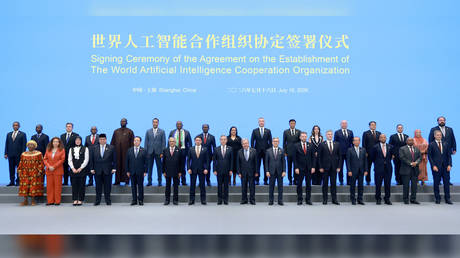
At the World Internet Conference in Wuzhen, Chinese President Xi Jinping put forward a concept that went largely unnoticed amid the daily noise of geopolitical sparring. He argued that AI development should not be a "solo performance" by a handful of dominant nations, but a "symphony of global collaboration." It is a grand metaphor. Yet, to truly understand what is at stake, we have to look past the diplomatic poetry and stand in the shoes of the people whose lives are being quietly reshaped by these decisions.
The Coder in Nairobi and the Lab in Zurich
Consider a young software engineer named Mwangi, working out of a shared office space in Nairobi. Mwangi is trying to build a localized AI model to help small-scale farmers predict crop yields based on erratic rainfall patterns. He does not want to conquer the world; he wants to help his uncle save three acres of maize.
But Mwangi faces a silent wall.
The state-of-the-art models, the massive datasets, and the computational raw power are locked behind geopolitical vaults. The American tech giants have their proprietary guardrails. The Chinese platforms operate within their own ecosystem. The European Union is constructing massive regulatory fortresses.
Mwangi is left with the scraps. To make his crop-prediction tool work, he has to jury-rig open-source models that were trained on Midwestern American soil conditions or European climate data. The AI does not understand the red clay of East Africa. It halluciates. It fails.
Meanwhile, in a pristine lab in Zurich, researchers are working on a highly advanced medical AI designed to detect early-stage lung cancers. Their algorithm is brilliant, but it suffers from a different kind of poverty: a lack of genetic diversity. It has been trained primarily on data from Western patients. When deployed globally, its accuracy plummets.
These are not isolated failures. They are the direct result of treating AI as a proprietary weapon rather than a shared human utility.
When we lock AI development into silos, we do not just slow down progress. We actively build bias, blind spots, and catastrophic failure points into the very foundation of our digital future.
The Illusion of the Solo Genius
We love the myth of the lone inventor. We want to believe that a single brilliant startup in Silicon Valley or a dedicated state-backed laboratory in Beijing will crack the code of artificial general intelligence and hand us the keys to utopia.
It is a comforting lie.
True technological leaps have always been messy, collaborative, and cross-border affairs. The internet itself was not built by a single committee. It emerged from a chaotic mix of military research, academic generosity, and international standards agreements. Had the early protocols of the web been kept under lock and key as classified national secrets, we would not have the modern digital economy. We would have a series of incompatible, national intranets that could not talk to one another.
We are on the verge of making that exact mistake with AI.
The current path is one of intense fragmentation. Washington restricts the export of advanced microchips. Beijing tightens control over data pipelines and domestic algorithms. Brussels draft sweeping regulations that threaten to isolate its market from foreign innovators.
The justification is always safety and security. We are told that we must keep our technology close to our chests because the "other side" cannot be trusted.
But this defensive crouch creates the very danger it seeks to avoid.
When AI development happens in total secrecy, we lose the ability to establish global safety standards. If a lab in one hemisphere is developing highly autonomous agents with zero oversight from the international community, the risks do not stop at their borders. A runaway algorithmic glitch in a financial system or a critical infrastructure network will not respect national sovereignty. It will spread across the globe in milliseconds.
An insecure, uncoordinated AI landscape is a threat to everyone, regardless of who owns the patent.
Tuning the Instruments
How do we actually play this symphony? It starts by recognizing that collaboration does not mean complete agreement on every political or philosophical issue. It means finding the baseline frequencies where our survival depends on harmony.
There are three distinct areas where global coordination is not just a high-minded ideal, but a matter of sheer survival.
1. The Safety Guardrails
We need a global, neutral body to evaluate the catastrophic risks of advanced AI—similar to how the International Atomic Energy Agency monitors nuclear materials. If we cannot agree on what constitutes a dangerous level of algorithmic autonomy, we are flying blind. We need shared red lines on autonomous weapons, bio-weapon synthesis, and systemic financial risks.
2. Data Commons
The greatest barrier to equitable AI is data poverty. We must establish international data trusts—secure, anonymized, and representative datasets that are accessible to researchers worldwide. This would allow innovators like Mwangi in Nairobi to train models that are culturally and geographically relevant, without having to bow to foreign corporate interests.
3. Open Standards for Interoperability
Just as the global shipping industry relies on standardized containers, future AI systems must be able to communicate with one another across borders. Proprietary walls stifle innovation. Open-source development must be protected and actively funded as a public good.
The Sound of Silence
It is easy to be cynical. We live in an era of rising nationalism, trade wars, and deep-seated suspicion. Telling nations to share their most valuable intellectual property sounds like asking wolves to negotiate a vegan diet.
But the alternative is a quiet, creeping catastrophe.
If we continue down the path of absolute division, we will end up with a fractured world where only the wealthiest nations benefit from the cognitive revolution. The global South will be left to deal with the economic fallout of automation without none of the tools to adapt. Global challenges like climate change, pandemic prevention, and resource scarcity will be tackled with fragmented, incompatible technologies.
Imagine a world map lit up at night. Right now, we are watching the lights partition themselves into distinct, warring constellations.
The true test of our collective intelligence is not whether we can build a machine that thinks. It is whether we can find the maturity to govern it together.
The conductor has raised the baton. The instruments are tuned, humming with immense, terrifying potential. We can choose to let every nation play its own chaotic, deafening solo until the noise tears the room apart. Or we can begin the hard, agonizing work of writing a score we can all play together.
The silence before the music starts is running out.