The chalk does not scrape against the blackboard anymore. Instead, it sits in a cracked plastic cup on a teacher’s desk that is slowly being reclaimed by the red dust of Baringo County. If you stand in the doorway of the abandoned primary school in this stretch of rural Kenya, the only sound you hear is the low, rhythmic thud of wooden cowbells.
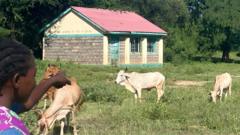
Outside, a herd of zebus grazes on the scrub brush that has broken through the earthen playground. There are forty-two cows out there. Inside the classroom, the attendance register for the term lists exactly three names.
This is not a temporary holiday. It is a erasure. Across the arid and semi-arid valleys of rural Kenya, hundreds of schools are quietly locking their gates. The desks are empty, the textbooks are gathering mold, and the government-funded solar panels are catching nothing but light for rooms where nobody sits.
To look at the official data, you might see a bloodless statistical trend labeled as "rural-to-urban migration" or "regional educational deficits." But statistics are remarkably good at hiding human heartbreak. The collapse of rural schooling in these regions is not a simple story of parents suddenly deciding they no longer value an education. It is a story about survival, ancient traditions colliding with a changing climate, and the terrifying math of poverty.
The Weight of a Single Calf
Consider a boy we will call Kiprop. He is twelve years old, which means he should be mastering fractions and learning about the history of East Africa. Instead, Kiprop is walking three miles behind a herd of thirty cattle, a long wooden staff balanced across his thin shoulders.
To understand why Kiprop is in the bush rather than a uniform, you have to understand what a cow means in his community. A cow is not livestock. It is a bank account, an insurance policy, a dowry, and a family’s singular shield against starvation. When the rains fail for three consecutive seasons, the bank account begins to die.
When the grass turns to dust near the permanent settlements, families face an agonizing choice. They can leave the children at home to attend school while the fathers take the herds to distant, unpredictable grazing lands. But a man cannot manage a hundred head of hungry cattle alone in territories where resources are scarce and conflict with rival herders is common. He needs scouts. He needs extra hands to draw water from deep, hand-dug wells. He needs his sons.
So, the family packs up their makeshift homestead. The school uniform is left hanging from a nail in a mud wall.
This is the hidden mechanics of the drop-out rate. The school does not fail the child; the environment makes the school an impossible luxury. A math exam cannot fill a stomach. A high school diploma cannot be traded for water when the community well runs dry. The immediate, visceral demand of keeping the herd alive outweighs the distant, abstract promise of a formal education.
The Economics of an Empty Classroom
Governments love to build structures. A new concrete building with a bright blue tin roof looks spectacular in a politician's campaign brochure. It provides a tangible sense of progress.
But a school is not made of concrete. It is made of people.
When a school’s enrollment drops below a certain threshold, the administrative machinery of the state begins to grind gears. In Kenya, capitation funds—the money the central government allocates per student to cover operational costs—are distributed on a per-capita basis. If a school has three hundred students, it can afford to pay for security, maintenance, and support staff. If a school’s population plummets to twenty children because their families have migrated in search of pasture, the funding dries up to a trickle.
Then come the teachers.
Most teachers assigned to these remote stations are not from the local pastoralist communities. They are young graduates from greener, southern counties, sent north by the Teachers Service Commission. They arrive in places where the heat is oppressive, the language is unfamiliar, and the infrastructure is non-existent. When they look out at a classroom of five children, surrounded by a community that is largely migratory, despair sets in.
The teachers request transfers. Those requests are often granted, or the teachers simply stop showing up, taking unauthorized leaves of absence that stretch into months. The children who do remain are left with a school that has no staff, no resources, and no clear future. It becomes a ghost building, a monument to an educational strategy that assumes everyone lives a sedentary life.
The Border Wars of the Scrublands
There is an even darker shadow hanging over these empty desks. Security.
In regions like Samburu, Elgeyo Marakwet, and Isiolo, cattle rustling is not a historical footnote. It is a modern, heavily armed reality. The traditional bows and arrows of past generations have been replaced by black-market automatic rifles. When a raid happens, it is swift, violent, and utterly devastating.
Schools, unfortunately, sit right on the geographic fault lines of these conflicts. A school built on the border between two communities to encourage integration often becomes a no-man's-land when tensions flare over water rights.
Imagine trying to teach a child to read when the sound of distant gunfire is a weekly occurrence. Imagine being a mother sending your daughter down a lonely dirt path to a schoolhouse, knowing that a raiding party could sweep through the valley before midday. The risk calculations change instantly. Keeping a child at home, under the direct supervision of the extended family, becomes the only logical way to ensure they see tomorrow.
When a school closes due to insecurity, it rarely reopens. The community scatters to safer zones, often clustering around urban centers or displaced persons camps where the schools are already bursting at the seams, completely unable to handle the influx of traumatized, left-behind rural youth.
The Flaw in the System
The real problem lies elsewhere, rooted deeply in how formal education is conceptualized in the capital city of Nairobi.
The national curriculum is designed for a stationary life. It assumes a child wakes up in a permanent house, eats breakfast, walks a predictable route to a school, sits at a desk from 8:00 AM to 4:00 PM, and returns home to study by a lamp. It is a system imported from Western models and cemented by decades of bureaucratic inertia.
But this model is fundamentally incompatible with the reality of millions of pastoralist citizens. It forces an unnatural ultimatum: give up your culture, your livelihood, and your ancestral way of life to get an education, or keep your cows and remain illiterate.
A few visionary local organizations have attempted to challenge this binary choice by introducing mobile schools. These are classrooms that travel with the herders. A teacher, often a volunteer from the community, packs a portable blackboard, a crate of books, and a solar lantern onto the back of a camel or a donkey. When the herd stops to graze for three weeks, school is in session under the shade of an acacia tree.
These mobile initiatives, however, receive only a fraction of the national education budget. They are treated as eccentric charities rather than the blueprint for rural educational survival. The state remains obsessed with permanent brick buildings, even as those buildings fill with goats and dust.
The Long-Term Bill
We are watching a generation of rural children grow up without basic literacy. This is not just a tragedy for the individuals; it is a time bomb for the entire nation.
When a young man in Baringo or Samburu cannot read or write, his economic options are brutally narrow. He cannot transition into the modern workforce. He cannot access digital financial tools. He cannot easily participate in the political processes that govern his life. His only viable option is to remain within the pastoralist economy.
But that economy is shrinking every year as climate patterns become more erratic and grazing lands are privatized or degraded. By allowing these schools to die, we are effectively funneling thousands of young men into a life of resource competition, where the only way to acquire wealth is to take it from a neighboring community with a rifle. The empty classroom of today is the breeding ground for the security crisis of tomorrow.
The solution requires an admission of failure. We must admit that the current rigid structure of schooling does not work for the margins of the country. Education must become as fluid and adaptable as the people it is meant to serve. Until the school calendar can bend around the rainy seasons, and until learning can move with the herds, the classrooms will remain empty.
The zebus will continue to graze among the abandoned desks. The bells around their necks will remain the only sound echoing through the valley, a hollow replacement for the voices of children who deserved a chance to learn, but were forced to choose survival instead.