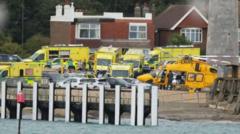
The death of six-year-old Saja El-Khawas, the final member of a family of four to succumb after being pulled from the sea at Shoreham-by-Sea, marks a devastating conclusion to an incident that shattered a quiet afternoon on the West Sussex coast. Saja passed away in a hospital on Friday, following the earlier deaths of her sister, 14-year-old Sara, and her parents, 55-year-old Hassan and 37-year-old Zeina. This family, with roots in the Rashidieh refugee camp in Lebanon, had traveled from London for a day out, only to be overtaken by the lethal, hidden mechanics of the English Channel.
Public officials and emergency services often frame such events as unfortunate accidents, yet this narrative fails to address the underlying reality of the British coastline. While Sussex Police maintain that their investigation suggests a tragic accident with no third-party involvement, the sheer speed at which this family was lost points to a recurring failure in how we educate the public about the sea. The water at Shoreham Fort, where the River Adur meets the sea, appears benign to the casual observer. It is a deceptively calm intersection of tidal forces that can transform an ordinary swim into a fatal struggle within seconds.
We must confront the inherent dangers of open water beyond the reach of lifeguarded zones. The El-Khawas family, like many, likely entered the water under the assumption that a popular beach during summer was fundamentally safe. This is a dangerous assumption. Coastlines are not parks. They are dynamic, high-energy environments where currents, rip tides, and sudden depth changes exist regardless of the weather forecast. When a child—or any person—gets into difficulty, the biological imperative of family members is to intervene.
Witness reports and community statements suggest a frantic attempt at rescue: the teenage daughter became entangled, leading the father and then the mother to enter the water to assist. This sequence of events is a classic, tragic pattern in drowning incidents. One person gets into trouble, and others, fueled by adrenaline and love, rush in to help, only to find themselves overwhelmed by the same conditions that claimed the first. The water does not negotiate, and it does not discriminate based on intent or heroism.
The conversation around water safety frequently shifts to the need for more education, yet we rarely discuss the physical infrastructure of our beaches. Warning signs are often ignored or insufficiently placed, and the average beachgoer lacks the baseline knowledge required to assess tidal flow or hidden obstacles like submerged debris or fishing nets. If we accept the premise that our coastlines are public recreational spaces, we must also accept the duty to manage them with the seriousness of a high-risk environment. Relying on the public to intuitively understand the sea is a flawed strategy.
We also need to address the psychological barriers that prevent people from seeking help or understanding the risks. There is a persistent belief that because someone is a strong swimmer in a pool, they are capable in the ocean. This is a false equivalence. A swimming pool offers predictable boundaries, buoyancy, and safety. The ocean offers none of these. The exhaustion that sets in when fighting a current is physical, immediate, and unforgiving. By the time a swimmer realizes they are in over their heads, the physiological process of drowning has often already begun.
The community of Shoreham-by-Sea now mourns a loss that will leave an indelible mark on those who witnessed the struggle and the responders who tried in vain to turn the tide. The tragedy is not just the loss of life, but the quiet inevitability of it occurring again. Until we move past the vague calls for "more awareness" and toward a concrete assessment of how and where the public interacts with our most dangerous, yet beautiful, natural borders, these stories will continue to surface with agonizing regularity. The sea remains indifferent to our grief, but we cannot afford to remain indifferent to the conditions that make such losses possible. Acknowledging the danger is the first step toward preventing the next, equally avoidable catastrophe.
The family members are gone, but their legacy is a cold, hard reminder of the stakes involved in our relationship with the water. The beach remains open. The tide will continue to roll in. Without a fundamental shift in how we approach coastal risk, the next family entering the water at Shoreham Fort or anywhere else may be just as unprepared for what lies beneath the surface.