The zipper always sticks on an overstuffed duffel bag.
You know the sound. That sharp, metallic groan as nylon teeth strain against fabric stretched a millimeter past its limit. Under the harsh fluorescent hum of an international arrivals hall, where air conditioning battles the thick, humid heat of West Africa, every small noise feels amplified. A wheel squeaks on polished tile. A passport stamp thuds against ink-stained paper. And then, a customs officer reaches out, rests a heavy hand on the top of a black rolling suitcase, and asks a simple question.
What is inside?
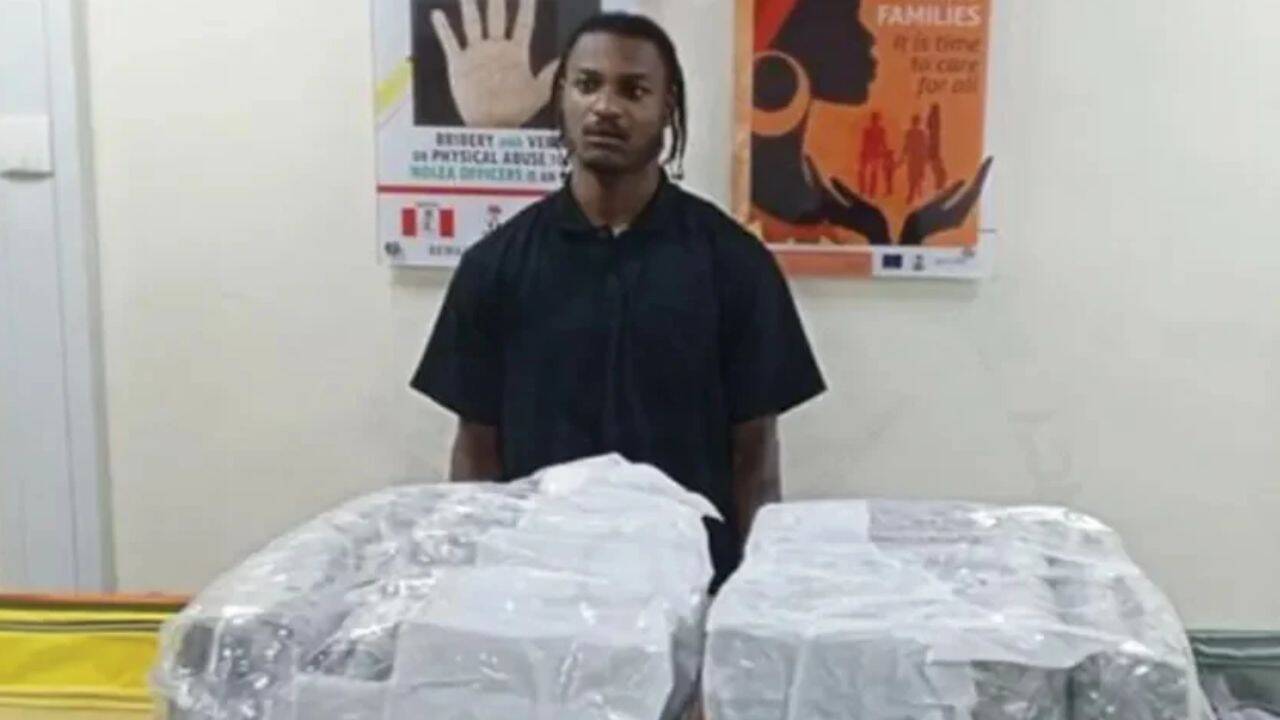
For an American basketball player standing at Murtala Muhammed International Airport in Lagos, Nigeria, the answer weighed roughly thirty-four kilograms. Seventy-five pounds.
To grasp what seventy-five pounds actually feels like, picture a standard checked bag packed for a two-week overseas tournament—extra sneakers, compression gear, resistance bands, a heavy winter coat—and then double it. Seventy-five pounds is the weight of a ten-year-old child. It is not a personal stash tucked into the corner of a toiletry kit or a forgotten vape cartridge rolling around the bottom of a backpack. It is cargo. It is an unmistakable, physical commitment that takes up space, bends axle rods, and shows up on an X-ray monitor as a dense, opaque brick of organic matter.
When Nigerian National Drug Law Enforcement Agency officers pulled those bags off the belt and sliced open the inner linings, the story instantly collapsed into a three-line news wire. US basketball player arrested in Nigeria with 34kg cannabis in airport luggage. Cold. Clinical. Reduced to a headline meant to be scrolled past between morning coffee and a commute.
Yet anyone who has spent time around the edges of international basketball knows that a headline like that is never just about contraband. It is the final, catastrophic frame of a film that started rolling years earlier, in dimly lit gyms, cramped economy seats, and bank accounts hovering dangerously close to zero.
The Invisible Economy of Overseas Hoops
Most fans view professional basketball through the gleaming prism of the NBA. They see chartered jets, eight-figure contracts, and customized nutrition plans. They do not see the shadow economy that swallows thousands of talented players every single autumn.
Consider a hypothetical scenario—let us call him Marcus—to trace the anatomy of how an athlete ends up staring across a metal desk in a foreign detention room. Marcus was a star at a mid-major Division I college. He had a smooth jumper, a twenty-two-point scoring average his senior year, and a drawer full of newspaper clippings from his hometown. Draft night came and went without his name being called. Summer League offered a brief taste of the spotlight, followed by a polite handshake and a release form.
Then the overseas market opened.
At first, the numbers sound intoxicating to a twenty-three-year-old who has never earned a paycheck. Five thousand dollars a month, tax-free, with an apartment and a car thrown in. Agents paint vivid pictures of Mediterranean beaches, passionate European crowds, or emerging leagues in Asia and Africa hungry for American talent. What the brochures leave out is what happens when the club's funding dries up in month three.
I have sat in enough foreign hotel lobbies waiting for a wire transfer that never arrived to know the specific, hollow panic it produces. You are six thousand miles from home. Your rent is paid directly by the team, meaning if you complain too loudly, you are not just unemployed—you are homeless in a country where you do not speak the language. The agent stops returning calls because his commission dried up the moment your check bounced. Suddenly, the glamour of being a "pro athlete" evaporates, leaving behind a young man with a bruised knee, an expiring tourist visa, and a credit card declining at the grocery store.
When desperation becomes your primary currency, bad ideas start sounding like business plans.
In the fringes of international sports, whispers circulate constantly. Someone knows a guy who needs a courier. Someone else mentions that the price of high-grade cannabis in major African metropolises—or bound for European transit hubs—is ten times what it costs in a legal dispensary back in California, Oregon, or Michigan. To an athlete conditioned to believe he is invincible, whose entire life has been built around calculating odds on a ninety-four-foot court, smuggling looks less like a felony and more like a high-stakes gamble. Just one trip. One bag. Enough cash to cover back rent, pay off a lingering medical bill, and buy a ticket home with dignity intact.
The math fails because it ignores a brutal geographical truth. Borders do not care about your crossover dribble.
The Illusion of Legalization
There is a dangerous psychological trap awaiting Americans who travel abroad in the mid-2020s, and it has nothing to do with malice. It is the quiet erosion of fear.
Over the last decade, cannabis in the United States underwent a rapid cultural transformation. What used to require hushed conversations in dark alleys became available in sleek, minimalist storefronts with Apple-store lighting and friendly budtenders. You can walk down a street in Denver, Los Angeles, or New York and smell it drifting from sidewalk cafes without a single police cruiser slowing down. For an entire generation of young Americans, weed ceased to register in the brain as a narcotic. It became ambient. Harmless. Almost boring.
That cultural conditioning creates a lethal blind spot the moment an airplane crosses international airspace.
Think of international drug law like walking across a frozen lake where the ice looks identical from shore to shore, even though the water underneath drops from two feet to two hundred. Back home, you are standing in the shallows; a misstep gets your shoes wet. Abroad, you are standing over an abyss.
In Nigeria, the National Drug Law Enforcement Agency—known universally by its acronym, the NDLEA—operates under a mandate forged in an era of relentless anti-trafficking crackdowns. Under the NDLEA Act, trafficking in narcotic drugs and psychotropic substances is not treated as a minor misdemeanor or a youthful indiscretion. The law makes no distinction between a hardened cartel operative and a twenty-something athlete trying to supplement a vanished paycheck. Possession, importation, or exportation of thirty-four kilograms of cannabis carries penalties that begin at fifteen years in prison and can stretch to life behind bars.
There is no plea bargain down to community service. There is no sympathetic local judge who views cannabis as a wellness product. When the scanners at Lagos airport lock onto seventy-five pounds of compressed plant matter—whether labeled as high-grade Loud, Colorado, or Canadian Loud, the street names Nigerian authorities routinely use for potent imported strains—the machinery of the state engages with mechanical finality.
Anatomy of an Interception
Modern airport interdiction is rarely the dramatic foot chase depicted in action movies. It is quiet, methodical, and deeply clinical.
Long before a passenger steps off the jet bridge in Lagos, intelligence networks have often flagged the flight corridor. Routes originating from North America or transiting through major European hubs like London, Frankfurt, or Istanbul receive heightened scrutiny by specialized NDLEA task forces stationed at Murtala Muhammed International Airport. Sniffer dogs patrol the baggage handling bays out of sight of passengers. High-density X-ray machines map the atomic composition of luggage, rendering organic matter in distinct shades of orange on the operator's screen.
Thirty-four kilograms does not hide. Even vacuum-sealed in multiple layers of plastic, wrapped in carbon paper, or buried beneath layers of clothing and athletic equipment, that volume of cannabis alters the geometry of a suitcase. It makes the bag ride low on its casters. It gives the exterior walls a rigid, boxy bulge that experienced customs officers can spot from twenty feet away.
Wait. Think about the final ten minutes before that bag gets pulled.
Imagine standing by the carousel, watching your teammates grab their suitcases and head toward the sliding glass doors leading to the humid Lagos night. Your palms are sweating despite the chill in the terminal. Every second the belt grinds forward without your bag appearing stretches into an eternity. When the black duffel finally tumbles down the chute, it looks heavier than you remembered. You lift it off the track, feeling the dead weight pull at your shoulder, and start walking toward the green "Nothing to Declare" channel.
Ten steps. Five steps.
Then an officer steps into your path. Not yelling. Just gesturing toward the inspection table with a clipboard in hand.
In that instant, every future you imagined—the next contract, the flight home, the text message to your mother telling her you landed safely—vanishes. The zipper pulls back. The scent hits the air, sharp and unmistakable even through layers of industrial plastic. Cameras flash for the official press release. Within forty-eight hours, your mugshot, your passport details, and the exact weight of the seizure are circulating across global sports blogs.
What Happens When the Lights Go Out
The public stops paying attention the moment the arrest report is published. We consume the shock value, shake our heads at the recklessness, and move on. Yet for the person sitting inside a Nigerian holding cell, the story has barely begun.
Navigating a foreign criminal justice system as an American citizen is a disorienting, terrifying experience that strips away every assumption you hold about due process. Back home, you know the script: a phone call, a bail hearing within forty-eight hours, a public defender or private attorney who knows the local prosecutor by first name. Abroad, the rules are written in a different ink.
When a U.S. citizen is arrested overseas, the American embassy or consulate is notified, and a consular officer will eventually visit. Many travelers harbor a Hollywood myth that the U.S. government can simply swoop in, flash a diplomatic badge, and escort a citizen onto a plane home. Reality is starkly different. Consular officers cannot get you out of jail. They cannot pay your legal fees, overrule local courts, or demand special treatment under host-country laws. Their job is strictly limited to ensuring you are not being tortured, helping you contact family members, and handing you a list of local attorneys.
And those attorneys require money—upfront, in cash or wire transfer, often tens of thousands of dollars—just to file initial motions in courts where dockets move at a glacial pace.
Meanwhile, the physical reality of detention sets in. Correctional facilities in West Africa are notoriously overcrowded, underfunded, and brutally hot. The food is unfamiliar and sparse. Malaria and waterborne illnesses are constant threats. For an athlete whose entire identity was built around physical perfection—measured macros, ice baths, eight hours of sleep on orthopedic mattresses—the sudden descent into concrete floors and stagnant air is a shock to the nervous system that few people fully recover from.
Your family back in the States is suddenly thrust into a nightmare they never asked for. Parents liquidate retirement savings or take out second mortgages to wire money across the Atlantic. Friends who cheered your highlights on Instagram quietly stop posting your name. Your basketball career—the thing you sacrificed your knees, your summers, and your twenties to build—is permanently over before you even enter a plea.
The Heavy Cost of Looking Away
It would be easy to dismiss an arrest like this as an isolated lapse in judgment—one reckless individual making a catastrophic choice. Doing so lets the larger ecosystem off the hook too easily.
Professional sports, at every tier below the television contracts, thrives on disposable labor. Leagues spring up overnight, sign young athletes with promises of exposure and quick payouts, and fold just as rapidly when gate receipts fall short. Agents collect fees without offering financial literacy, legal guidance, or basic duty of care when a player gets stranded in a foreign city. We celebrate the hustle of the "overseas grinder" on social media—the grainy gym footage, the passport stamps, the romanticized struggle—while ignoring the desperation that festers when the checks stop clearing.
At the same time, individual accountability remains absolute. Nobody packs seventy-five pounds of cannabis into a suitcase by accident. Between the moment someone agrees to carry a bag and the moment they step onto an international flight, there are dozens of exit ramps—dozens of quiet moments to turn around, leave the luggage on the hotel floor, and walk away. Choosing to step onto that plane means betting your freedom against a machine designed specifically to catch you.
In the end, the tragedy of an athlete standing handcuffed beside open suitcases in an airport terminal is measured in the sheer disproportion of the trade. Years of early-morning conditioning, thousands of practice shots, a college degree, and decades of future freedom—all traded away for whatever fit inside the lining of a rolling duffel bag.
Long after the press release fades from the news cycle, the fluorescent lights in that customs hall keep humming, the conveyor belts keep turning, and somewhere behind concrete walls, a twenty-something kid who used to fly above the rim is learning how slowly time moves when the doors lock from the outside.