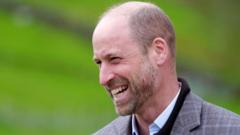
The media is swooning over Prince William’s grand plan to liquidate a fifth of the £1.1 billion Duchy of Cornwall estate. We are being served a masterclass in royal PR: a modern, progressive prince selling off ancestral land to raise £500 million for housing and nature projects. His chief executive, Will Bax, went on the record to state that the Duchy "shouldn't just exist to own land" but must "have a positive impact on the world."
It is a beautiful narrative. It is also an absolute economic illusion.
The lazy consensus treats this massive portfolio shake-up as an act of pure, altruistic sacrifice. The reality is far more calculated. This is asset consolidation disguised as charity, and using medieval feudal structures to solve modern systemic housing shortages is fundamentally flawed. Having managed institutional real estate portfolios for over fifteen years, I have seen corporate entities pull this exact trick. They offload underperforming, far-flung, or high-maintenance assets, rebrand the capital flight as an ESG (Environmental, Social, and Governance) victory, and centralize their power in high-yield core markets.
Prince William isn't saving the British housing market. He is running a highly sophisticated asset relocation strategy.
The Myth of the Fifty Percent Cut
The headline figure sounds staggeringly generous: a £500 million cash injection achieved by offloading 20 percent of the Duchy’s portfolio over the next decade. But when you look beneath the veneer of the press releases, the financial math tells a completely different story.
The Duchy of Cornwall is not a charity. It is a private, multi-million-pound property empire spanning over 130,000 acres. That empire yielded a private net income of nearly £23 million last year alone to fund the official and private lives of the Wales family. Under centuries-old rules, the Duke of Cornwall is entitled to the profits but cannot simply liquidate the capital to buy superyachts. The capital is locked.
By announcing a massive sell-off to invest in "social need" and "environmental challenges," the Duchy achieves a massive PR victory while executing a classic portfolio optimization. They are divesting from peripheral, fragmented holdings across 19 counties to double down on five key geographical "heartlands"—including Cornwall, Dartmoor, and Kennington in south London.
In real estate, maintaining fragmented, distant holdings is an operational nightmare that bleeds cash through management fees, local maintenance, and administrative friction. Consolidating into core hubs drastically reduces overhead. To frame a standard corporate restructuring as a noble crusade against homelessness is brilliant marketing, but it isn't philanthropy. It is efficient asset management.
Why Feudal Landlords Make Terrible Urban Developers
The core premise of the Duchy’s housing push is that benign, paternalistic oversight creates better communities than the free market or municipal councils. They point to Poundbury and Nansledan—the Duchy's flagship "model towns"—as blueprints for the future. The plan outlines a target of 12,000 new homes by 2040, with 30 percent designated as affordable.
But look at how this plays out on the ground. Just recently, the Duchy’s 2,500-home "garden neighbourhood" development in Faversham, Kent, faced fierce local backlash. Residents and parish councillors didn't see a progressive paradise; they saw an "eyesore," a "Trojan Horse" for urban sprawl, and a project that destroys high-quality agricultural land while choking local infrastructure.
When a private developer builds a massive housing estate, they are subject to intense democratic scrutiny, local planning boards, and elected councils that can block them at every turn. When the Duchy of Cornwall builds, it carries the overwhelming weight of the Crown. The power dynamic is entirely skewed. Local communities are expected to bow and thank the Prince for his benevolence, even when the development inflicts massive traffic congestion and erodes the rural landscape.
True affordable housing requires structural reform:
- Abolishing restrictive zoning laws.
- Empowering elected local authorities with direct capital grants.
- Taxing land value speculation.
Relying on a hereditary landlord to hand-deliver "superior" social housing out of his personal real estate portfolio is a step backward. It replaces democratic urban planning with aristocratic whim. If the Prince decides to change focus in ten years, the pipeline vanishes. A stable society does not rely on the moral awakening of its landlords to keep its citizens sheltered.
The Human Toll of Corporate PR
The most egregious flaw in the "positive impact" narrative is the direct collateral damage left in its wake. Land sales require land to be cleared.
Earlier this year, tenants on the Bradninch estate in Devon spoke out about being left "enormously stressed" by the Duchy’s sudden plans to sell off their farms. Generations of families who worked the land were abruptly told that the centuries-old relationship with the Duchy was shifting. The official response from leadership was that tenants were being "engaged in a conversation around buying their farm."
Imagine running a tenant farm for decades, absorbing the volatile shocks of modern agriculture, and suddenly being told you must capital-fund a multi-million-pound land purchase or face displacement because your landlord wants to fund a green energy project somewhere else.
This reveals the inherent contradiction of the Duchy's new strategy:
| Claimed Priority | Ground Reality |
|---|---|
| Mental health provision for rural tenants | Inflicting extreme stress through abrupt land sales |
| Tackling the "nature crisis" | Paving over high-quality agricultural land for urban sprawl |
| Community-first partnership | Top-down asset liquidation to meet a £500 million target |
You cannot claim to protect rural communities while treating the people who live on your land as disposable chess pieces in a corporate restructuring plan.
The Transparency Smokescreen
Let's address the elephant in the room: the timing of this sudden pivot toward aggressive social impact is not accidental. The royal family is facing unprecedented scrutiny over its opaque financial structures, tax exemptions, and value proposition to the British public.
By aggressively pivoting toward homelessness initiatives and wildlife restoration, the Duchy builds a defensive moat against political critics. If a politician demands a review of the Duchy’s tax-exempt status or its sovereign immunity, the Palace can instantly point to the 12,000 homes and the £500 million investment. It turns a systemic debate about inequality into a debate about taking homes away from the vulnerable.
The downside of pointing out this reality is that it sounds cynical. People want to believe that a wealthy prince can step in and fix the housing crisis with a wave of his hand. It is comforting to think that the ultra-wealthy can save us. But buying into that comforting narrative ignores the structural damage. When we praise royal philanthropy for building homes, we validate the underlying system that allows a single family to hoard 130,000 acres of land while the rest of the nation suffers from a chronic, systemic lack of property ownership.
If the Duchy of Cornwall truly wanted to solve the housing crisis, it wouldn’t sell off 20 percent of its land to fund proprietary, tightly controlled developments. It would voluntarily surrender its vast holdings back to the public trust, allowing local councils to manage the land democratically.
Instead, we get a masterfully spun asset reallocation wrapped in a green ribbon. It protects the core portfolio, sheds operational inefficiencies, mutes political criticism, and keeps the sovereign power firmly intact. It is a masterclass in modern corporate survival. Just don't call it charity.