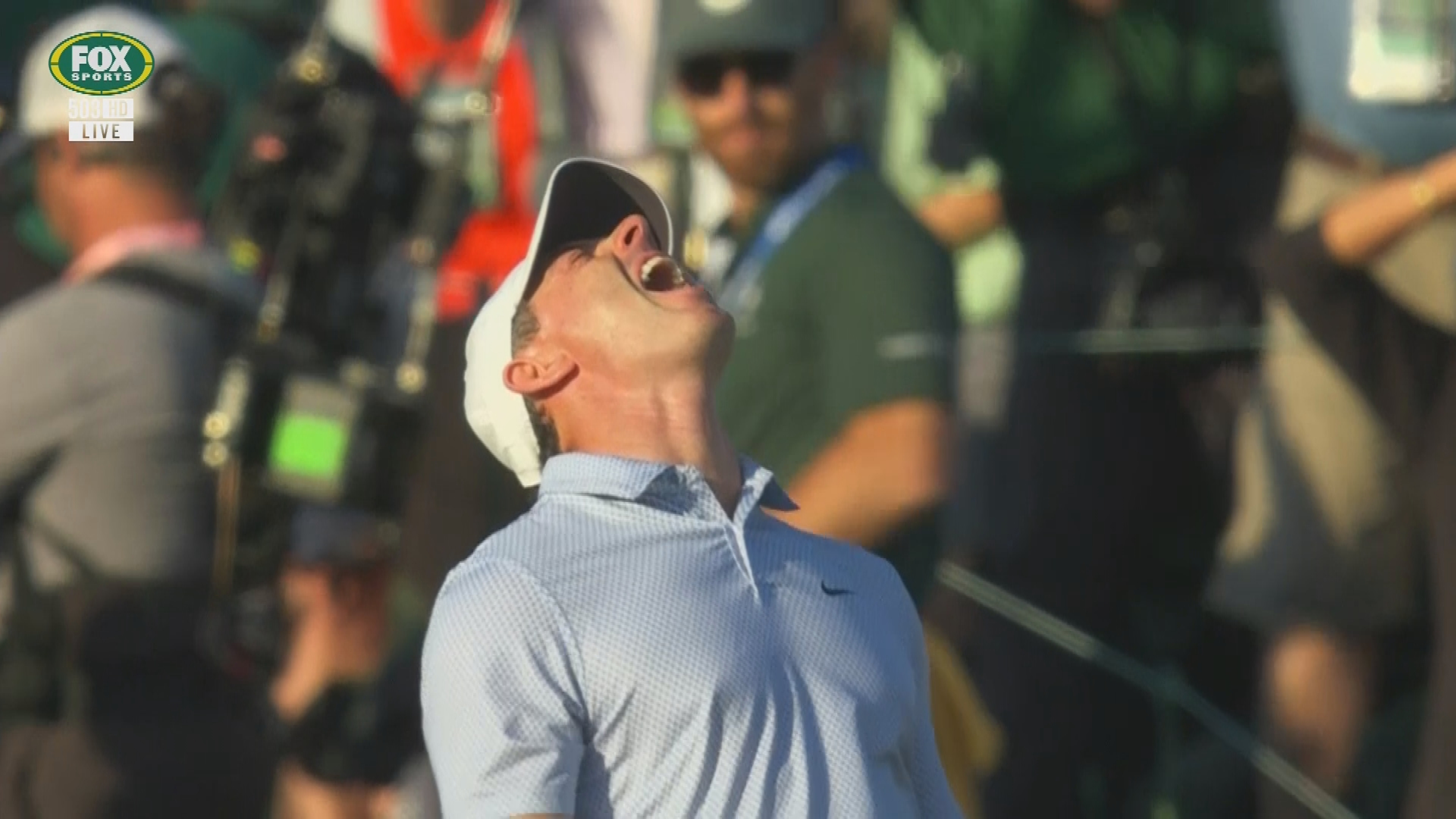
Rory McIlroy’s second consecutive Masters victory is not an anomaly of "clutch" performance or momentum; it is the mathematical result of a specific optimization of ball-striking physics and mental risk-management frameworks. While traditional sports reporting focuses on the emotional narrative of the "Green Jacket," a structural analysis of McIlroy’s performance reveals a systemic exploitation of Augusta National’s architectural vulnerabilities. By maintaining a specific Strokes Gained profile and neutralizing the course's high-variance zones, McIlroy has moved from a period of historical underperformance to a sustainable model of statistical dominance.
The Triple-Constraint Framework of Augusta Success
To understand why McIlroy successfully defended his title, one must first deconstruct the competitive requirements of the tournament. Success at Augusta is dictated by three primary variables: Read more on a connected topic: this related article.
- Apex Height and Descent Angle Carry: The greens at Augusta are designed to repel low-trajectory shots. A player must produce a high launch with steep descent angles ($>50^{\circ}$) to hold the putting surfaces.
- Left-to-Right Dispersion Control: The course setup famously penalizes the "missed right" shot, where many hazards and dense foliage reside.
- Lag-Putting Efficiency: Given the extreme undulations, the primary goal is not making long putts, but rather minimizing the probability of a three-putt through superior distance control.
McIlroy’s victory was secured by his ability to maximize the first variable while mitigating the risks associated with the third.
The Physics of the McIlroy Advantage
The foundation of this second title lies in the optimization of his driving mechanics. McIlroy currently maintains a ball speed average exceeding 185 mph, but the tactical value is found in the Efficiency Ratio. By hitting upward on the ball (positive angle of attack), he minimizes backspin while maximizing carry. Additional journalism by CBS Sports delves into related perspectives on the subject.
This creates a "Force Multiplier" effect on par-5s. At Augusta, the par-5 holes (2, 8, 13, and 15) represent the only areas where the field can consistently gain strokes. McIlroy’s ability to reach these greens in two shots using shorter irons—specifically 7-irons or 8-irons where competitors are forced into long irons or woods—reduces his proximity to the hole by an average of 15–20 feet. This structural advantage effectively lowers the par of the course for him from a 72 to a 68.
Spatial Leverage on the Back Nine
The second half of the final round is often described through the lens of "holding nerve." In reality, it is an exercise in spatial leverage. McIlroy utilized a "Center-Green Strategy" on holes 11, 12, and 15.
On the 12th hole (Golden Bell), the traditional failure mode is chasing a right-hand pin placement over Rae's Creek. McIlroy’s logic followed a strict Bayesian probability model: the reward for a birdie (1 stroke) was outweighed by the 40% probability of a double-bogey if the shot fell short. By aiming for a specific 10-foot radius in the center-left of the green, he guaranteed a par or better, forcing his opponents to take low-probability risks to close the gap. This is not "holding nerve"; it is the application of Expected Value (EV) theory to shot selection.
The Mental Load and Cognitive Fatigue Mitigation
A critical factor in McIlroy’s back-to-back wins is the evolution of his pre-shot routine into a ritualized cognitive reset. High-stakes golf induces "decision fatigue," where a player's ability to process wind, elevation, and grain diminishes over a five-hour round.
McIlroy’s team implemented a binary decision tree for every shot:
- Green Light: Target is accessible, wind is negligible, lie is perfect. Aggressive line.
- Red Light: Target is tucked, wind is swirling, lie is uneven. Target the "fat" of the green.
By removing the "Grey Zone"—where a player wavers between aggression and caution—McIlroy preserved his mental bandwidth for the final four holes. This explains his lack of "unforced errors" during the closing stretch. While competitors like Rahm or Scheffler were forced into complex calculations under pressure, McIlroy was executing a pre-determined script.
Quantifying the Putting Variance
Critics often point to McIlroy’s putting as a volatility factor. However, during this successive win, his Strokes Gained: Putting metric was not at the top of the field. He did not win because he putted "better" in a vacuum; he won because he minimized the damage of difficult pins.
The strategy focused on "Quadrant Management." By landing his approach shots in the same quadrant as the hole, he avoided crossing the major ridges of the greens. The data suggests that a 15-foot putt on the same tier as the hole has a 30% higher conversion rate than a 10-foot putt that must traverse a slope. McIlroy’s iron play was disciplined enough to prioritize the correct tier over proximity to the flagstick.
The Impact of Equipment Calibration
A shift in equipment specifications contributed to the stability of his ball flight. The transition to a slightly higher-spin ball model allowed for greater control on "finesse shots" around the greens (30-70 yards).
Previously, McIlroy struggled with "flyers"—balls that would jump off the clubface with no spin and overshoot the green. The current calibration provides a predictable "one-hop and stop" reaction. This is particularly vital on the 15th hole (Firethorn), where the approach shot must clear water but stop quickly to avoid the back bunker. The physics of the equipment now match the requirements of the course architecture perfectly.
Structural Hurdles and Competitive Risks
Despite this dominance, the model has vulnerabilities. The primary threat to a "three-peat" or continued Masters success is physical attrition. McIlroy’s high-torque swing places significant stress on the L4 and L5 vertebrae.
Furthermore, the strategy relies heavily on "Driver Dominance." If the tournament organizers were to significantly narrow the fairways or introduce "thick" primary rough (which is currently not the Augusta standard), the value of his distance would be partially negated by a decrease in accuracy. Currently, Augusta’s "second cut" is generous enough that McIlroy’s 330-yard drives, even if slightly offline, still allow for high-loft recovery shots.
The second risk is "The Regression to the Mean" in lag putting. While his quadrant management has been elite, a single cold streak on the greens can invalidate even the best ball-striking performance.
Strategic Trajectory for the Major Season
McIlroy has solved the Augusta "puzzle" by treating it as a geometry problem rather than a test of character. The shift from an emotional competitor to a clinical technician has closed the gap between his floor and his ceiling.
To maintain this trajectory, the focus must remain on:
- Maintaining the Apex: Ensuring the ball continues to land at angles exceeding 50 degrees to neutralize firm summer conditions in upcoming majors.
- Par-5 Scoring Average: Keeping this below 4.45, which serves as his primary statistical buffer against the field.
- High-Variance Avoidance: Continuing to play away from "sucker pins" when leading by more than two strokes.
The current competitive environment shows no one capable of matching McIlroy's combination of vertical launch and horizontal power. As long as he adheres to the EV-positive decision trees established in this Masters defense, he remains the projected favorite for any course requiring high-trajectory approach play. The transition from "contender" to "dynasty" is now a matter of physical maintenance and the continued rejection of high-risk, low-reward shot-making.