Stop Romanticizing Metal Scrap
Archaeology has a problem with narrative addiction. A single piece of copper alloy turns up in a Spanish field and suddenly the headlines are screaming about a direct link to Britain’s northern frontier. This isn't science. It's a marketing campaign for a field that desperately needs funding.
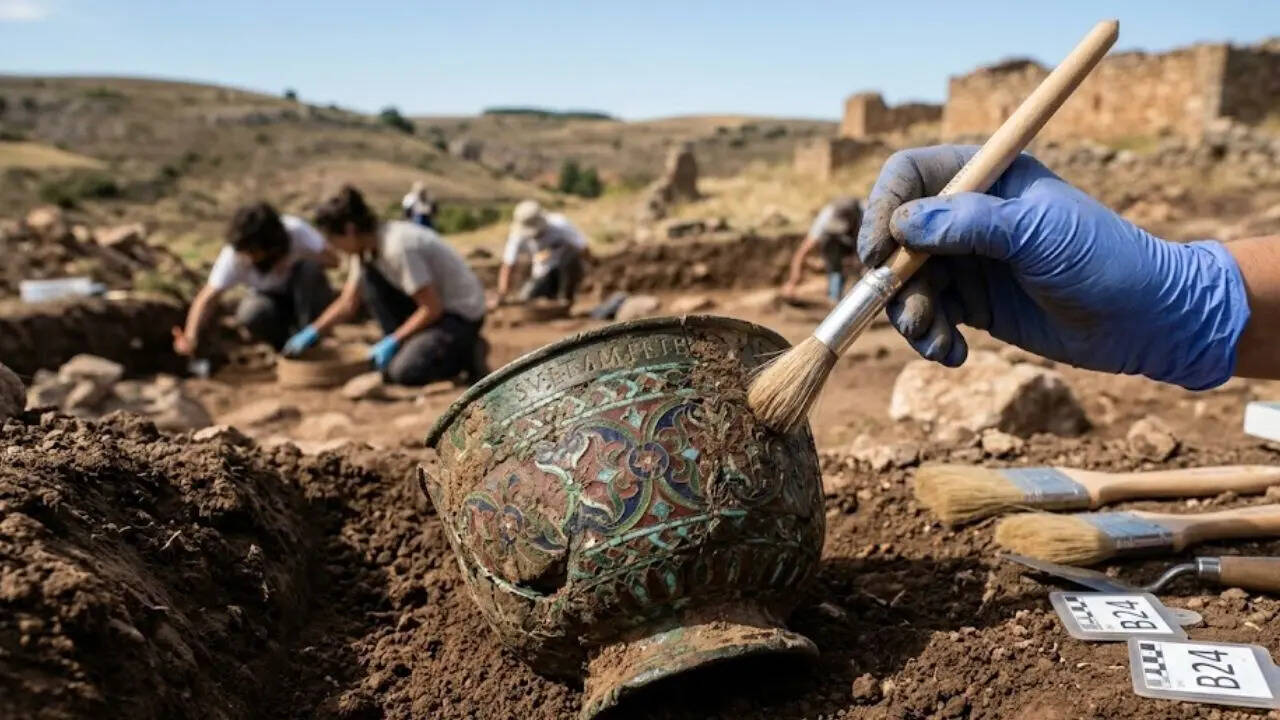
The item in question is a small, ornate cup. It features a list of forts along Hadrian’s Wall. To the average observer, this looks like a smoking gun—proof of a veteran’s journey from the rainy hills of Northumbria to the sun-soaked plains of Hispania. To anyone who understands the Roman economy, it’s just a piece of mass-produced souvenir kitsch.
Calling this a "direct link" is like finding a "I Heart NYC" mug in a landfill in Tokyo and concluding that the owner was a personal advisor to the Mayor of New York. We are mistaking a consumer product for a historical manifesto.
The Souvenir Industrial Complex
Let’s dismantle the premise that this cup is rare or significant as a personal relic. In the second century, the Roman Empire was the world’s first truly globalized marketplace. Standardized goods moved across borders with a fluidity that would make a modern logistics manager weep with envy.
The "Amiens Skillet" and the "Rudge Cup" are famous examples of this exact same phenomenon. These weren't unique commissions. They were the Roman equivalent of a gift shop trinket.
- The Geography of Branding: These cups were likely manufactured in Gaul (modern France) or the Rhineland.
- Standardization: The inscriptions aren't personal diaries; they are a fixed list of names.
- Volume: For every cup we find, thousands more were melted down or lost.
We are looking at the remnants of a brand, not the footprint of a person. The Roman military was a massive bureaucratic machine. Soldiers moved, yes. But objects moved even faster. To suggest this cup "proves" a specific soldier’s movement is a logical leap that ignores the reality of Roman trade routes.
The Logic of the Lack of Evidence
Archaeologists often fall into the trap of "confirmation bias." They want the story to be true because it makes the data more palatable to the public. They see a fort name and they see Spain, and they bridge the gap with a heartwarming tale of a retired centurion.
Consider the physics of the find. Most of these cups are found in contexts that suggest they were discarded or buried as part of a hoard. They weren't necessarily prized possessions. They were metal. And in the ancient world, metal had intrinsic value.
If we look at the chemical composition of these vessels—usually a leaded bronze or a high-tin alloy—they reveal a manufacturing process that was highly centralized. If these items were truly personal mementos of a specific career path, we would see far more variation in the fort lists. Instead, we see the same "Greatest Hits" of the Wall over and over. This is a template. It is a product line.
Why the "Veteran" Theory is Lazy
The most common "People Also Ask" response for these finds is: "Did Roman soldiers take souvenirs home?"
The answer is: maybe, but it doesn't matter.
By focusing on the imaginary veteran, we ignore the much more interesting reality of the Roman middle class. These cups were likely purchased by people who had never even seen Britain. The Wall was a symbol of imperial might. Owning a piece of "Frontier Chic" was a status symbol for a merchant in Spain or a clerk in Gaul.
It’s the same reason someone in London wears a NASA t-shirt today. It doesn’t mean they’ve been to the moon. It means they want to be associated with the prestige of the institution.
The Problem with Modern Archaeology
We have reached a point where the "story" is considered more valuable than the "stratigraphy." We use high-end imaging and chemical analysis only to wrap the results in a 19th-century Victorian narrative of "The Great Traveler."
I’ve seen museums spend hundreds of thousands of dollars on exhibits centered around a single "link" that is statistically insignificant. We are prioritizing the anecdotal over the systemic.
- Systemic: The Roman Empire had a centralized economy that shipped standardized metalware across three continents.
- Anecdotal: This cup belonged to a man named Marcus who missed the cold wind of the Wall.
Which one is supported by the data? The systemic one. Which one gets the grant money? The anecdotal one.
The Nuance of the Trade Route
If we want to actually learn something from the Spanish cup, we should stop looking at the names of the forts and start looking at the dirt it was found in.
The find location in Spain is near major mining districts. It is far more likely that this cup traveled as part of a commercial shipment, perhaps traded for local silver or lead, than it is to have been carried in a soldier's pack for 1,500 miles.
The Roman transport network was a series of hubs. A merchant ship leaving Britain or Gaul wouldn't just carry one item. It would carry crates of these things. Finding one in Spain isn't an anomaly; it’s a statistical inevitability. If we didn't find them there, that would be the mystery.
Rejecting the Narrative
Stop asking if this cup tells us about a person. Start asking what it tells us about the factory that made it.
We need to treat these finds with the cold, hard logic of an actuary. The Roman world was not a collection of individual adventures; it was a massive, grinding system of production and consumption. Every time we try to turn a piece of bronze into a biography, we lose sight of the incredible, boring, and highly efficient reality of how the ancient world actually functioned.
The cup isn't a bridge to the past. It's a receipt for a purchase that happened 1,900 years ago.
Stop looking for the man. Look for the market.