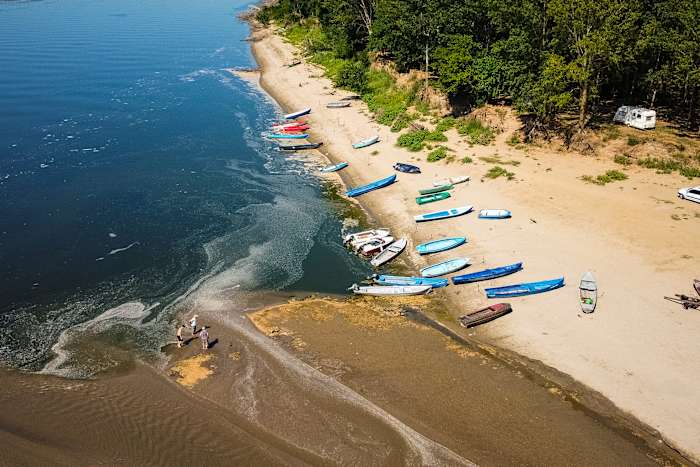
The water does not shout when it dies. It shrinks.
Listen closely to the banks of the Danube this season, and you will hear only the dry slide of sediment, the dry rustle of reeds that have forgotten what it means to touch a current. For centuries, this great artery of Central Europe has carried empires, merchants, poets, and barges heavy with grain and steel. Right now, it is struggling to carry itself.
Heat has a way of erasing things slowly. First, it takes the rain. Then, it bakes the soil until the earth cracks open like old porcelain. Finally, it steals the rivers. Across Central Europe, a relentless drought has dragged water levels down to historic lows. What remains is a skeletal channel of mudbanks and exposed hulls—ghost ships from past wars and forgotten shipping errors, suddenly dragged back into the punishing sunlight.
To understand what this means, you have to step away from the satellite maps and walk the docks of Budapest or Vienna.
Consider a hypothetical captain named Stefan. Let us call him Stefan because a hundred real Stefans are currently pacing the wheelhouses of grounded vessels, staring at fuel gauges and river gauges with the same dull ache in their chests. Stefan has spent thirty years reading the mood of the Danube. He knows every bend between Ulm and the Black Sea. He knows the secret shoals that shift after a spring flood, and he knows how the light hits the water when a storm is brewing over the Carpathians.
Today, Stefan is parked.
His barge, designed to swallow two thousand tons of cargo, is sitting half-empty at a quay. To load it fully right now would mean scraping the hull against the riverbed, tearing open the steel, and spilling diesel into a shrinking ecosystem. So he waits. The math is brutal. When a ship carries half its weight, the cost per ton doubles. The supply chain chokes. Power plants that rely on river water for cooling begin to sweat. Chemical factories slow their output. Cruise ships carrying travelers eager to see the Wachau Valley vineyards are forced to drop anchor weeks early, their passengers bused from town to town on stifling highways instead of drifting past ancient castles.
We talk about climate change in the abstract. We treat degrees Celsius like stock market tickers. But climate change has a physical weight, and right now, that weight is resting entirely on the shoulders of people who live by the water.
The economic fallout is a slow-motion shockwave. Central Europe relies on its inland waterways as a cheap, low-emission alternative to freight trucks. When the rivers fail, the roads pay the price. Thousands of extra trucks rumble onto highways that were never designed to shoulder this kind of continental traffic. The asphalt buckles under the strain. Carbon emissions spike just as the environment is crying out for relief.
Prices creep upward in grocery aisles hundreds of miles away. A drought in the Danube basin is not a localized inconvenience. It is a tax on everything that moves.
Yet the truest tragedy of the vanishing Danube is not economic. It is cultural.
For the communities lining its shores, the river is not just a commercial resource. It is a pulse. It is the morning fog rising past cathedral spires. It is the generations of fishermen whose nets now come up tangled in thick, stagnant algae instead of silver carp. It is the psychological anchor of a region that has survived wars, borders shifting like sand, and political upheavals, trusting always that the water would remain.
Now, the water is leaving.
Walk down to the riverbanks in Serbia or Romania right now, and the local fishermen will show you something chilling. They will point to rocks that have not seen the air since the great droughts of the last century—stones carved with warnings by ancestors who watched their own crops wither. If you see me, weep, the old German-inscribed hunger stones along European riverbeds famously declare.
We are seeing them.
The heat does not care about borders. It grips the wheat fields of Hungary. It bakes the vineyards of Austria. It turns the shipping lanes into narrow trickles of mud. And as the world watches, mesmerized by the unfolding crisis, a heavy, quiet realization settles over the basin.
The old rhythms are broken.
The solutions whispered in air-conditioned boardrooms—dredging deeper channels, building new locks, shifting to alternative freight routes—feel small against the scale of what is happening. They are bandages on a fracture. They treat the symptom while the fever burns higher.
The sun dips below the horizon, casting a bruised orange glow over the exposed mud flats of Budapest. A solitary heron stands motionless in the shallow center of what used to be a roaring shipping lane, hunting for fish trapped in shrinking puddles.
Tomorrow, the temperature will rise again.